| name |
Amanita calyptratoides |
| author |
Peck. 1909. Bull. Torrey Bot. Club 36: 329. |
| name status |
nomen acceptum |
| english name |
"Peck's Candlestick Amanita" |
| synonyms |
≡ Venenarius calyptratoides (Peck) Murrill. 1912. Mycologia 4: 241.
The editors of this site owe a great debt to Dr. Cornelis Bas
whose famous cigar box files of Amanita nomenclatural information
gathered over three or more decades were made available to RET for computerization
and make up the lion's share of the nomenclatural information presented on this site.
|
| MycoBank nos. |
215590 |
| GenBank nos. |
Due to delays in data processing at GenBank, some accession numbers may lead to unreleased (pending) pages.
These pages will eventually be made live, so try again later.
|
| lectotypes |
NYS |
| lectotypifications |
Jenkins. 1978a. Ibid.: 26. |
| type studies |
Jenkins. 1978a. Mycotaxon 7: 26. |
| intro |
The following text may make multiple use of each data field.
The field may contain magenta text presenting data from a type study
and/or revision of other original material cited in the protolog of the present taxon.
Macroscopic descriptions in magenta are a combination of data from the protolog and
additional observations made on the exiccata during revision of the cited original
material.
The same field may also contain black text, which is data from a revision of the present
taxon (including non-type material and/or material not cited in the protolog).
Paragraphs of black text will be labeled if further subdivision of
this text is appropriate.
Olive text indicates a specimen that has not been
thoroughly examined (for example, for microscopic details) and marks other places in the text
where data is missing or uncertain.
Except where the work of another author is cited, the following is based on original research by R. E. Tulloss. |
| pileus |
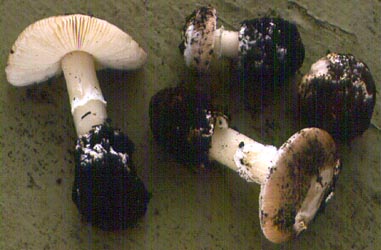
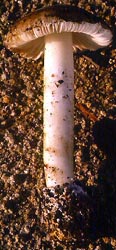
30 - 100 mm wide, slightly sordid brownish white to pale grayish brown (much paler and both more creamy and more tan than 5B3) to pale brown (10YR 6/6) to (occasionally) rich saturated brown, unchanging when bruised, hemispheric at first, then convex and finally planoconvex, shiny-viscid when wet, becoming dull and subviscid then matte when dry; context watersoaked to white, 4.5 - 11 mm thick at stipe, thinning evenly to margin or thinning for 85% to 90% of radius, then membranous to margin; margin usually striate (0.1 - 0.2R), with striations lacking at first in largest young specimens, nonappendiculate, decurved; universal veil absent or as patch or patches or warts or with latter resting on large region (sometimes covering entire pileus) with white "bloom," white, unchanging when cut or bruised, detersile, membranous, at times relatively thick over disk. |
| lamellae |
free or narrowly adnate with decurrent tooth, in either case with long and distinct decurrent line on stipe apex, close to subcrowded, off-white to pale cream in mass, white to slightly off-white to slightly watersoaked off-white in side view, 4.5 - 8 mm broad, subventricose (not rounded at pileus margin), thickest about at about 75% of radius from stipe; lamellulae truncate to truncate with tooth at pileus context to subtruncate to rounded truncate to subattenuate, unevenly distributed, of diverse lengths, plentiful. |
| stipe |
54 - 145 × 6 - 20 mm, slightly translucent, watery off-white to watery pale cream to off-white, with the appearance of a wax candle, unchanging when cut or bruised, subcylindric or narrowing upward or downward slightly or broadest near midpoint and tapering both upward and downward slightly, not or slightly flaring at apex, at first decorated above the partial veil with white pulverulence, this disappearing as though dissolving from apex downward, at times completely lacking the dry superficial fibrils usually seen in Amanita (these sometimes becoming apparent after handling); context often watersoaked in outer half to quarter of region beyond central cylinder, otherwise nearly white, unchanging when cut or bruised, hollow, with central cylinder lined with (sometimes also with crosswalls of) white and loosely interwoven fibrils that have more of an appearance of plastic foam than cotton, occasionally with crosswalls of firmer tissue, with central cylinder 4 - 8 mm wide; partial veil superior to subsuperior to nearly median, white, scant, very narrow, thin, membranous, tearing, becoming appressed to stipe rather quickly, relatively rapidly shrinking to narrow white line and then disappearing (appearing to dissolve as with apical pulverulence); universal veil as saccate volva, white, membranous to fleshy, rather tough, with limb less than 1 to 2.5 mm or more thick at point halfway between attachment of limbus internus and highest point of limb, with highest point of limb 20 - 45 mm above base of volva, 15 - 44 mm wide, soft, with exterior smooth and slightly fibrillose, with small to ledge-like limbus internus attached one-half to three-quarters of distance from highest point of limb to attachment of universal veil at stipe base, with region from limbus internus to stipe base appearing adnate to stipe in young material. |
| odor/taste |
Odor absent to slightly rank, but then over-powered by odor of wet soil. Taste faintly bitter. |
macrochemical
tests |
Spot test for laccase (syringaldazine) - negative throughout basidiome. Spot test for tyrosinase (paracresol) - positive in most of pileus context, most of lower stipe context, and in spots on lamellae. Test vouchers: Tulloss 1-8-87-A, 2-15-98-C. |
| lamella trama |
bilateral; wcs = 50 - 65 µm; subhymenial base entirely composed of branching hyphae, with some hyphal segments partially inflated near pileus context; filamentous, undifferentiated hyphae ? µm wide, ?; terminal, divergent inflated cells not observed; vascular hyphae ? µm wide, ?; clamps present. |
| subhymenium |
wst-near = (25-) 35 - 60 (-65) µm; wst-far = (45-) 60 - 90 (-95) µm; nearly entirely comprising uninflated to partially inflated elements in branched structure, with more inflation near pileus context; with basidia arising from ??; clamps present. |
| basidia |
63 - 86 × 10.2 - 13.2 µm, dominantly 4-sterigmate, occasionally 2-sterigmate; clamps present. |
| basidiospores |
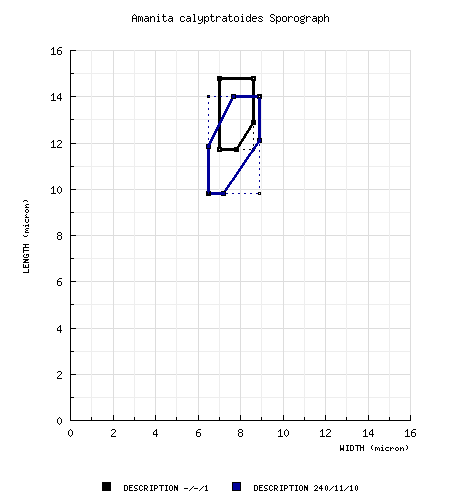
from type study of Jenkins (1978a): [-/-/1] 11.7 - 14.8 × (6.2-) 7.0 - 8.6 μm, (Q = 1.50 - 2.27; Q' = 1.66), hyaline, thin-walled inamyloid, ellipsoid to elongate to cylindric, often adaxially flattened; apiculus sublateral, cylindric; contents guttulate; color in deposit not recorded.
[240/11/10] (8.5-) 9.8 - 14.0 (-17.0) × (5.5-) 6.5 - 8.9 (-11.8) μm, (L = (11.2-) 11.6 0 13.0 μm; L' = 12.0 μm; W = (7.3-) 7.6 - 8.0 μm; W' = 7.8 μm; Q = (1.26-) 1.36 - 1.82 (-1.99); Q = (1.40-) 1.44 - 1.70; Q' = 1.55), hyaline or somewhat clouded, colorless, smooth, with walls thin or up to about 0.5 µm thick, inamyloid, broadly ellipsoid to ellipsoid to elongate, often at least slightly adaxially flattened, sometimes not at all flattened adaxially adjacent to apiculus and then sometimes flattened on side opposite to apiculus, occasionally expanded at one end; apiculus sublateral, cylindric to narrowly truncate-conic; contents monoguttulate with or without additional small granules; white in deposit. |
| ecology |
Solitary to subgregarious. In California: In dense, dark, somewhat sandy clay, in open Quercus agrifolia woods at the edge of chapparal vegetation or under Q. agrifolia. |
| material examined |
from type study of Jenkins (1978a): U.S.A.: CALIFORNIA—Los Angeles Co. - Claremont, i.1909 C. F. Baker s.n. (lectotype, NYS).
MÉXICO: BAJA CALIFORNIA DEL NORTE—??.
U.S.A.:
CALIFORNIA—Alameda Co. - Oakland, Dunsmuir
Cyn., 29.i.2005 D. Rust s.n. [mushroomobserver.org #
31834]
(RET 382-8). Los Angeles Co. - Malibu Crk.
Pres., 29.iii.1981 G. Wright s.n. [F. Nishida 1016]
(LAM 250874); Santa Monica Mtns., Cold Crk. Cyn.
Preserve, Stunt Cyn., 27.xii.1992 Matthew Bell s.n.
[F. H. Nishida 4919] (in herb. F. Nishida); Santa
Monica Mtns., Malibu Cyn., Tapia Co. Pk., 14.i.1993
R. E. Tulloss 1-14-93-A (RET 081-2), -B (MEXU; RET
081-1); Walnut Crk., 7.ii.1981 Tim Paulitz s.n.
(LAM 250779). Monterey Co. - Garland Ranch
Reg. Pk., 15.ii.1998 D. Parker s.n. [Tulloss
2-15-98-B] (F; RET 273-7); Hastings Historical
Preserve, 15.ii.1998 Igor Malcevski s.n. [Tulloss
2-15-98-C] (RET 0274-7). Riverside Co. -
Cleveland Nat. For., El Ceriso, "Big Woods,"
18.ii.1979 F. Nishida s.n. (LAM 250944), 8.i.1987
Greg Wright s.n. [Tulloss 1-8-87-A]
(RET 116-1). San Diego Co. - Poway, Blue Sky
Ecological Preserve [33.0155° N/ 117.0245° W, 225 m],
3.i.2019 Cindy Trubovitz s.n. [mushroomobserver
354030]]
(RET 856-7, nrITS-LSU seq'd.).
Unkn. Co. -
unkn. loc., winter.1998 David
Arora s.n. [Tulloss winter.1988.DA2]
(RET 244-7).
WASHINGTON—Klickitat Co. - Lyle
Cemetery, Balch Road [45.7204° N/ 121.3281° W,
175 m], 13.vi.2011 Dr. Michael Beug 21MWB110613
(RET 614-6, nrITS seq'd.). |
| discussion |
t.b.d.
Material from Tlaxcala originally included on this page has a distinct nrITS sequence (among other genetic differences) and is now treated on this site as A. tlaxcandela. The question of morphological segregation is still an open one—more information is needed on the Mexican species. |
| citations |
—R. E. Tulloss |
| editors |
RET |
|



 Spore data sets and their composite