
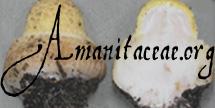
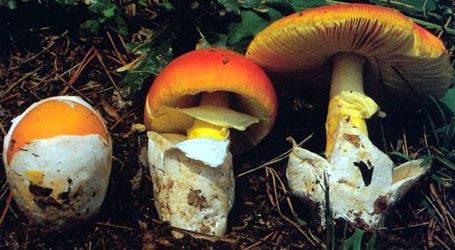
| name | Amanita tlaxcandela | ||||||||||||||||||||||||||||||||
| author | Tulloss and Sánchez-Ram. | ||||||||||||||||||||||||||||||||
| name status | nomen provisorum | ||||||||||||||||||||||||||||||||
| english name | "Mexican Candlestick Caesar" | ||||||||||||||||||||||||||||||||
| etymology | Tlaxcala + "candela" (candle)—an elision. | ||||||||||||||||||||||||||||||||
| GenBank nos. |
Due to delays in data processing at GenBank, some accession numbers may lead to unreleased (pending) pages.
These pages will eventually be made live, so try again later. Search:
Showing 1 to 4 of 4 entries | ||||||||||||||||||||||||||||||||
| intro |
Olive text indicates a specimen that has not been
thoroughly examined (for example, for microscopic details) and marks other places in the text
where data is missing or uncertain. The following material is derived from original research of this page's authors. | ||||||||||||||||||||||||||||||||
| pileus | 66 mm wide, brown over disc becoming paler toward margin; context white, unchanging when bruised or cut, 7 mm thick over stipe, thinning evenly for 80% of radius, then membranous to margin; margin striate (0.25R), nonappendiculate; universal veil not evident in single known specimen. | ||||||||||||||||||||||||||||||||
| lamellae | ??, ??, white, 6 mm broad, broadest ca. mid-radius, ventricose; lamellulae ??. | ||||||||||||||||||||||||||||||||
| stipe | 119 × 11 mm, with appearance and color of tallow candle, narrowing upward, one-half buried in substrate; context hollow, white, uncanging when bruised or cut, with some cross-walls of loosely packed white cottony material, with central cylinder occupying ca. 40-50% of stipe width; partial veil white, superior, appearing to melt into stipe surface; universal veil as saccate volva, white, membranous, 52 × 19 mm, 1.5 - 2 mm thick at mid-height, eventually collapsing on stipe. | ||||||||||||||||||||||||||||||||
| odor/taste | not recorded. | ||||||||||||||||||||||||||||||||
| macrochemical tests |
none recorded. | ||||||||||||||||||||||||||||||||
| lamella edge tissue | sterile. | ||||||||||||||||||||||||||||||||
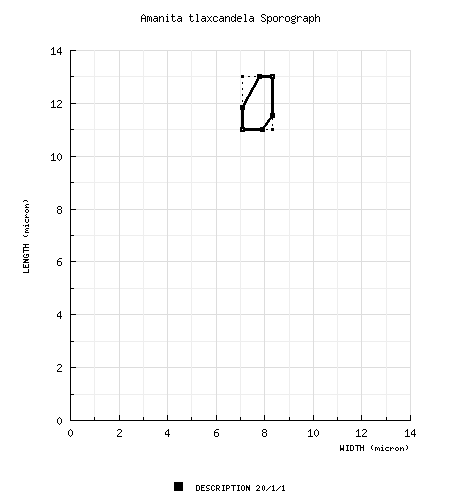
| basidiospores | [20/1/1] 11.0 - 13.0 (-15.0) × 7.1 - 8.3 (-9.6) μm, (L = 12.0 μm; W = 7.9 μm; Q = (1.36-) 1.39 - 1.67 (-1.69); Q = 1.52), ??, smooth, inamyloid, ellipsoid to (occasionally) elongate, adaxially flattened; apiculus sublateral, ??; contents ??; color in deposit not recorded. | ||||||||||||||||||||||||||||||||
| ecology | Solitary. At 2775 m elev. In Pinus-Quercus-Abies forest. | ||||||||||||||||||||||||||||||||
| material examined | MEXICO: TLAXCALA—Mpio. Tlaxco, Cerro El Peñon, ca. km 4.5 on Camino El Rosario, El Rodeo [19°41'19" N/ 98°14'02"W, 2775 m], 20.viii.1998 Anna Gerenday s.n. [Tulloss 8-20-98-B] (RET 292-1; TLXM). | ||||||||||||||||||||||||||||||||
| discussion |
In the field, this species was originally identified as A. calyptratoides because of the stipe's having the typical appearance of the stipe of the latter species as well as there being similarities general basidiome stature. The cap appears to be less gray than most specimens of A. calyptratoides, and the limited field notes simply give the cap color as brown. The marginal striations appear to be proportionally longer in A. tlaxcandela. The single annotated specimen for the present species has no membranous volval patch on the cap; such a patch is a prominent characteristic of A. calyptratoides. All comparison has to be done with caution because we have notes on only one specimen. The very similar spores of A. tlaxcandela and A. calyptratoides are compared via sporographs in the following figure: Phylogenetic studies indicate that the two taxa are distinct. | ||||||||||||||||||||||||||||||||
| citations | —R. E. Tulloss and S. Sánchez-Ramírez | ||||||||||||||||||||||||||||||||
| editors | RET | ||||||||||||||||||||||||||||||||
Information to support the viewer in reading the content of "technical" tabs can be found here.
 Spore data sets and their composite
Each spore data set is intended to comprise a set of measurements from a single specimen made by a single observer; and explanations prepared for this site talk about specimen-observer pairs associated with each data set. Combining more data into a single data set is non-optimal because it obscures observer differences (which may be valuable for instructional purposes, for example) and may obscure instances in which a single collection inadvertently contains a mixture of taxa.

Text and User-Generated Sporographs are published under the Creative Commons License.

In the case of a taxon page, image credits are on the 'image' tab.