| name |
Amanita cacaina |
| author |
Tulloss |
| name status |
nomen provisorum |
| english name |
"Dark Chocolate Ringless Amanita" |
| etymology |
cacainus, of cacao |
| GenBank nos. |
Due to delays in data processing at GenBank, some accession numbers may lead to unreleased (pending) pages.
These pages will eventually be made live, so try again later.
|
| intro |
Olive text indicates a specimen that has not been
thoroughly examined (for example, for microscopic details) and marks other places in the text
where data is missing or uncertain.
The following material is based on molecular studies
of L. V. Kudzma and other original research of R. E.
Tulloss. |
| pileus |
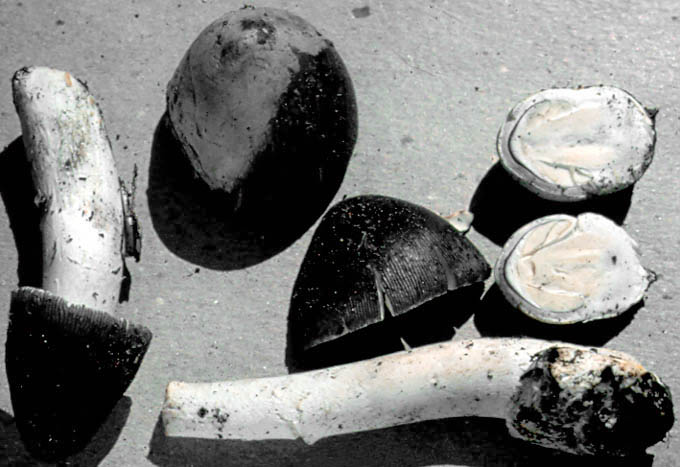
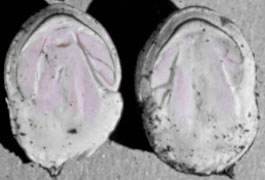
58 - 74 wide, chocolate brown to deep brown-gray (6F3-4), rounded conic at first, remaining umbonate during expansion, dull, tacky; context white with watersoaked line above lamellae and below pileipellis or simply with dark gray tones under pileipellis in disc, pinkish when sectioned in button, otherwise unchanging when cut or bruised, 3 - 5 mm thick, thinning evenly for one half to three quarters of radius, then a membrane; margin striate (0.4R), nonappendiculate; universal veil absent or (frequently) as a pale gray or pale grayish white calyptra, smooth, soft, leathery, easily peeled from pileipellis, membranous, at times perforated in one or a few places, at times the patch consisting of most of universal veil, even hanging below pileus margin. |
| lamellae |
free, without decurrent line on stipe apex, close(?), off-white in mass, white to cream in side view, drying ??, pinkish when sectioned in button, otherwise unchanging when cut or bruised, with white minutely pulverulent edge, 5 - 6.5 mm broad; lamellulae truncate or truncate in steps or truncate with prominent attenuate tooth at pileus context. |
| stipe |
72 - 81 × 10.5 - 11 mm, white to whitish, pale brown to grayish from handling, narrowing upward, barely or not flaring at apex, surface pulverulent and chalky near apex, finely fibrillose below, faintly longitudinally striate; context off-white to whitish to sordid, larva tunnels concolorous, pinkish when sectioned in button, otherwise unchanging when cut or bruised or becoming slightly (more) dingy, stuffed to hollow or stuffed only in lower half, with 4 - 6 mm wide central cylinder; exannulate; universal veil carried entirely on pileus or as a saccate volva, whitish, dry, soft, leathery, about 1 mm thick, tough, membranous, from highest point on limb to base of stipe 25± mm, no limbus internus distinguished in the material seen (all stipe bases damaged). |
| odor/taste |
Odorless. Taste not recorded. |
macrochemical
tests |
L-tyrosine test for tyrosinase: positive on surface and in context of stipe; other tissues not tested. Test voucher: Tulloss 8-2-85-C. |
| basidiospores |
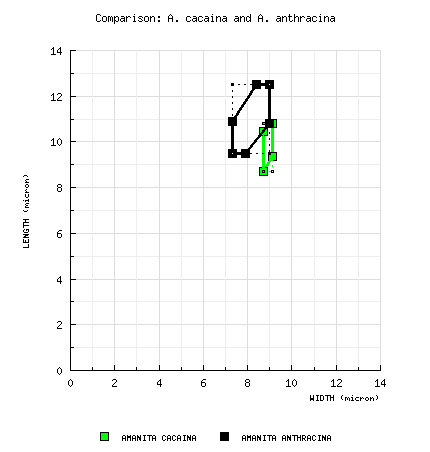
[15/1/1] 8.7 - 10.8 (-11.9) × (7.3-) 8.7 - 9.1
(-10.8) µm, (L = 10.0 µm; W = 8.9 µm;
Q = 1.03 - 1.20 (-1.23); Q = 1.12), colorless,
hyaline, thin-walled, smooth, inamyloid, globose to
subglobose to broadly ellipsoid,
??; apiculus
sublateral, ?; contents ?guttulate;
?? in deposit. |
| ecology |
Solitary or subgregarious. West Virginia: In clay under Tsuga canadensis, Betula sp., Quercus sp., and Acer sp. or in dark loam under Picea rubens, Betula allegheniensisT. canadensis and Rhododendron sp. in region of Alnus and Sphagnum bogs. |
| material examined |
U.S.A.: WEST
VIRGINIA—Randolph Co. - Monongahela Nat. For.,
Otter Creek Wilderness, Philip Musgrove [Tulloss
8-2-85-C] (RET 201-10). Tucker
Co. - Canaan St. Pk. [39°00’57” N/ 79°27’49” W, 1000
m.], David C. Tulloss 8-2-85-F (RET 203-7, nrITS
& nrLSU seq'd.). |
| discussion |
The bisterigmate basidia may have been caused by
the Randolph Co. collection being in rather early
stages of sporulation. The Tucker Co.
collection (RET 203-7) seems contaxic with the
other on macroscopic grounds; however, sporulation
had not begun when the material was dried. Gene
sequences were derived for RET 203-7; however, we
have not had such success for RET 201-10.
Another very dark-capped species of section
Vaginatae is A. anthracina. This
latternspecies is known from east Texas and Missouri
and is distinguished morphologically by having a
non-graying volva and spores with different
size/shape. It is also distinct
genetically—based on sequencing of the nrITS
locus:
This species was formerly known as "Amanita sp.
W3" in RET's notes, keys, and correspondence. |
| citations |
—R. E. Tulloss and L. V. Kudzma |
| editors |
RET |
|




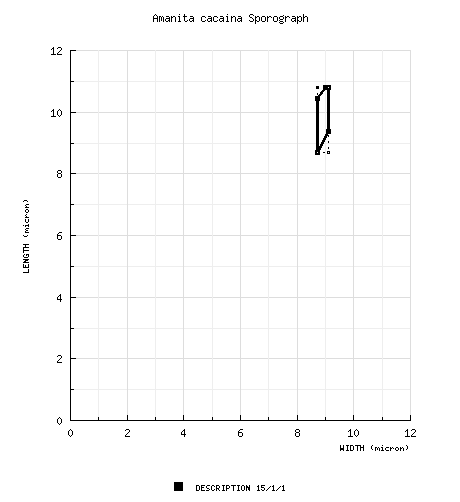
 Spore data sets and their composite