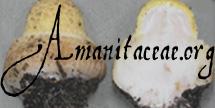
1. Amanita anthracina, Big Thicket Nat. Preserve, Texas, U.S.A.
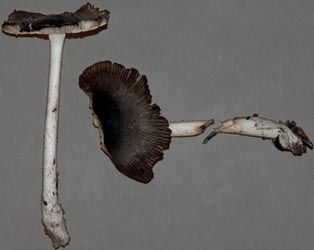
2. Amanita anthracina, Ha Ha Tonka St. Pk., Missouri, U.S.A.
cap
The cap is 29 - 36 mm wide, dark gray, nearly black, sometimes virgate, sometimes shiny over the marginal striations, with its context white, unstaining, and about 2 mm thick above the stem. The marginal striations take up about 40% - 55% of the cap's radius. Usually, no volval material is present.
gills
The gills are free, close to crowded, whitish to off-white in side view, sometimes becoming grayish white with age, and about 2 mm broad. The short gills are not plentiful, truncate, of diverse lengths, and unevenly distributed.
stem
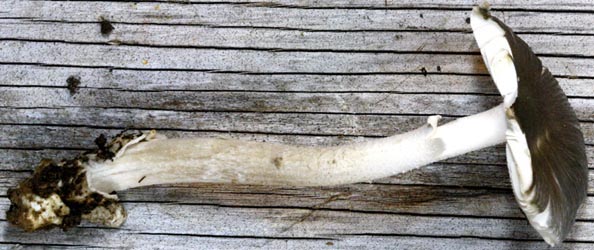
The stem is 63 - 85 × 3 - 6 mm, white, becoming sordid from handling, pulverulent in the top 20 (appox.) mm, and, elsewhere, bears very fine raised fibrils (10× lens). It is also exannulate. The volva is white on the exterior, sack-like, membranous, barely attached at the stem's base, and sometimes easily and entirely separable from the stem.
spores
The spores measure (8.5-) 9.5 - 12.5 (-13.5) × (7.0-) 7.3 - 9.0 (-11.0) µm are broadly ellipsoid to ellipsoid (infrequently subglobose or elongate) and inamyloid. Clamps are not to be found at the bases of basidia.
discussion
This species has been found from the sandy pine-oak woods of
eastern Texas (USA) to as far north as Ha Ha Tonka St. Pk.,
Missouri(USA). This species was formerly known as
"Amanita sp-T10" on this site.—R. E. Tulloss
brief editors
RET
name
Amanita anthracina
author
Tulloss & D. P. Lewis
name status
nomen provisorum
english name
"Coal Black Ringless Amanita"
etymology
anthracinus, coal black
GenBank nos.
Due to delays in data processing at GenBank, some accession numbers may lead to unreleased (pending) pages.
These pages will eventually be made live, so try again later.
Search:
accession
locus
voucher
source
No data available in table
Showing 0 to 0 of 0 entries
intro
Olive text indicates a specimen that has not been
thoroughly examined (for example, for microscopic details) and marks other places in the text
where data is missing or uncertain.
The following is based on
original research by R. E. Tulloss.
Solitary to subgregarious. Missouri: In Quercus-Carya forest. Texas: In a “Creek hardwood bottomland forest” or in a Fagus dominated “slope forest.”
material examined
U.S.A.:
LOUISIANA—Lafayette Parish - Lafayette, Acadian Nature Center, 27.xi.2009 M Vinnson s.n. [Tulloss 11-17-09-C] (F?).
MISSOURI—Camden Co. - ca. Camdenton, Ha Ha Tonka St. Pk., River Cave, 24.vi.2009 Jay Justice, C. Crabtree, S. Kaye s.n. [Tulloss 6-24-09-E] (RET 441-5, nrITS seq'd.).
TEXAS—Hardin Co. - Big Thicket National Preserve, Jack Gore Baygall Unit, 16 km N of Silsbee, NAMA 2000 foray 6, 10.vi.2000 Diane Pruden s.n. (RET 313-4). Newton Co. - Bleakwood, Co. Rd. 3062, Lewis prop. [30º42.509’ N/ 93º49.630’ W], 24.vii.2007 D. P. Lewsi 8148 (in herb. D. P. Lewis). Tyler Co. - Big Thicket National Preserve, Canyonlands Unit, Spurger, 9.vi.2009 Eastfield College student s.n. [D. P. Lewis 8997A] (in herb. D. P. Lewis).
discussion
This species was formerly called Amanita sp-T10.
citations
—R. E. Tulloss
editors
RET
Information to support the viewer in reading the content of "technical" tabs
can be found here.
name
Amanita anthracina
name status
nomen provisorum
author
Tulloss & D. P. Lewis
english name
"Coal Black Ringless Amanita"
images
1. Amanita anthracina, Big Thicket Nat. Preserve, Texas, U.S.A.
2. Amanita anthracina, Ha Ha Tonka St. Pk., Missouri, U.S.A.
photo
David P. Lewis - (1) Big Thicket National Preserve, Texas, U.S.A. [Photoshop® edit by RET]
Each spore data set is intended to comprise a set of measurements from a single specimen made by a single observer;
and explanations prepared for this site talk about specimen-observer pairs associated with each data set.
Combining more data into a single data set is non-optimal because it obscures observer differences
(which may be valuable for instructional purposes, for example) and may obscure instances in which
a single collection inadvertently contains a mixture of taxa.




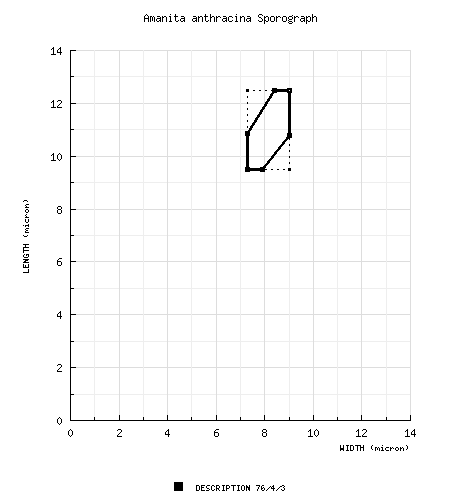
 Spore data sets and their composite