| name |
Amanita austrostraminea |
| author |
D. A. Reid. 1978. Victorian Naturalist 95: 47, fig. 43. |
| name status |
nomen acceptum |
| english name |
"Australian Straw-Colored Lepidella" |
| synonyms |
≡ Amanita straminea Cleland nom. illeg. 1927. Trans. Roy. Soc. S. Austral. 51: 299. [Posterior homonym. ICBN §53.1]
non Amanita straminea Lam. 1783 ["1784"]. Encycl. Mèth. Bot. ... 1: 106.
≡ Aspidella straminea (Cleland) E.-J. Gilbert. 1940. Iconogr. Mycol. (Milan) 27, suppl. (1): 79, tab. 50 (fig. 6). non Amanita citrina f. straminea non Amanita straminea Secr.
The editors of this site owe a great debt to Dr. Cornelis Bas
whose famous cigar box files of Amanita nomenclatural information
gathered over three or more decades were made available to RET for computerization
and make up the lion's share of the nomenclatural information presented on this site.
|
| MycoBank nos. |
308540, 278931, 284333 |
| GenBank nos. |
Due to delays in data processing at GenBank, some accession numbers may lead to unreleased (pending) pages.
These pages will eventually be made live, so try again later.
|
| lectotypes |
AD |
| lectotypifications |
Bas. 1969. Ibid.: 514. [Note: Description of excluded syntype on p. 540 with figs. 339-342.] |
| revisions |
Bas. 1969. Persoonia 5: 513, figs. 294-296. |
| intro |
The following text may make multiple use of each data field.
The field may contain magenta text presenting data from a type study
and/or revision of other original material cited in the protolog of the present taxon.
Macroscopic descriptions in magenta are a combination of data from the protolog and
additional observations made on the exiccata during revision of the cited original
material.
The same field may also contain black text, which is data from a revision of the present
taxon (including non-type material and/or material not cited in the protolog).
Paragraphs of black text will be labeled if further subdivision of
this text is appropriate.
Olive text indicates a specimen that has not been
thoroughly examined (for example, for microscopic details) and marks other places in the text
where data is missing or uncertain.
The text below is largely derived from the revision of Bas (1969) under the name A. straminea and original research of R. E. Tulloss based on material apparently introduced to Hawai'i.
from Bas (1969): Basidiome small. |
| pileus |
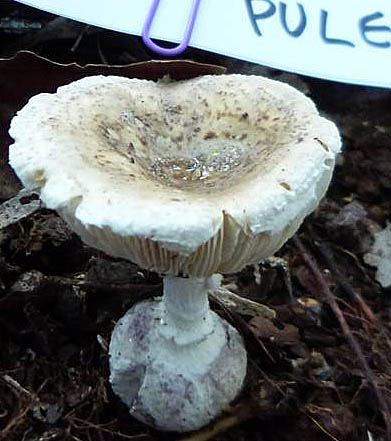
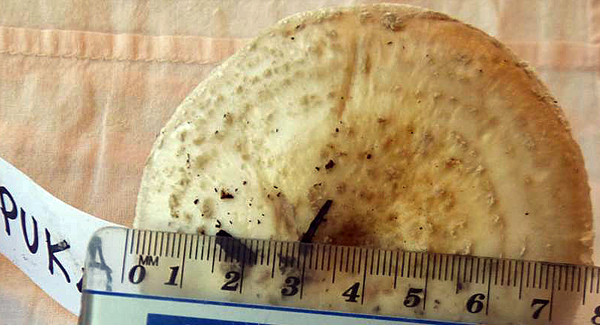
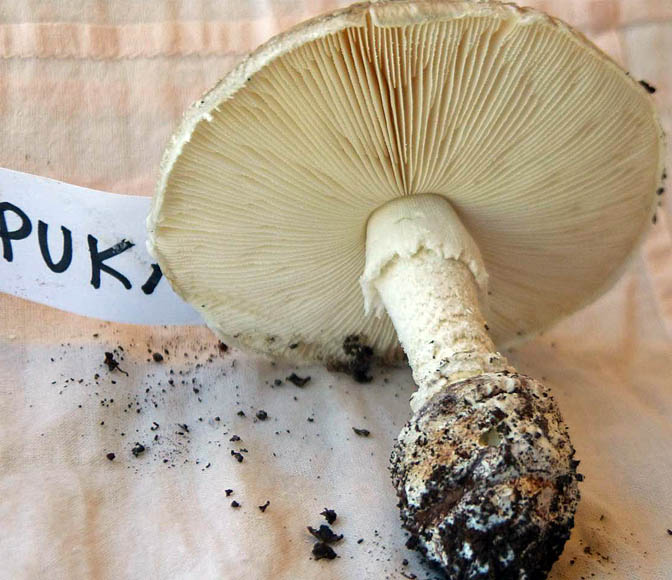
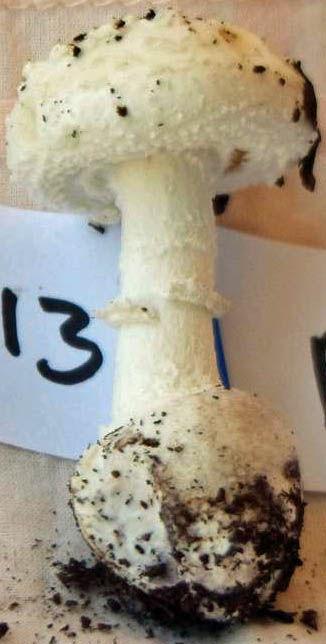
from Bas (1969): 40 - 56 mm wide, white, convex to nearly plane, with slightly depressed center, unpolished, glabrescent with age, then probably viscid when moist; context white; margin non-sulcate, slightly appendiculate; universal veil as pulverulent covering, white, thin. |
| lamellae |
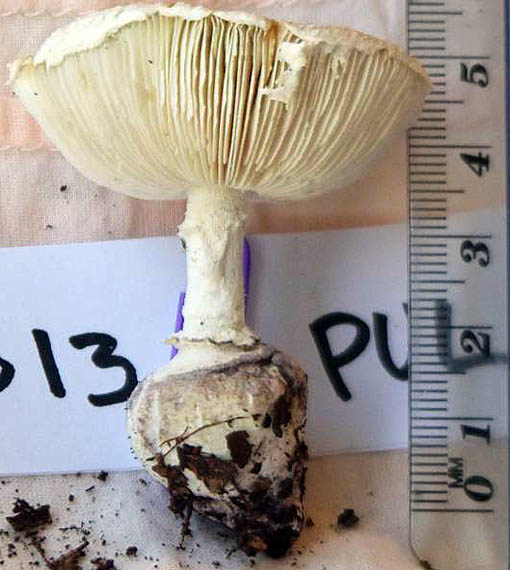
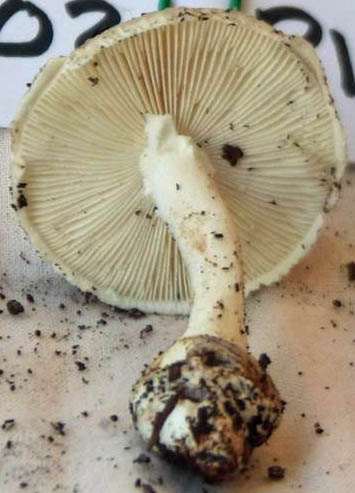
from Bas (1969): adnexed to narrowly adnate, rather crowded, more or less Straw Yellow of Ridgway, up to 10 mm broad, proportionately "rather broad"; lamellulae attenuate. |
| stipe |
from Bas (1969): 40 - 58 × 6 - 10 mm, white, cylindric, subpulverulent to subfibrillose; bulb subfusiform ellipsoid, immarginate, ca. 15 - 20 × 8 - 12 mm; context white, solid; partial veil subapical, membranous, pendent, white; universal veil not discernible. |
| odor/taste |
not recorded. |
macrochemical
tests |
none recorded. |
| pileipellis |
from Bas (1969): with rather thick gelatinized layer, slightly yellowish in alkaline solution; hyphae 2.5 - 5 (-8) μm wide, subradially arranged, with walls slightly thickened, "embedded in gelatinous matter". [Note: From the above, it seems uncertain whether there is both a layer of gelatinized hyphae and a second layer comprising a gelatinous matrix in which are to be found ungelatinized hyphae.—ed.]
RET: suprapellis ca. 330 μm thick, as extensively gelatinized matrix (see below); subpellis ca. 55 μm thick, not gelatinized, densely compacted vertically; filamentous undifferentiated hyphae 1.0 - 4.8 μm wide, subradially arranged, thin-walled in subpellis, with walls (including septa) slightly thickened in rather sparse partially gelatinized hyphae in gelatinized matrix of suprapellis; vascular hyphae not observed; clamps not observed. |
| pileus context |
not described. |
| lamella trama |
from Bas (1969): bilateral. |
| subhymenium |
from Bas (1969): inflated ramose to subcellular. |
| basidia |
from Bas (1969): 45 - 55 × 10 - 12 μm, 4-sterigmate; clamps lacking.
from Reid (1980): 33 - 43 × 9 - 10 μm.
RET: ca. 42 × 9.5 μm, 4-sterigmate, with sterigmata up to ?? μm; clamps not observed. |
| universal veil |
from Bas (1969): On pileus: hyphae, irregularly disposed, abundant, 3 - 8 μm wide; inflated cells in terminal chains, ellipsoid or globose to (more rarely) clavate or elongate, up to 70 × 50 μm or 150 × 25 μm. On stipe base: absent.
RET: On pileus in low "shapeless" wart: filamentous undifferentiated hyphae ?? μm wide, plentiful, interwoven, irregularly disposed except in very base of wart and there periclinally organized; inflated cells plentiful, with disorderly disposition, terminal in short chains or quite often singly, globose to subglobose to ellipsoid to ovoid (up to 44 × 40 μm) and clavate to subcylindric to fusiform-bacilliform (up to 64 × 20 μm), with walls up to 0.5 μm thick; vascular hyphae not observed; clamps not observed. On stipe base: ??. |
| stipe context |
from Bas (1969): filamentous hyphae scattered; acrophysalides abundant; clamps lacking. |
| partial veil |
not described. |
| lamella edge tissue |
from Bas (1969): scanty; inflated cells dominant, clavate, 20 - 45 (-80) × 12 - 25 μm.
RET: sterile. |
| basidiospores |
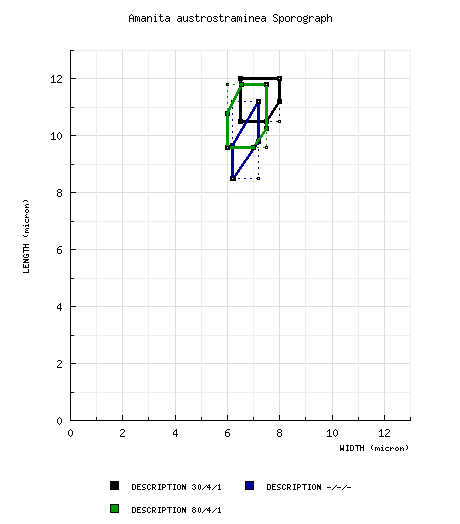
from revision of Bas (1969): [30/4/1] 10.5 - 12.0 (-13.5) × (6.0-) 6.5 - 8.0 μm, (Q = 1.40 - 1.90; Q = 1.50 - 1.70), rather thin-walled, colorless to slightly yellowish in alkaline solution, amyloid, ellipsoid to elongate; contents usually refractive; yellowish in deposit.
from revision of Reid (1980): [-/-/-] 8.5 - 11.2 × (5.2-) 6.2 - 7.2 μm, (est. Q = 1.36 - 1.56; Q' = 1.47), amyloid.
RET: [80/4/1] (8.5-) 9.6 - 11.8 (-13.7) × 6.0 - 7.5 (-8.0) μm, (L = 10.0 - 10.9 μm; L' = 10.6 μm; W = 6.4 - 6.8 μm; W' = 6.6 μm; Q = (1.30-) 1.37 - 1.80 (-1.95); Q = 1.47 - 1.71; Q' = 1.61), hyaline, colorless, smooth, thin-walled, amyloid, ellipsoid to elongate, usually adaxially flattened, sometimes expanded toward one end; apiculus sublateral, cylindric; contents granular to monoguttulate and then with or without additional small granules; white in deposit. |
| ecology |
from revision of type by Bas (1969): Australia: Under shrubs.
RET: Hawai'i, U.S.A.: Under introduced (alien) Eucalyptus. |
| material examined |
from revision of Bas (1969) and Reid (1980): AUSTRALIA: SOUTH AUSTRALIA—Sturt Co. - Kinchina, 8.vi.1926 J. B. Cleland s.n. (lectotype, ADW 9271 => AD).
RET: U.S.A.: HAWAII—Oahu -
Keaiwa Heiau St. Recreation Area [21.399° N/ 157.895°
W, 292 m], 20.vii.2013 Shenandoah J. Greco 01792013
[mushroomobserver
#140464
(pele), mushroomobserver
#140466
(piko), mushroomobserver
#140469
(pono), mushroomobserver
#140574
(puka), mushroomobserver
#140575
(pule)] (RET 553-7,nrITS seq'd.). |
| discussion |
from Bas (1969): "In the original description two syntypes are mentioned, vix. one from Kinchina, June 8, 1926, and another from Encounter Bay, without date. I received on loan ... [ADW] 9271 (Kinchina, June 8, 1926) and ... [ADW] 9258 (Encounter Bay, without date) As I am fairly certain that these two collections are not conspecific, the choice of the lectotype is important. I have chosen ... [ADW] 9271 for the following reasons:"
"(i) The field notes of ... 9271 fit the protologue almost exactly.
"(ii) In ... 9258 the base of the stem is surrounded by a groove; hence the bulb is marginate and a narrow free limb is appressed against the base of the stem. In ...9271 the base of the stem passes gradually into the bulb and there are no discernible remnants of the volva there. In the protologue no rim or limb on the bulb is mentioned.
"(iii) The spore sizes of the two syntypes differ. In ... 9258 I found 9.5 - 12 × 5 - 6.5 μm and in ... 9271 10.5 - 12 (-13.5) × (6-) 6.5 - 8 μm. The spore size given in the protolog is 11 - 13 × 7.5 μm.
"(iv) In ... 9271 many basidia and spores have refractive contents which probably cause the yellow tinge of gills and spore-print. This is not the case in ... 9258."
"In the package of ... 9258 there is a slip of brown paper with the indication "Portion of type," probably written by Cleland himself. I think, however, that the facts mentioned above show clearly that this indication is contrary to the protologue. Gilbert (1940: pl. 55 fig. 6; 1941: 400) probably studied only ... 9258 and considered that collection the type.
"The exculded syntype, ... 9258, is treated in this work as a nameless species of Amanita placed near A. sublutea (see p. 540)."
Reid (1980) cites Bas' study of the lectotype and provides only measurements of spores and basidia by way of his own revision.
Grgurinovic (1997) deals neither with the present species nor with the excluded syntype in her work.
This species has recently been found with imported Eucalyptus on the island of Oahu in Hawai'i by Paul Hill and later collected at the same site by Shenandoah Greco and her children. |
| citations |
—R. E. Tulloss |
| editors |
RET |
|



 Spore data sets and their composite