
| name | Amanita kammala |
| name status | insufficiently known |
| author | Grgur. |
| english name | "Ill-Defined Lepidella" |
| intro |
This description is taken from Bas (1969) and the original description of C. A. Grgurinovic (1997). |
| cap |
The cap of Amanita kammala is up to 30 mm wide, plano-convex, possibly white with faint yolk-yellow tinges (color of the original material is unknown), probably viscid, with a nonsulcate and not or slightly appendiculate margin. Volva remnants are not distinct on the single specimen known. |
| gills |
The gills are narrowly adnate, subdistant, rather broad, slightly ventricose, white. The short gills are truncate. Bas points out that there are yellowish refractive hyphae that may have given a yellow tint to the gills of A. straminea (see below) that are absent in the present species. |
| stem | The stem is up to 35 × 3 mm and exannulate. The stem has an ellipsoid emarginate (Grgurinovic) or marginate (Bas) basal bulb on the top of which is an upstanding submembranous fringe of volval material that stands off from the stem a short distance, but collapses on the stipe. |
| odor/taste | Odor and taste have not been reported for this species. |
| spores | The spores measure (9.6-) 10.8 - 14.6 × 5.4 - 7.8 µm (Grgurinovic) or 9.5 - 12 (-13.5) × (6-) 6.5 - 8 µm (Bas) and are elongate to cylindric and amyloid. Clamps are absent at bases of basidia. |
| discussion |
Neither Bas nor Grgurinovic knew this species in its fresh state. The specimen on which the current name is based was avoided as a type by Bas (1969) because too little was known of it; and the specimen is apparently the only one known of this entity. It was collected in the state of South Australia. No plants were reported in association with the mushroom. The name applies to a specimen that was included by Cleland in A. sublutea. Bas (1969: 540) demonstrated that it was not conspecific with the type of A. sublutea. According to Bas, the stirps to which this species might be assigned is stirps Preissii. See A. preissii (Fr.) Sacc. and, within that stirps at Bas' (1969) suggestion, A. sublutea (Cleland) E.-J. Gilbert.—R. E. Tulloss |
| brief editors | RET |
| name | Amanita kammala | ||||||||||||||||||||
| author | Grgur. 1997. Larger Fung. S. Austral.: 412, fig. 275(a-c). | ||||||||||||||||||||
| name status | insufficiently known | ||||||||||||||||||||
| english name | "Ill-Defined Lepidella" | ||||||||||||||||||||
| synonyms |
=Amanita sp. indet. 1 Bas. 1969. Persoonia 5: 539, figs. 333-334.
=Amanita sublutea sensu Cleland p.p. 1934. Toadst. Mushr. S. Austral. 1: 52.
non Amanita sublutea Cleland 1934. Toadst. Mushr. S. Austral. 1: 52. The editors of this site owe a great debt to Dr. Cornelis Bas whose famous cigar box files of Amanita nomenclatural information gathered over three or more decades were made available to RET for computerization and make up the lion's share of the nomenclatural information presented on this site. | ||||||||||||||||||||
| etymology | kammala - "fungus" (from unidentified language of original peoples of Australia) | ||||||||||||||||||||
| MycoBank nos. | 443366 | ||||||||||||||||||||
| GenBank nos. |
Due to delays in data processing at GenBank, some accession numbers may lead to unreleased (pending) pages.
These pages will eventually be made live, so try again later. Search:
Showing 0 to 0 of 0 entries | ||||||||||||||||||||
| holotypes | AD | ||||||||||||||||||||
| intro |
The following text may make multiple use of each data field. The field may contain magenta text presenting data from a type study and/or revision of other original material cited in the protolog of the present taxon. Macroscopic descriptions in magenta are a combination of data from the protolog and additional observations made on the exiccata during revision of the cited original material. The same field may also contain black text, which is data from a revision of the present taxon (including non-type material and/or material not cited in the protolog). Paragraphs of black text will be labeled if further subdivision of this text is appropriate. Olive text indicates a specimen that has not been thoroughly examined (for example, for microscopic details) and marks other places in the text where data is missing or uncertain. The following material is derived from the protolog of the present species and from (Bas 1969). Bas (1969): "There are no field-notes in the package of Cleland 9258 which I had on loan. But as Cleland mentioned this collection in the protologue of A. straminea, I gather that the colours of were similar to those of the type specimens of A. straminea." from protolog: "There were no notes on macroscopic characters accompanying this collection." | ||||||||||||||||||||
| pileus |
Bas (1969): ca 30 mm wide, white with faint yolk yellow tinges, plano-convex, probably viscid; context not recorded: margin non-sulcate, not or very slightly appendiculate; universal veil apparently lacking. from protolog: [quotes the above]. | ||||||||||||||||||||
| lamellae |
from Bas (1969): narrowly adnate, subdistant, white, rather broad, slightly ventricose; lamellulae truncate. from protolog: [quotes the above]. | ||||||||||||||||||||
| stipe |
Bas (1969): ca. 35 × 3 mm; bulb ca. 12 × 8 mm, ellipsoid, immarginate; context not described; partial veil exannulate; universal veil as fringed limb, up to 2.5 mm high, "with slight constriction between limb and bulb." from protolog: [quotes the above]. | ||||||||||||||||||||
| odor/taste | not recorded. | ||||||||||||||||||||
| macrochemical tests |
none recorded. | ||||||||||||||||||||
| pileipellis |
Bas (1969): filamentous hyphae 1.5 - 5 μm wide, interwoven, gelatinized. from protolog: filamentous hyphae interwoven, gelatinized. | ||||||||||||||||||||
| pileus context | not described. | ||||||||||||||||||||
| lamella trama |
Bas (1969): bilateral. from protolog: not described. | ||||||||||||||||||||
| subhymenium |
Bas (1969): subcellular, with cells somewhat irregular but not coralloid. from protolog: not described. | ||||||||||||||||||||
| basidia |
Bas (1969): 45 - 50 × 9 - 11 μm, 4-sterigmate; clamps lacking. from protolog: [5/1/1] 43 - 54 × 11.6 - 14.8 μm, avg. length = 49 μm, avg. width = 12.7 μm, with sterigmata up to 4.4 μm long, 4-sterigmate; clamps not observed. | ||||||||||||||||||||
| universal veil |
Bas (1969): On pileus: macroscopically indiscernible, scattered, "probably participating in process of gelatinization of pileipellis"; filamentous hyphae 3 - 8 μm wide, loosely interwoven, branching; inflated cells broadly clavate to ellipsoid, up to 110 × 50 μm or 70 × 60 μm, terminal singly or in short chains. On stipe bulb: very thin tissue, comprising elements similar to those on pileus, but "here embedded in gelatinous matter." from protolog: On pileus: scattered over pileus surface; filamentous hyphae loosely interwoven, branching; inflated cells broadly clavate to ellipsoid, terminal singly or in short chains. | ||||||||||||||||||||
| stipe context | not described. | ||||||||||||||||||||
| partial veil | absent. | ||||||||||||||||||||
| lamella edge tissue | not described. | ||||||||||||||||||||
| basidiospores |
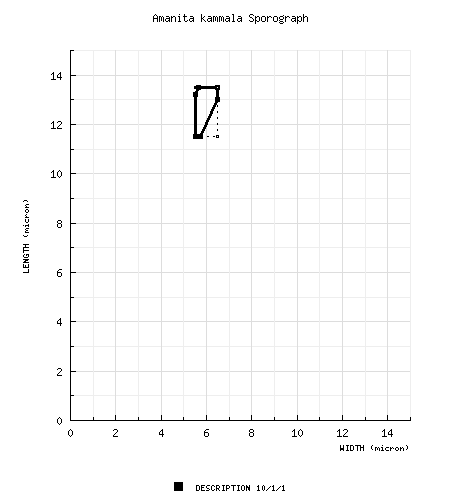
Bas (1969): [10/1/1] 11.5 - 13.5 (-14.5) × 5.5 - 6.5 μm, (Q = 2.0 - 2.4; Q - 2.15), thin-walled, amyloid, cylindric; apiculus not described; contents not described; color in deposit not recorded. Grgurinovic (1997): [50/1/1] (9.6-) 10.8 - 14.6 × 5.4 - 7.8 μm, (L = 12.1 μm; W = 6.2 μm; Q = 1.95), amyloid, cylindric; apiculus not described; contents not described; color in deposit not recorded. [Note: We have not estimated a range for Q based on the (Grgurinovic 1997) spore data for this species in order to prevent automatic generation of a sporograph that we believe would be misleading. We evaluated the Amanita spore length and width ranges from (Grgurinovic 1997) in comparison to comparable data published by other authors and often based on revision of the same specimens. This experiment involved a total of 19 descriptions of a total of 13 species from the work of 3 authors. In a range of the form "x - y" of spore length (width) from (Grgurinovic 1997) compared to a range of the form (a-) b - c (-d) of spore length (width) in the other works, the value of "y" was compared to the value of "c" as a ratio. In the case of spore length ranges, on average (per author), the ratio y/c ranged from 1.06 - 1.10 (possibly due to the non-segregation of a "d" value in the ranges of concern). In the case of spore width ranges, on average (per author), the ratio ranged from 1.14 - 1.23 (indicating the probability of compounding causes at play—possibly, the absence of the "d" value in the ranges of concern and failure to restrict spore measurement to spores strictly presenting in lateral view). When sporographs were attempted from the Grgurinovic data, the results were not useful.—ed.] | ||||||||||||||||||||
| ecology | Grgurinovic (1997): Solitary[?]. On the ground. | ||||||||||||||||||||
| material examined | Bas (1969) and Grgurinovic (1997): AUSTRALIA: SOUTH AUSTRALIA—Hindmarsh Co. - Encounter Bay, Hills Crk., 24.v.1932 J. B. Cleland 9573 (holotype, ADW 9573 => AD 3254). | ||||||||||||||||||||
| discussion |
When he studied the single collection that became the type of Amanita kammala, Dr. Bas felt that it should not be described formally as new. This was his usual practice when significant information was lacking concerning the fresh condition of available collections. In the present case, he states four independent criteria with which to differentiate the material from A. sublutea to which Cleland had assigned the collection in question. The collection was not in good condition and Bas could not satisfy himself as to whether there was layering of the limb of the universal veil present on the stipe's base. Grgurinovic remeasured the spores with a larger sample; but otherwise relied heavily on the previous work of Bas. No new information about the fresh condition has been found. No answers can be provided to Bas' questions raised by the imperfect state of preservation of the material. As a consequence, RET suggests that the state of knowledge of this single collection has not changed, and that A. kammala should be considered an insufficiently known taxon. | ||||||||||||||||||||
| citations | —R. E. Tulloss | ||||||||||||||||||||
| editors | RET | ||||||||||||||||||||
Information to support the viewer in reading the content of "technical" tabs can be found here.
| name | Amanita kammala |
| bottom links |
[ Section Lepidella page. ]
[ Amanita Studies home. ]
[ Keys & Checklists ] |
| name | Amanita kammala |
| bottom links |
[ Section Lepidella page. ]
[ Amanita Studies home. ]
[ Keys & Checklists ] |
 Spore data sets and their composite
Each spore data set is intended to comprise a set of measurements from a single specimen made by a single observer; and explanations prepared for this site talk about specimen-observer pairs associated with each data set. Combining more data into a single data set is non-optimal because it obscures observer differences (which may be valuable for instructional purposes, for example) and may obscure instances in which a single collection inadvertently contains a mixture of taxa.

Text and User-Generated Sporographs are published under the Creative Commons License.

In the case of a taxon page, image credits are on the 'image' tab.