

| name | Amanita aurantisquamosa |
| name status | nomen acceptum |
| author | Trueblood, O. K. Mill. & Dav. T. Jenkins |
| english name | "Trueblood's Orange-Scaled Amanita" |
| intro | This description is based on the original description (1990). |
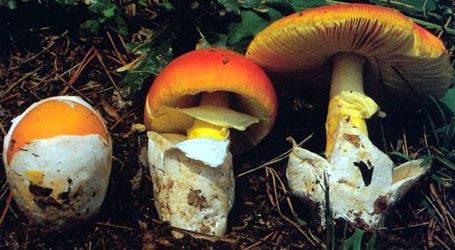
| cap | The cap of Amanita aurantisquamosa is 35 - 70 mm wide, robust, convex to nearly plane at maturity, glabrous, light tan to pale tannish-orange, with faintly striate margin when young and a striate and slightly downturned margin at maturity. The volval remnants are floccose-membranous patches, randomly distributed, thinning toward the margin. The patches are firmly attached, white, but frequently having yellowish to yellowish-brown stains over the surface. |
| gills | Gills are moderately crowded, free, off-white to orange-white when young, white at maturity. The short gills are moderately abundant, mostly short, and truncate to rounded truncate. |
| stem | Its stem is 40 - 110 (-135) × 8 - 22 mm, narrowly clavate, tapering toward the slightly expanded top, white with small, white, floccose scales near the top of the stem and a series of appressed, obscure to well-developed, white to pale orange scales near the middle and base of the stem. The flesh of the stem is pale pinkish-white. The central cylinder of the stem is stuffed. The basal bulb is ovoid, sometimes only slightly broader than the stem at maturity. The volval remnants may be lost in collecting but sometimes are attached to the bulb and more or less limbate, sometimes quite large, then soon easily breaking, white with yellowish to yellowish-brown stains on the the surface. The ring is delicate, white, small, and not close to the top of the stem, and often under the stem's midpoint, easily breaking, frequently absent in older specimens. |
| odor/taste | This species is reported to have no distinct odor or taste. |
| spores | The spores measure 10.2 - 12.5 × 9.4 - 10.9 µm and are subglobose to broadly ellipsoid and are inamyloid. Clamps are absent at bases of basidia. |
| discussion |
This species was originally described from Idaho (USA) where it occurs scattered under Douglas Fir (Pseudotsuga menziesii), Aspen (Populus tremuloides), and juniper (Juniperus scopulorum). The authors believe that one or both of the first two trees listed were the host species. As far as we know, this species is still known only from southern Idaho.—R. E. Tulloss |
| brief editors | RET |
| name | Amanita aurantisquamosa | ||||||||||||||||||||
| author | Trueblood, O. K. Mill. & Dav. T. Jenkins O. K. Mill., Trueblood & Dav. T. Jenkins. 1990. Mycologia 82: 123, figs. 5-7, 13. | ||||||||||||||||||||
| name status | nomen acceptum | ||||||||||||||||||||
| english name | "Trueblood's Orange-Scaled Amanita" | ||||||||||||||||||||
| MycoBank nos. | 133538 | ||||||||||||||||||||
| GenBank nos. |
Due to delays in data processing at GenBank, some accession numbers may lead to unreleased (pending) pages.
These pages will eventually be made live, so try again later. Search:
Showing 0 to 0 of 0 entries | ||||||||||||||||||||
| holotypes | VPI | ||||||||||||||||||||
| intro |
The following text may make multiple use of each data field. The field may contain magenta text presenting data from a type study and/or revision of other original material cited in the protolog of the present taxon. Macroscopic descriptions in magenta are a combination of data from the protolog and additional observations made on the exiccata during revision of the cited original material. The same field may also contain black text, which is data from a revision of the present taxon (including non-type material and/or material not cited in the protolog). Paragraphs of black text will be labeled if further subdivision of this text is appropriate. Olive text indicates a specimen that has not been thoroughly examined (for example, for microscopic details) and marks other places in the text where data is missing or uncertain. The following material is drawn entirely from the protolog of the present species. from protolog: Basidiomes small to medium-sized. | ||||||||||||||||||||
| pileus | from protolog: 35 - 70 mm wide, with disc drab at first (ca. 7B1-2), becoming light tan to pale tannish orange, fading toward the margin, convex to nearly plane at maturity, "robust," glabrous, moderately viscid when moist; context white, unchanging, thin, up to 5 mm thick above stipe, tapering toward margin; margin faintly striate, slightly downcurved at maturity; universal veil as floccose-membranous patches, white, frequently with yellowish to yellow-brown superficial stains, randomly distributed, thinner toward margin, "fairly firmly attached"; pileipellis easily separable from context. | ||||||||||||||||||||
| lamellae | from protolog: free, moderately crowded, off-white to orange-white (6A2) when young, white at maturity; lamellulae truncate to rounded-truncate, moderately abundant, mostly short. | ||||||||||||||||||||
| stipe | from protolog: 40 - 110 (-135) × 8 - 22 mm, white, narrowing upward, with slightly expanded apex, with small white floccose scales near apex, with series of appressed obscure to well-developed white to pale orange scales from mid-height toward base of stipe; bulb "moderately developed," only slightly broader than stipe base to ovoid; context stuffed. very pale pinkish white; paratial veil median to inferior, thin, delicate, white, soon fragmented, frequently absent in age; universal veil at first "more or less saccate," later as "somewhat large" floccose-membranous patches, randomly distributed, detersile to subappressed, fragmenting with age, white with conspicuous yellow to yellowish brown superficial stains. | ||||||||||||||||||||
| odor/taste | from protolog: Odor and taste not distinct. | ||||||||||||||||||||
| macrochemical tests |
none recorded. | ||||||||||||||||||||
| pileipellis | from protolog: layering not described; filamentous undifferentiated hyphae 2.5 - 6.5 μm wide, subradially arranged, interwoven, "moderately gelatinized," moderately branched; vascular hyphae rare; inflated cells rare; clamps absent. [Note: If inflated cells were ever seen, one wishes they had been described because they are rarely seen in the pileipellis of amanitas.—ed.] | ||||||||||||||||||||
| pileus context | from protolog: filamentous undifferentiated hyphae 2 - 8 μm wide, moderately branched; acrophysalides abundant ellipsoid to fusiform, up to 176 × 25 μm, terminal singly or with subtending inflated cell or short chain of inflated cells; clamps absent. | ||||||||||||||||||||
| lamella trama | from protolog: bilateral; filamentous undifferentiated hyphae 1.8 - 7.5 μm wide, moderately branched; inflated cells mostly ellipsoid to slightly irregular, up to 144 × 30 μm, terminal singly or in short chains; clamps absent. | ||||||||||||||||||||
| subhymenium | from protolog: ramose, clamps absent. | ||||||||||||||||||||
| basidia | from protolog: up to 76 × 3.9 - 17.2 μm, 2- and 4-sterigmate; clamps lacking. | ||||||||||||||||||||
| universal veil | from protolog: On pileus: filamentous undifferentiated hyphae numerous, 2.5 - 8.5 μm wide, moderately branched; inflated cells numerous, subglobose to broadly ellipsoid (up to 95 × 78 μm) or ellipsoid [to elongate to cylindric—ed.] (up to 93 × 35 μm), terminal and usually in short chains, with more elongate cells subtending broader cells; vascular hyphae occasionally present; clamps absent. On stipe's bulb: filamentous undifferentiated hyphae dominating, 2.3 - 8.1 μm wide, moderately branched; inflated cells subglobose to broadly ellipoid, up to 84 × 72 μm, terminal in short chains, with majority of subtending cells smaller than 90 × 20 μm and ellipsoid; vascular hyphae not described; clamps absent. [Note: The shapes of the subtending cells in the universal veil on the stipe's bulb appear to be ellipsoid to elongate to cylindric to bacilliform from the data provided.—ed.] | ||||||||||||||||||||
| stipe context | from protolog: longitudinally acrophysalidic; filamentous undifferentiated hyphae 1.5 - 6.5 μm wide, conspicuous, sparsely branched; acrophysalides up to 187 × 37 μm; clamps lacking. | ||||||||||||||||||||
| partial veil | from protolog: filamentous undifferentiated hyphae 1.6 - 7.5 μm wide, moderately branched; inflated cells conspicuous, subglobose to broadly ellipsoid (up to 62 × 36 μm), or ellispoid to clavate (infrequent, up to 31 × 7 μm, usually subtending larger cells), terminal singly or in short chains; clamps absent. | ||||||||||||||||||||
| lamella edge tissue | not described. | ||||||||||||||||||||
| basidiospores | from protolog: [-/-/-] 10.2 - 12.5 × 9.4 - 10.9 μm, (Q = 1.04 - 1.25; Q' = 1.15), hyaline, thin-walled, inamyloid, globose to subglobose to broadly ellipsoid, adaxially flattened; apiculus sublateral, "short," cylindric; contents guttulate; white in deposit. | ||||||||||||||||||||
| ecology | from protolog: Solitary or scattered. In deep duff with only pileus visible under Pseudotsuga menziesii, Populus tremuloides, and Juniperus scopulorum Sarg. | ||||||||||||||||||||
| material examined | from protolog: U.S.A.: IDAHO—Owyhee Co. - Boulder Creek, 12.vii.1977 V. Croft & E. Trueblood 6310 (paratype, MICH); Macivor cabin on South Mountain Rd., 9.vii.1980 E. & T. Trueblood, O. & H. Miller 18858 (holotype, VPI). | ||||||||||||||||||||
| discussion |
from protolog: "This taxon is another example of amanitas which fruit in a semi-arid environment where possible ectomycorrhizal hosts are limited.... Trueblood has found specimens of A. aurantisquamosa near Coyote Creek, South Mountain, Owyhee Co., Idaho, where it was in a plant association with aspen, sage, and juniper. This collecting site was denuded of aspen by 1977, and A. aurantisquamosa has not been found [there] since. Another collecting site along the South Fork of Boulder Creek, at 5800-6000 ft. [1770 - 1830 m] elevation, has aspen sagebrush, juniper, and Douglas fir. In this area many collections have been found in mid-July but fruiting depends upon the occurrence of late May and June rains. The only plants capable of forming ectomycorrhizae in the collecting sites are aspen and Douglas fir. It would appear that one or both of these species are the likely mycorrhizal hosts." Its authors assigned the present species to Amanita sect. Amanita due to the its bearing inamyloid spores and having a bulbous stipe base. If our interpretation of the volval remnants at the stipe base is correct, among the taxa with rare or absent clamps, this taxon would be classified with the "gemmatoid" taxa; and in this group, the size and shape of its spores are rather distinctive—closely similar only to spores of the New Zealand species A. taiepa. | ||||||||||||||||||||
| citations | —R. E. Tulloss | ||||||||||||||||||||
| editors | RET | ||||||||||||||||||||
Information to support the viewer in reading the content of "technical" tabs can be found here.
| name | Amanita aurantisquamosa |
| bottom links |
[ Keys & Checklists ] [ Pacific coastal states (USA) & region key ] |
| name | Amanita aurantisquamosa |
| bottom links |
[ Keys & Checklists ] [ Pacific coastal states (USA) & region key ] |
 Spore data sets and their composite
Each spore data set is intended to comprise a set of measurements from a single specimen made by a single observer; and explanations prepared for this site talk about specimen-observer pairs associated with each data set. Combining more data into a single data set is non-optimal because it obscures observer differences (which may be valuable for instructional purposes, for example) and may obscure instances in which a single collection inadvertently contains a mixture of taxa.

Text and User-Generated Sporographs are published under the Creative Commons License.

In the case of a taxon page, image credits are on the 'image' tab.