

| name | Amanita taiepa |
| name status | nomen acceptum |
| author | G. S. Ridl. |
| english name | "Fenced Amanita" |
| images |
  1. Amanita taiepa 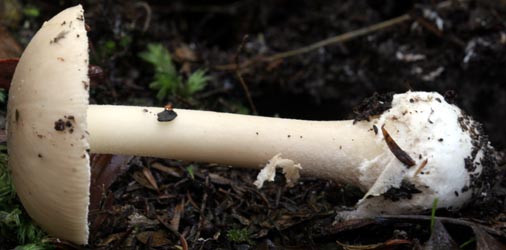 2. Amanita taiepa 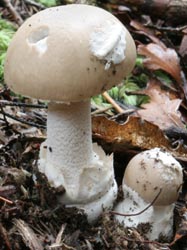 3. Amanita taiepa 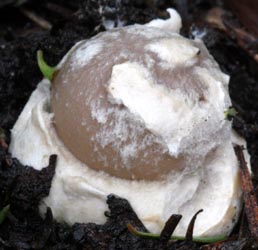 4. Amanita taiepa 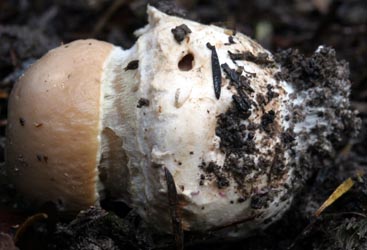 5. Amanita taiepa 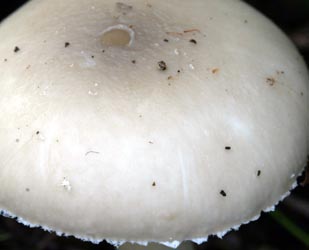 6. Amanita taiepa 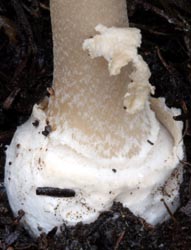 7. Amanita taiepa 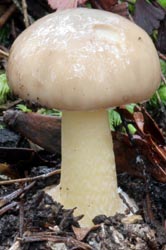 8. Amanita taiepa 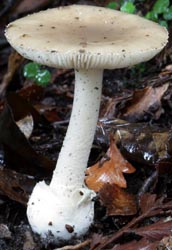 9. Amanita taiepa 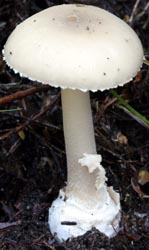 10. Amanita taiepa 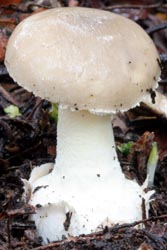 11. Amanita taiepa 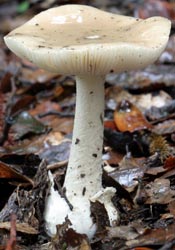 12. Amanita taiepa 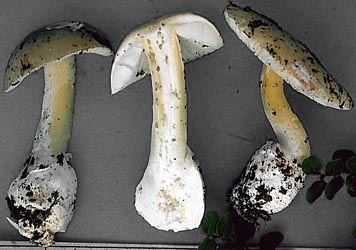 13. Amanita taiepa, Waimekamiri Rest Area, Canterbury, New Zealand. (RET 367-4). 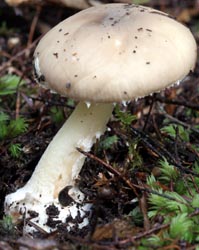 14. Amanita taiepa |
| intro |
Permission to quote extensively from the original description of this species (1991) was granted by its author, Dr. Geoffrey Ridley. The name is Maori for "fence" and refers to the limbate volva on the stem's basal bulb. |
| cap |
Amanita taiepa has a cap that is 14 - 76 mm wide and convex to planar. Its colors range from dark buff, vinaceous buff, or smoky gray in the center to pale yellow or buff at the margin, occasionally fawn. The cap is viscid when young or wet. The margin of the cap can be striate for up to 15% of the cap radius. The flesh of the cap is largely white with pale yellow to grayish buff below the cap's skin. The volva on the cap is white to buff and may take the form of "membranous scales and/or scattered floccose scurf"; it is occasionally absent. |
| gills |
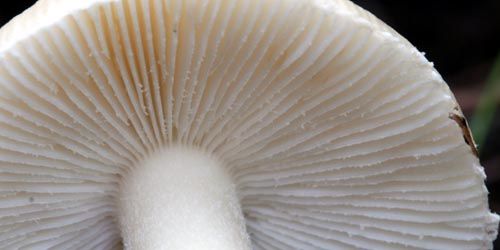
The gills of this species are free to narrowly attached, crowded, and white. They are 5 - 12 mm wide with a buff margin. Short gills are truncate to subtruncate to attenuate. |
| stem |
The stem is 30 - 110 × 4 - 14 mm with a prominent, white, bulbous base up to 34 mm wide. The stem is pale buff to honey or occasionally ochreous and smooth. There may be floccose fibrils near the top of the stem and some fine scales near the stem base. Infrequently the stem is viscid. The interior of the stem is hollow with flesh ranging from white to pale yellow. The volva on the bulb is in the form of an irregular limb. |
| odor/taste |
Odor and taste were not reported for this species. |
| spores |
The spores of this species measure 7.5 - 12 × 7.5 - 12 µm according to the original description and are globose to subglobose to (less frequently) broadly ellipsoid and inamyloid. RET's spore measurements from one paratype and from the Shirley collection are as follows: (7.5-) 8.4 - 10.6 (-11.8) × (6.1-) 7.0 - 8.6 (-9.5) µm; and nearly all spores were subglobose to broadly ellipsoid to ellipsoid. More than half of the spores measured were broadly ellipsoid. Clamps are present, but may be difficult to detect at the bases of basidia according to the original description. |
| discussion |
Amanita taiepa is found only in New Zealand in association with Nothofagus, Leptospermum, and Kunzea.
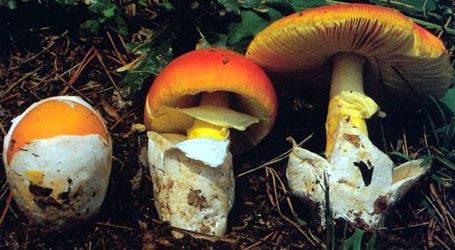
With regard to Karl Soop's photo (immediately above, upper) the yellow in the pileus and stipe, which clearly affects the external appearance of those parts of the mushroom seems to arise in the flesh. Since this is rather unusual in Amanita, it may be worth examing the possibility that this is related to the yellowing syndrome, which is usually seen in species of sect. Lepidella [see A. subsolitara (Murrll) Murrill].—R. E. Tulloss |
| brief editors | RET |

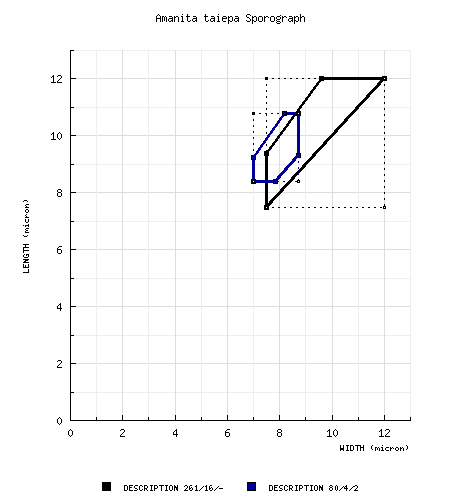
 Spore data sets and their composite