| name |
Amanita alboflavescens |
| author |
Hongo. 1970. Mem. Fac. Liberal Arts Shiga Univ.; 20: 50, fig. 27(7-9). |
| name status |
nomen acceptum |
| english name |
"East Asian Yellow-Staining Lepidella" |
| MycoBank nos. |
308533 |
| GenBank nos. |
Due to delays in data processing at GenBank, some accession numbers may lead to unreleased (pending) pages.
These pages will eventually be made live, so try again later.
|
| holotypes |
TNS [per Doi. 1991. Bull. Nat. Sci. Mus., Tokyo, Ser. B 17(2): 49] |
| type studies |
Yang and Doi. 1999. Bull. Natl. Sci. Mus. Tokyo B 25(3): 116-117, fig. 12. |
| revisions |
Z. L. Yang. 1997. Biblioth. Mycol. 170: 158, figs. 130-131. |
| selected illustrations |
Imazeki and Hongo. 1987. Color. Illus. Mushr. Japan 1: 131, pl. 33 (fig. 227). |
| intro |
The following text may make multiple use of each data field.
The field may contain magenta text presenting data from a type study
and/or revision of other original material cited in the protolog of the present taxon.
Macroscopic descriptions in magenta are a combination of data from the protolog and
additional observations made on the exiccata during revision of the cited original
material.
The same field may also contain black text, which is data from a revision of the present
taxon (including non-type material and/or material not cited in the protolog).
Paragraphs of black text will be labeled if further subdivision of
this text is appropriate.
Olive text indicates a specimen that has not been
thoroughly examined (for example, for microscopic details) and marks other places in the text
where data is missing or uncertain.
The following material is based upon the protolog of the present species, (Yang 1997), (Yang and Doi 1999), and original research by R. E. Tulloss.
NOTE: Spore measurements from papers by Z. L. Yang use his "Times New Roman" face for "Q" and "Q'"—respectively, "Q" and "Q." |
| pileus |
protolog: 40 - 65 mm wide, white then yellowing (to Buff-Yellow" or Naples Yellow or Cream Color), convex, then planar, dry; context white, yellowing when damaged, thick in disc, thin at margin; margin nonstriate, appendiculate at first; universal veil white to whitish to yellowish, as furfuraceous covering and/or as rather densely distributed irregular floccose-membranous warts and patches [per fig. 7—ed.]. |
| lamellae |
protolog: free but with subdecurrent tooth, subdistant to subcrowded, whitish then cream, yellowing when damaged, 5 - 7 mm broad, ventricose, with farinose edge; lamellulae truncate. |
| stipe |
protolog: 50 - 70 × 8±, white then yellowing, pruinose at apex, floccose-squamulose below; bulb 18 - 23 mm wide, obovate to fusiform-radicate; context solid; partial veil superior, thick, floccose-membranous, finely striate [above?], friable, white then yellowing; universal veil floccose-membranouse, white then yellow, evanescent. |
| odor/taste |
protolog: Odor marked. Taste mild. |
macrochemical
tests |
none recorded. |
| lamella trama |
protolog: bilateral. |
| basidia |
protolog: 24 - 30 × 9 - 10 μm, 4-sterigmate.
Yang and Doi (1999): 36 - 40 × 8 - 11 μm, dominantly 4-, sometimes 2-sterigmate; clamps status uncertain.
Yang (1997): 38 - 46 × 9 - 10 μm, 4-sterigmate, with sterigmata up to 3 μm long; clamps status uncertain. |
| universal veil |
protolog: On pileus: filamentous hyphae 2.5 - 7.5 μm wide, branching, hyaline, colorless; inflated cells 18 - 38 μm wide, ellipsoid to pyriform to broadly clavate, terminal singly or in short chains. |
| lamella edge tissue |
protolog: inflated cells 25 - 40 × 13 - 19 μm, subglobose to subellipsoid to clavate, thin-walled. |
| basidiospores |
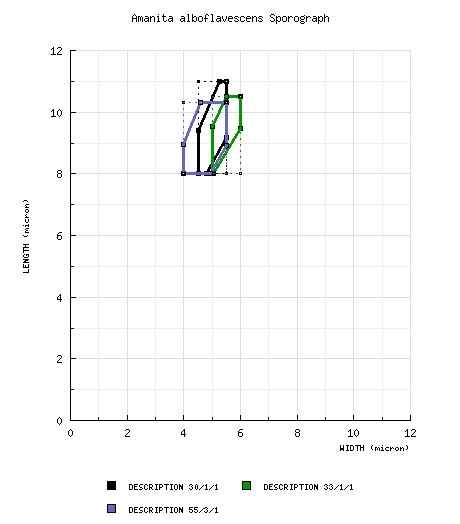
Yang and Doi (1999): [30/1/1] 8.0 - 11.0 (-13.0) × (4.0-) 4.5 - 5.5 (-6.5) μm, (Q = (1.63-) 1.67 - 2.09 (-2.12); Q = 1.88 ± 0.16), hyaline, colorless, smooth, thin-walled, amyloid, elongate, [occasionally cylindric—ed.]; apiculus small.
Yang (1997): [33/1/1] (7.5-) 8.0 - 10.5 (-11.5) × (4.5-) 5.0 - 6.0 μm, (Q = (1.52-) 1.58 - 1.91 (-2.30); Q = 1.72 ± 0.14), mostly elongate, occasionally ellipsoid or subcylindric, [rarely cylindric—ed.]; apiculus small.
composite of data from all material revised by RET: [55/3/1] (7.7-) 8.0 - 10.3 (-11.0) × (3.6-) 4.0 - 5.5 (-6.0) μm, (L = 8.7 - 9.4 μm;/ L' = 9.2 μm; W = 4.4 - 5.0 μm; W' = 4.8 μm; Q = (1.40-) 1.62 - 2.24 (-2.39); Q = 1.88 - 2.0; Q' = 1.92 ± 0.21), elongate to cylindric, rarely ellipsoid, hyaline, colorless, amyloid, smooth, thin-walled, adaxially flattened, sometimes sinuate, occasionally constricted, occasionally subclatave; apiculus sublateral; contents ??; ?? in deposit.
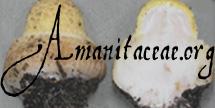
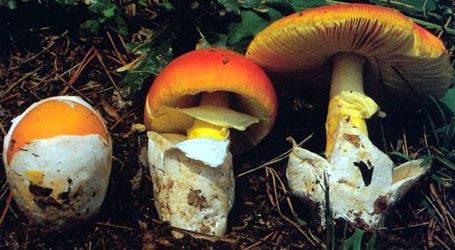
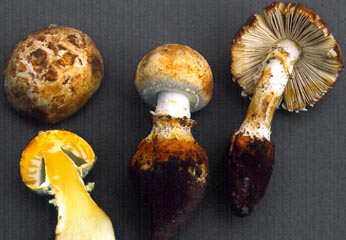
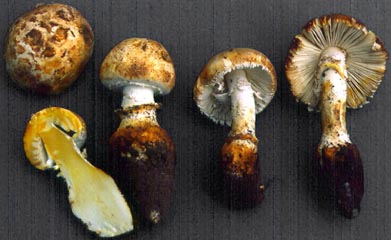
[Note: While work is not complete, RET suggests that the abnormal forms of some spores and the range of size and shape suggest that the material illustrated in Arora's photographs on this taxon page may represent an Amanita exhibiting the "yellowing syndrome."] |
| ecology |
Solitary to scattered. Japan: In forest under Quercus acutissima, Q. glauca, etc. or in Pinus densiflora-Q. serrata forest. |
| material examined |
protolog: JAPAN: HONSHU—Shiga-ken - Ôtsu-shi, Kamidanakami-Dô, 18.ix.1969 Hongo 4014 (holotype, in herb. T. Hongo => TNS F-237274); Ôtsu-shi, Mt. Tanakami, 20.viii.1966 Hongo 3281 (paratype, in herb. T. Hongo).
type study of Yang and Doi (1999): JAPAN: HONSHU—Shiga-ken - Ôtsu-shi, Kamidanakami-Dô, 18.ix.1969 Hongo 4014 (holotype, in herb. T. Hongo => TNS F-237274).
Yang (1997): CHINA: YUNNAN—Chuxiong Yi Autonomous Prefecture - Unkn. Co., Jishan, 24.viii.1983 W. K. Zheng 8349 (HKAS 12053).
RET: CHINA: YUNNAN—Chuxiong Yi Autonomous Prefecture - Lufeng Co., unkn. loc., 2.viii.2002 D. Arora 02-43 (RET 357-3; SFSU). |
| discussion |
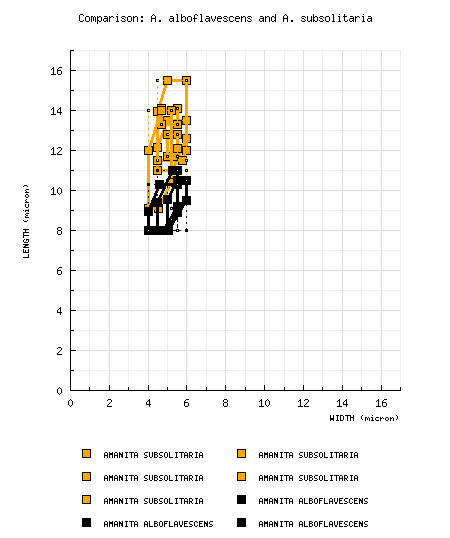
In the protolog, Hongo compared the present species with A. crassifolia Bas nom. prov. (now considered to be based on material of A. subsolitaria exhibiting the "yellowing syndrome"). The spores of A. subsolitaria are markedly longer and, hence, proportionatly narrower than those of the present species as can be seen in the comparison of sporographs in the following figure:
The Japanese name for this species is "ki-uroko-tengutake" (Doi 1991). |
| citations |
Translations from Latin and German by RET.—Zhu L. Yang, R. E. Tulloss |
| editors |
RET |
|




 Spore data sets and their composite