| name |
Limacella sp-Wallace-MO46000 |
| name status |
cryptonomen temporarium |
| GenBank nos. |
Due to delays in data processing at GenBank, some accession numbers may lead to unreleased (pending) pages.
These pages will eventually be made live, so try again later.
|
| intro |
Olive text indicates a specimen that has not been
thoroughly examined (for example, for microscopic details) and marks other places in the text
where data is missing or uncertain.
The following material is based upon original research by Michael Wallace first presented at www.mushroomobserver.org/46000. |
| pileus |
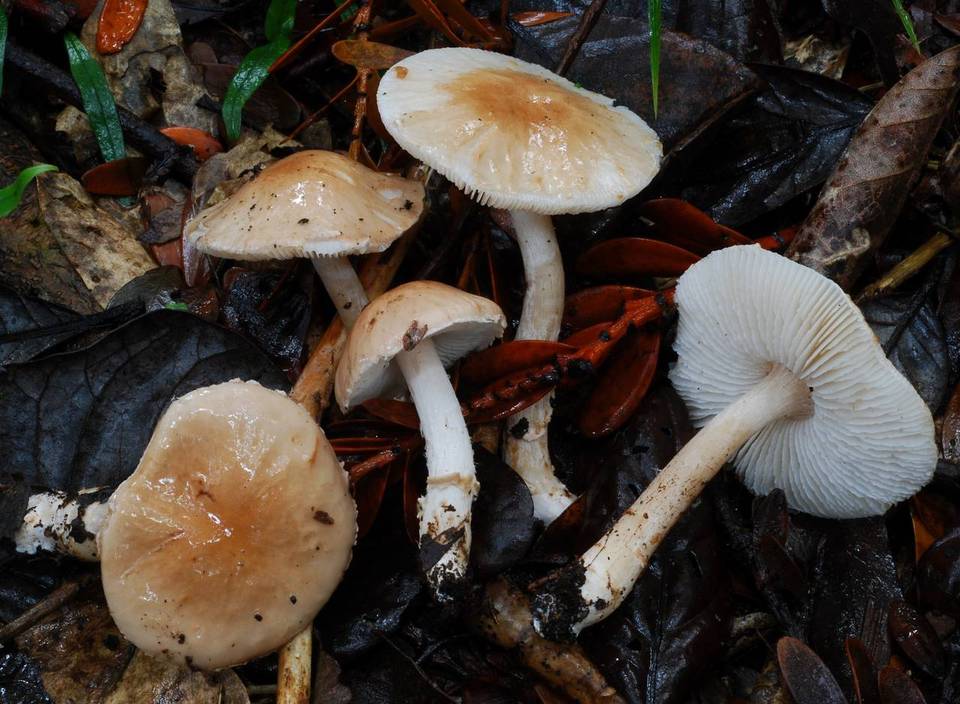
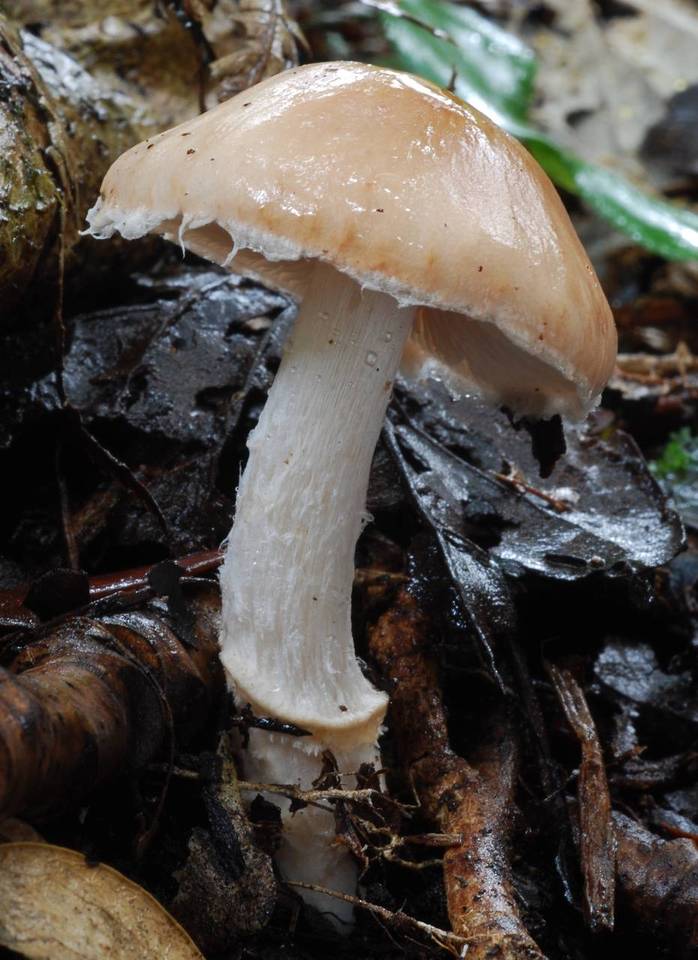
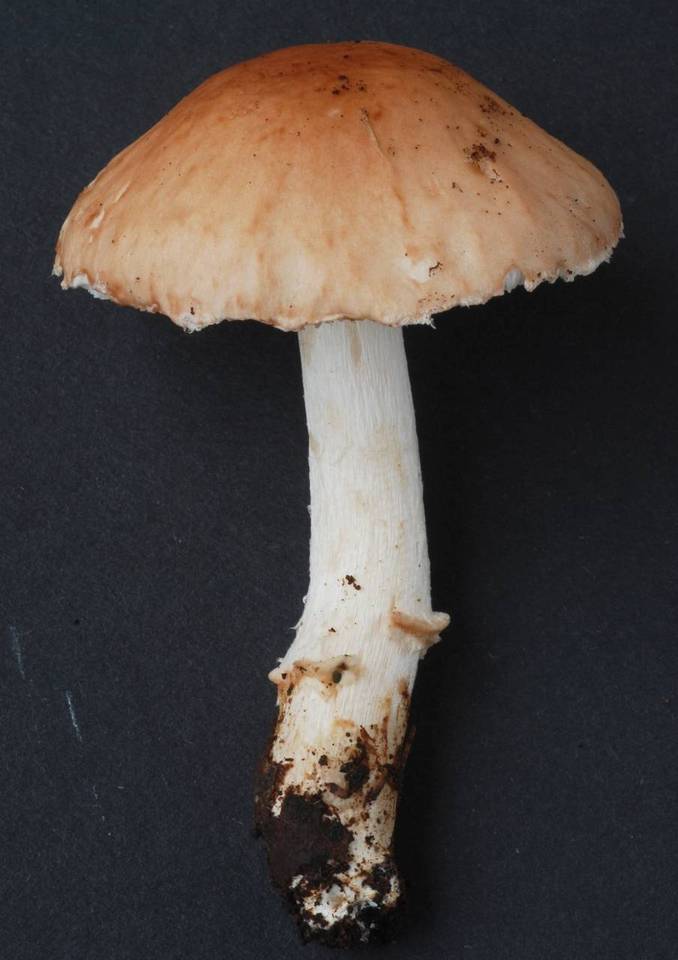
45 - 60 mm wide, convex to plano-convex, pale yellowish brick-brown, darker towards disk, paler towards margin, viscid to glutinous when wet, finely pubescent on drying, with gluten and mass of gluten-supporting hyphae splitting in aged specimens and then exposing context; context white, ??; margin non-sulcate, exceeding lamellae, appendiculate with fine, loosely interwoven, fibrillose material in young specimens. |
| lamellae |
free, close, white to pale cream or buff, subventricose in mature specimens, ?? mm broad, with margin entire (wavy [or eroded??] in mature specimens); lamellulae ??. |
| stipe |
50 - 70 × 7 - 15 mm, narrowing upward, subclavate, white to pale buff, concolourous with lamellae; bulb lacking??; context solid, cartilaginous; partial veil median, arachnoid, fugacious and only visible in young specimens, leaving remnants on pileus margin and just above stipe base in young specimens, with latter remnants bearing ring of gluten concolourous with gluten on pileus, but slightly more yellow.
[Note: The glutinous ring on the young stipe is probably a part of the gluten layer that developed attached to the partial veil and/or the incurved edge of the cap. One of the hypotheses of Reijnders was that the arachnoid partial veil in section Limacella at least partially is an extension of the hyphae of the gluten layer that grows toward and connects with the stipe (this seals off the cavity into which the gills grow (downward from the underside of the pileus context). One of the things that needs to be done is to clarify how we talk about the partial veil and the gluten layer. Do we treat them as complete and separate entities in the "adult" mushroom? Do we treat them as a stage in a complex development process?—RET] |
| odor/taste |
?? |
macrochemical
tests |
?? |
| pileipellis |
absent?? |
| pileus context |
?? |
| lamella trama |
bilateral (divergent); ?? |
| subhymenium |
?? |
| basidia |
32 × 6.5 µm, 4-spored, clavate; clamps ??. |
| gluten layer |
On pileus: Gluten supporting hyphae anticlinal, branching, comprising cylindrical and ??inflated, gelatinized?? segments encrusted with a yellowish-brown pigment, often constricted at septa; terminal cells cylindric with rounded apex, 20 - 35 × 5 - 12 µm, with length/width ratio = 2.9 - 4.0; with basal septa ?? - ?? μm; clamp connections present. On stipe: ?? |
| stipe context |
longitudinally acrophysalidic; filamentous, undifferentiated hyphae ?? μm wide, ??; acrophysalides ??cylindric??, predominantly in chains in mature material, 75 - 402 × 15 - 25 μm, with avg. length = 177 µm, with avg. width = 20 µm; vascular hyphae ??; clamp connections present. |
| partial veil |
?? |
| lamella edge tissue |
fertile?? |
| basidiospores |
[12/1/1] 5.0 - 6.0 × 5.0 - 5.6 (-6.0) µm, (L = 5.5 µm; W = 5.3 µm; Q = 1.0 - 1.08; Q=1.04), hyaline, colorless, ??wall thickness??, ??inamyloid or dextrinoid or??, punctate, globose to subglobose; apiculus conspicuous, up to 1.0 µm long; contents ??view in dilute KOH or ammonium??; white in deposit. |
| ecology |
Solitary or in pairs. On soil under Vitex lucens, Rhopalostylis sapida, Agathis australis, Dysoxylum spectabile, Cyathea dealbata, and Beilschmiedia tarairi. |
| material examined |
NEW ZEALAND: AUCKLAND—Orewa, 27.v.2010 M. Wallace s.n. [Mushroom Observer 46000] (in herb. M. Wallace; RET). |
| discussion |
?? |
| citations |
—R. E. Tulloss and M. Wallace |
| editors |
RET |
|




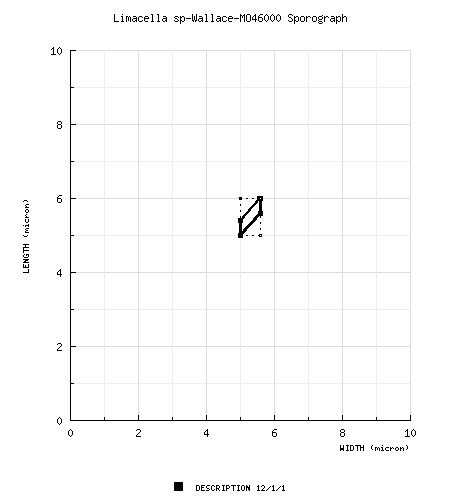
 Spore data sets and their composite