| name |
Limacella sp-L-IL01 |
| author |
Tulloss & Kuo |
| name status |
cryptonomen temporarium |
| GenBank nos. |
Due to delays in data processing at GenBank, some accession numbers may lead to unreleased (pending) pages.
These pages will eventually be made live, so try again later.
|
| intro |
Olive text indicates a specimen that has not been
thoroughly examined (for example, for microscopic details) and marks other places in the text
where data is missing or uncertain.
Information below comes From annotation of fresh material by M. Kuo and revision by RET and CRC. DNA sequencing was performed under the direction of Dr. József Geml. |
| pileus |
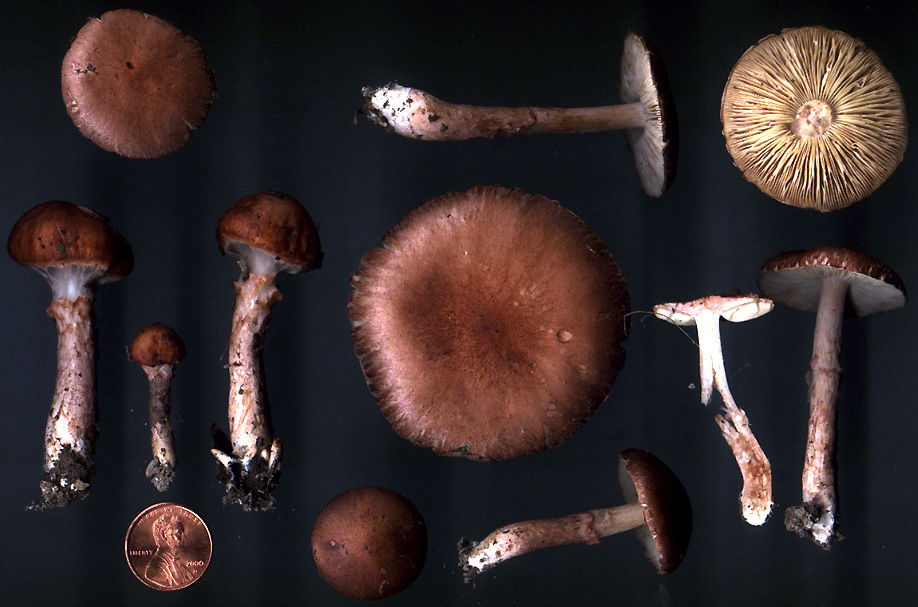
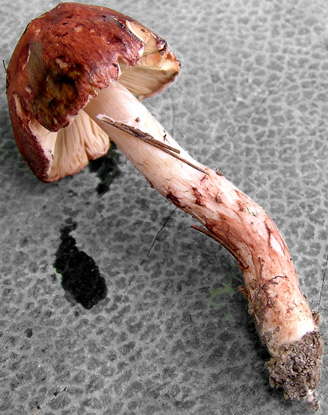
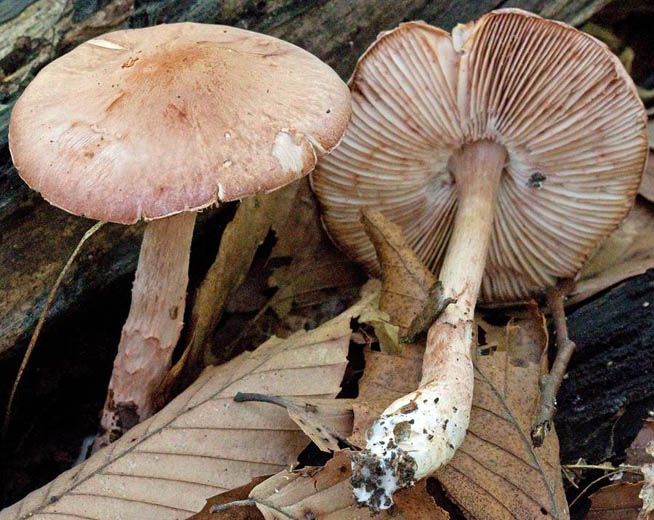
20–60 mm wide, rose-brown to reddish brown to brownish-red, red more dominant at first, sometimes subvirgate, convex becoming planoconvex, smooth to finely fibrillose, viscid at first, later dry; context whitish except pinkish in upper part, "thick" over stipe; margin nonstriate, incurved even in age, becoming rimose with age; gluten ??. |
| lamellae |
free or narrowly attached, close, white to off-white, becoming cream and spotted with pink; lamellulae plentiful. |
| stipe |
30–100 x 5–10 mm (apex), whitish at apex, elsewhere with ground color whitish or pinkish, narrowing upward to subcylindric, slightly enlarged at base, smooth above annular zone, shaggy with reddish pink scales or reddish-brownish peronate in zones below (and separated from) annular zone; bulb ??; context whitish, becoming pink in stipe base; partial veil, superior, fragile, cortinate, gluten coated, fragmenting, whitish to pinkish; gluten ??. |
| odor/taste |
Odor and taste farinaceous. |
macrochemical
tests |
KOH - on pileus, olive-gray; on flesh, yellowish. |
| pileipellis |
absent. |
| lamella trama |
bilateral, divergent; ??. [Note: Difficult to rehydrate in material examined.—ed.] |
| basidia |
?? × ?? μm, 4-sterigmate, with sterigmata up to ?? × ?? μm; clamps common at bases of basidia. |
| gluten layer |
On pileus, in older material: gluten layer 25 - 35 μm thick, colorless; ??. |
| stipe context |
longitudinally acrophysalidic; filamentous undifferentiated hyphae 2.0 - 13.0 μm wide, with the broadest having walls up to 0.5 μm thick, plentiful to dominating, dominating exclusively near surface, branching, ??; acrophysalides up to 284 × 17.5 μm relatively common locally away from surface, with broadest having walls thickened as in filamentous hyphae; vascular hyphae apparently present ??; clamps relatively common. |
| partial veil |
absent in material examined. |
| lamella edge tissue |
fertile. |
| anatomical figures |
|
| basidiospores |
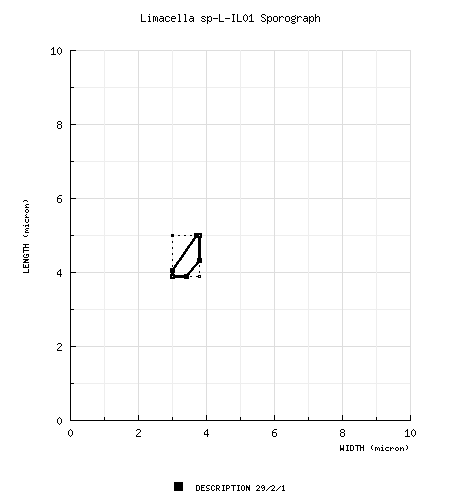
[29/2/1] (3.6-) 3.9 - 5.0 (-5.5) × (2.9-) 3.0 - 3.8 (-4.5) μm, (L = 4.2 - 4.4 μm; L' = 4.3 μm; W = 3.4 - 3.5 μm; W' = 3.4 μm; Q = (1.09-) 1.14 - 1.35 (-1.48); Q = 1.24 - 1.26; Q' = 1.25), hyaline, colorless, often smooth, occasionally minutely verruculose, thin-walled, inamyloid, broadly ellipsoid to ellipsoid, occasionally subglobose, often at least somewhat adaxially flattened; apiculus cylindric, sublateral; contents mono- to multiguttulate or granular; white in deposit. |
| ecology |
Solitary to scattered. Illinois: Under Pinus
resinosa in plantation (Kuo 08290201) or in leaf
litter under mixed hardwoods including Robinia,
Fraxinus, Quercus, Carya,
Cornus, and Acer with P. resinosa and
P. strobus nearby (Kuo 07220705). |
| material examined |
U.S.A.: ILLINOIS—Coles Co. -
Fox Ridge St. Pk., 22.vii.2007 M. Kuo 07220705 (in herb.
M. Kuo; RET, nrITS & nrLSU seq'd.). Piatt Co. -
Monticella, Lodge Pk., 29.viii.2002 M. Kuo 08290201 (in
herb. M. Kuo; RET, nrITS & nrLSU seq'd.).
INDIANA—Montgomery Co. - Waveland, Shades St.
Pk. [39.9378° N/ 87.0894° W, 223 m], 28.viii.2012 Stephen
Russell s.n. [mushroomobserver #107737]
(RET 532-10, nrLSU seq'd.). |
| discussion |
A sporograph comparison of the present species with
material identified as A. glischra is provided
here:
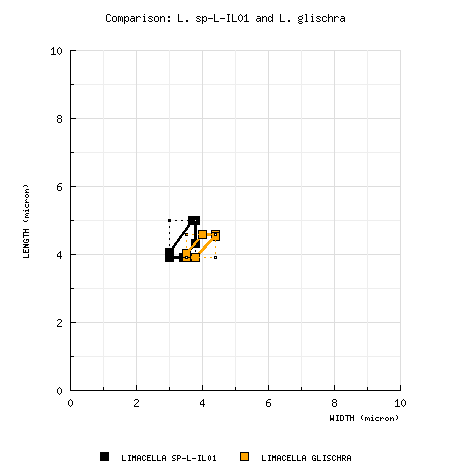
Unfortunately, Kuo 07220705 is immature and no spores
could be found on it. The conspecifity of the two
collections is supported by other morphology and by
nrITS and nrLSU sequence data. |
| citations |
—R. E. Tulloss, M. Kuo, J. Geml, C. Rodríguez Caycedo |
| editors |
RET |
|




 Spore data sets and their composite