| name |
Limacella glischra |
| author |
(Morgan) Murrill. 1914a. N. Amer. Fl. 10:41. |
| name status |
nomen acceptum |
| english name |
"Red-brown Slimy Stem Limacella" |
| synonyms |
≡Lepiota glischra Morgan. 1906. J. Mycol. 12: 203.
The editors of this site owe a great debt to Dr. Cornelis Bas
whose famous cigar box files of Amanita nomenclatural information
gathered over three or more decades were made available to RET for computerization
and make up the lion's share of the nomenclatural information presented on this site.
|
| MycoBank nos. |
530307, 191107 |
| GenBank nos. |
Due to delays in data processing at GenBank, some accession numbers may lead to unreleased (pending) pages.
These pages will eventually be made live, so try again later.
|
| holotypes |
no type designated. |
| selected illustrations |
Miller. 1972. Mushr. N. Amer.: pl. 17. [Note that associated text appears to confuse the present species with L. kauffmanii.]
McKnight and McKnight. 1987. Field Guide Mushr. N. Amer.: pl. 24 [bottom right]. [Note that associated text confuses the present species with L. kauffmanii.]
Kibby. 1993. Illus. Guide Mushr. Fungi N. Amer.: 93 [bottom]. [As L. glioderma.] |
| intro |
The following text may make multiple use of each data field.
The field may contain magenta text presenting data from a type study
and/or revision of other original material cited in the protolog of the present taxon.
Macroscopic descriptions in magenta are a combination of data from the protolog and
additional observations made on the exiccata during revision of the cited original
material.
The same field may also contain black text, which is data from a revision of the present
taxon (including non-type material and/or material not cited in the protolog).
Paragraphs of black text will be labeled if further subdivision of this text is appropriate.
Olive text indicates a specimen that has not been
thoroughly examined (for example, for microscopic details) and marks other places in the text where data is missing or uncertain.
The following material is based on collector's notes and original research of R. E. Tulloss. |
| pileus |
from protolog: 30 - 40 mm wide, brown, darker in center, subovoid then convex and expanded; context rather thin, white, fleshy; margin ?; gluten layer brown, continuous with "marginal veil" and gluten on stipe.
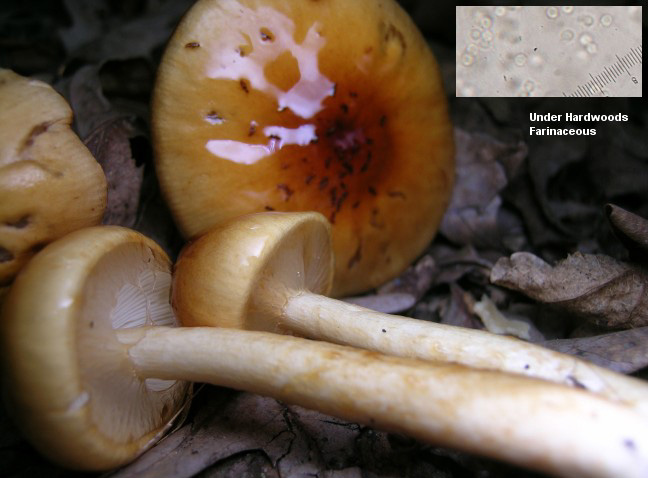
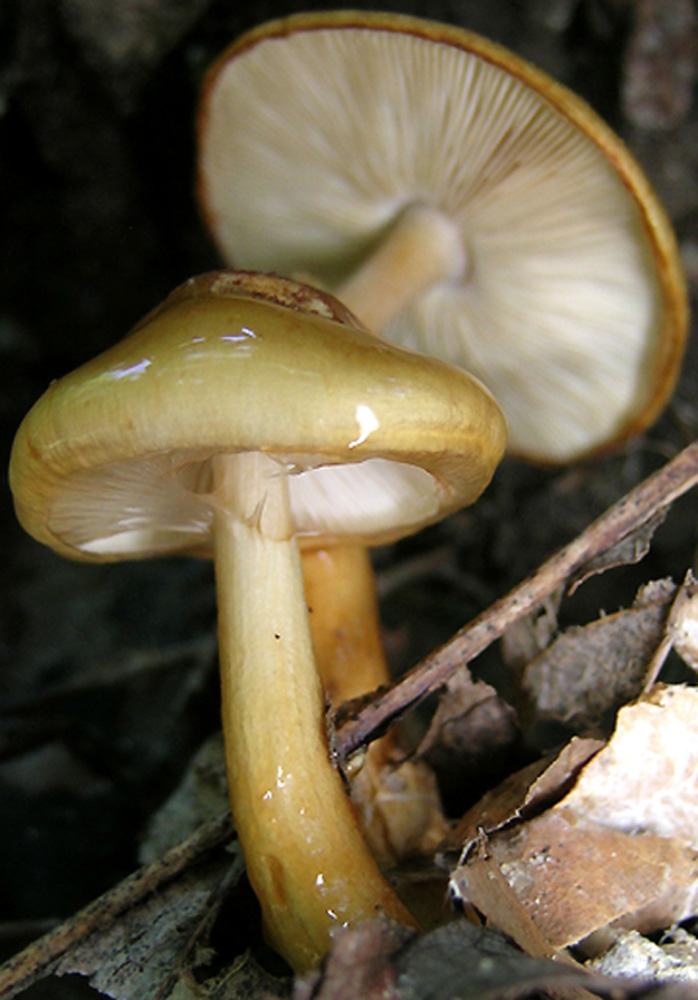
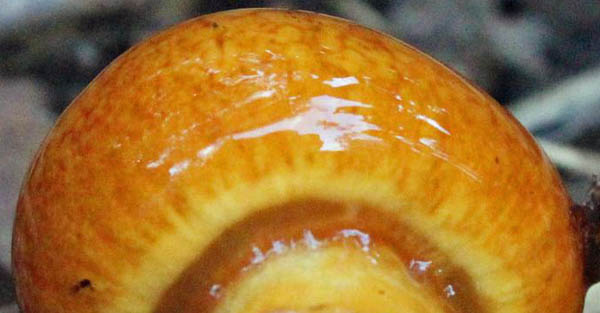
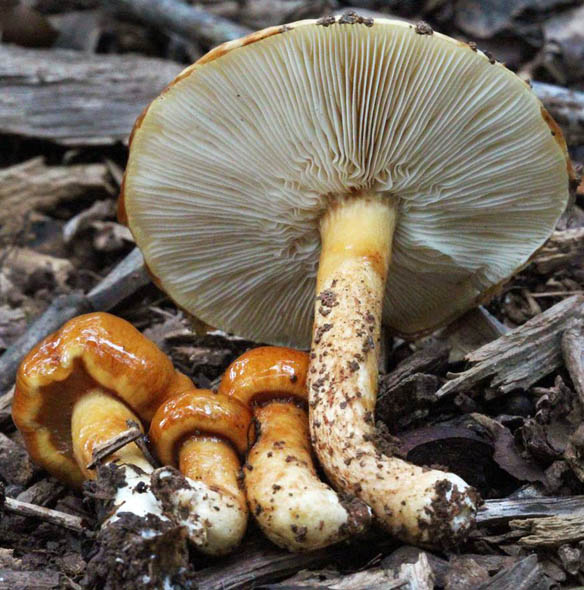
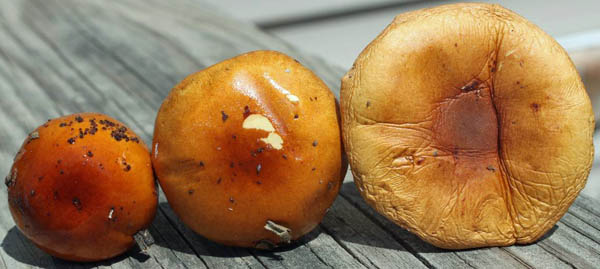
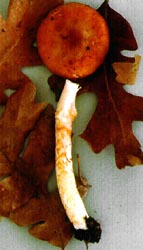
22 – 52 mm wide, reddish brown, fading to rufus or fulvous with reddish brown disc after collection [no good matches in Munsell (1975)], in Kuo 07020702 brownish yellow without visible red tint (leaving yellow stain on waxed paper), in Braaten s.n. mottled orange and yellow, apparently not changing color when bruised, broadly convex to planar, often subumbonate or with low broad central umbo at least at first, glutinous; context white or whitish or off-white, unchanging when cut or bruised, sometimes with dark line above lamellae, very palely concolorous with gluten in very narrow region below gluten layer, 2.5 mm thick above stipe, thinning evenly for one half to two-thirds R, thence of constant thickness (or thinning very slowly) to margin; margin very slightly incurved, nonstriate or faintly striate here and there, exceeding ends of lamellae by 1± mm; gluten layer orangish tan, reddish brown over disc, very pallid near and at margin, source of pileus pigmentation, with gluten-supporting hyphae, and probably hyphae from upper context together peeling to disc. |
| lamellae |
from protolog: free, close, white, rounded behind, approximate, broad; lamellulae not described.
free to very narrowly adnate, close to crowded, off-white to pale yellowish cream in mass (except sometimes palely concolorous gluten pile on pileus near pileus margin), in side view pallid and water soaked or off-white near edge and pale yellowish to pale tannish white near pileus context, apparently not changing color when bruised, subventricose, 5- mm broad, proportionately rather thick, with somewhat uneven wavy edge; lamellulae irregularly attenuate to attenuate, very plentiful, of diverse lengths (about half very short), somewhat unevenly distributed (sometimes 2 between pair of lamellae, sometimes 4 or 5, sometimes none). |
| stipe |
from protolog: 40 - 60 × 3 - 4 mm, whitish and fibrillose under gluten, narrowing upward; context solid; bulb not mentioned; partial veil not mentioned; gluten layer brown, continuous with that on pileus.
28 – 84 × 2.5 – 10 mm, with pallid ground color, with streaky red-brown gluten (later visible as red-brown fibrils) over approximately middle third below partial veil to lower half or lower two-thirds of stipe, cylindric or very slightly narrowing upward, barely flaring at apex, glutinous, with white base blunt to narrowly clavate and decorated with white mycelial threads; bulb lacking; context solid, white below, off-white with fine longitudinal watery streaks above, sometimes with rufus tint near surface; partial veil as fibrillose (somewhat tufted) annular zone, superior, white above, reddish or pinkish brown on part most distant from stipe; gluten layer concolorous with that on pileus covering stipe below last point of contact with pileus, coloring most intense in complete undulant ring adjacent to, and below, annular zone. |
| odor/taste |
Odor like cucumber or medicinal or mildly unpleasant, sometimes rather strong when pileal gluten pile "peeled." Taste not recorded. |
macrochemical
tests |
Spot test for laccase (syringaldazine) - In mature material, strongly positive in disc and stipe base in about 1 min; after 2 min positive throughout pileus context, on edges of lamellae, and in apical and basal thirds of stipe; beginning to fade about 8 min after application of reagent.
Spot test for tyrosinase (paracresol) - negative throughout mature basidiome, except for possible faint positive in disc.
KOH - no reaction on pileus.
Test vouchers: Kuo 07020702, 08260501; Tulloss 6-18-95-A. |
| pileipellis |
absent. |
| lamella trama |
bilateral; ??. |
| gluten layer |
On pileus: with gluten pigment dissolving?? in de-ionized water; gluten-supporting filamentous undifferentiated hyphae with nonterminal segments 3.5–8.0 µm wide, branching, with terminal cells 24–58 × 1.8–5.5 (–10.5)? µm, with 1.5–3.8 µm wide basal septum??, with length/max.-width ratio = 2.4–20, at first erect in compacted (“turf-like”) arrangement, in age or during/after heavy rains collapsing in disordered fascicles (coparallel or criss-crossing), eventually gelatinizing, narrowly clavate, narrowly subfusiform, often constricted in one or more places, sometimes subcapitulate, frequently constricted at base; vascular hyphae, infrequent, up to 6.1 µm wide; clamps plentiful. On stipe: ??. |
| stipe context |
longitudinally acrophysalidic; filamentous undifferentiated hyphae 4.1 – 7.9 µm wide, sometimes yellowish and subrefractive, common to dominating, with intercalary inflated cells having form of acrophysalides (up to 34?? µm wide); acrophysalides 92 – 106 × 10.5 – 21 µm; vascular hyphae not observed; clamps plentiful. |
| lamella edge tissue |
fertile. |
| basidiospores |
from protolog: [-/-/-] 4 - 5 × 4 μm, globose to "ovoid," "apiculate."
RET: [20/1/1] (3.6–) 3.9 – 4.6 (–5.3) × 3.5 – 4.4
(–5.0) µm, (L = 4.3 µm; L’ = 4.3 µm;
W = 3.9 µm; W’ = 3.9 µm; Q = 1.03 –
1.15 (–1.17); Q = 1.10; Q’ = 1.10),
hyaline, colorless, thin-walled, smooth, mostly
inamyloid, some apparently dextrinoid (in Tulloss
6-18-95-A), globose to subglobose, infrequently
broadly ellipsoid, often at least slightly adaxially
flattened; apiculus sublateral, cylindric;
contents multi- or monoguttulate;
?? in deposit. |
| ecology |
from protolog: In rich soil in woods, Preston, Ohio, U.S.A.
RET: Costa Rica: Solitary. At 1300 m
elev. By road in primary forest including
scattered Quercus. Arizona, U.S.A.:
Solitary. At 2090 m elev. In mixed
forest including Juglans major, Pinus
engelmannii, P. arizonica, Pseudotsuga
menziesii, and Quercus gambelii.
Illinois, U.S.A.: Scattered. In ravine under
Platanus occidentalis with
Quercus-Carya understory, with
mycelium binding leaf litter. Indiana:
Under Prunus.
New Jersey, U.S.A.: On splintered would at base of
fallen tree. Tennessee, U.S.A.: On soil
under hardwoods. |
| material examined |
COSTA RICA:
PUNTARENAS—Ctn. Coto Brus - La Amistad,
Hacienda La Amistad, Fila Palmital
[8°54’45” N/ 82°46’58” W], 18.vi.1995 R. E. Halling
& R. H. Petersen s.n. [Tulloss 6-18-95-A]
(RET 330-2; USJ).
U.S.A.:
ARIZONA—Cochise Co. - CMP site #10,
23.viii.1994 R. E. Tulloss 8-23-94-A [CMP3308]
(RET 143-4).
ILLINOIS—Coles Co. - Fox Ridge St. Pk.,
26.viii.2005 Michael Kuo 08260501 (in herb. M. Kuo;
RET. nrITS seq'd.), 2.vii.2007 M. Kuo 07020702 (in
herb. M. Kuo, nrITS & nrLSU seq'd.).
INDIANA—Grant Co. - Marion [40.5442° N/
85.6385° W, 200-250 m] 8.ix.2012 Stephen Russell
s.n. [mushroomobserver #109357]
(RET 540-4, nrITS & nrLSU seq'd.). Henry
Co. - Summit Lake St. Pk. [40.0147° N/
85.3142° W, 330 m], n.d. S. Russell s.n.
(RET 540-8, nrITS & nrLSU seq'd.). Monroe
Co. - , Bloomington, Leonard Springs [39.1104° N/
86.0880° W, 286 m], 16.ix.2012 S. Russell s.n.
[mushroomobserver #110010]
(540-2, nrITS & nrLSU seq'd.); Bloomington,
Winslow Woods [39.1418° N/ 86.5194° W, 220-230 m],
22.vii.2012 S. Russell s.n. [mushroomobserver #102431]
(RET 540-9, nrITS & nrLSU seq'd.).
Montgomery Co. - Waveland, Shades St. Pk.
[39.9378° N/ 87.0894° W, 223 m], 29.viii.2012 S.
Russell s.n. [mushroomobserver #107660]
(RET 540-6, nrITS & nrLSU seq'd.), 28.viii.2012
S. Russell s.n. [mushroomobserver #107655]
(RET 540-3, nrITS & nrLSU seq'd.). Owen
Co. - Spencer, McCormick's Creek St. Pk. [39.2982°
N/ 86.7217° W, 218 m], 15.ix.2012 S. Russell s.n.
[mushroomobserver #109776]
(540-7, nrITS & nrLSU seq'd.).
MISSOURI—Cape Girardeau Co. - Jackson,
Trail of Tears St. Pk., Old Shepard Hill Trailhead
[37.4634° N/ 89.4612° W, 111 m], 23.vi.2012
Jay Justice MO-LIM-2 (RET 502-8, nrITS & nrLSU
seq'd.). St. Louis Co. - Forest 44 Conservation Area
[38.5230º N/ 90.5329º W, 178 m], 20.viii.2017 Patrick
Harvey s.n. [mushroom observer
#287379]
(RET 795-3, nrLSU & rpb2 seq'd.).
Unkn. Co. - ca. Meramec St. Pk.,
16.vii.2011 unkn. coll. [J. Justice MO-LIM-1]
(RET 502-3, nrITS seq'd.).
NEW JERSEY—Hunterdon Co. -
unkn. loc., 15.vii.2016 Tom Bigelow s.n.
(RET 779-10).
TENNESSEE—Monroe Co. - Venore,
Kahite Trail [35.5618°
N/ 84.2371° W, 259 m ], 17.vii.2012 Christine
Braaten s.n. [mushroomobserver #101796]
(RET 509-9, nrITS & nrLSU seq'd). |
| discussion |
ROUGH NOTES ONLY
Additional material: In WTU, there are 3 collections.
Moser’s illustration is of IB 88/177.
RET could not confirm the observation by H.V. Smith (1945) of fine punctate decoration to the spore wall in Melzer’s reagent or in 3% KOH when viewed at 1250× either with normal bright field or with Nomarski DIC.
Any information here? Mycologia 56: 624. |
| citations |
—R. E. Tulloss and M. Kuo |
| editors |
RET |
|



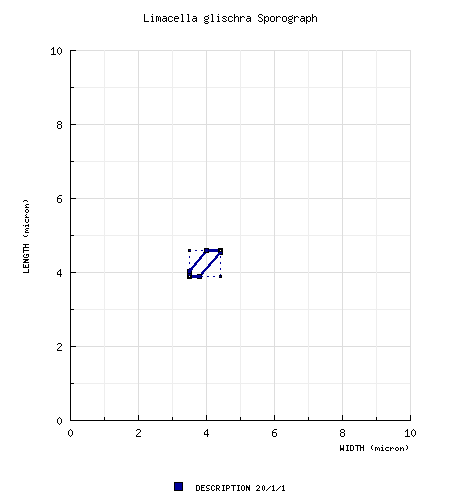
 Spore data sets and their composite