| name |
Amanita zayantensis |
| author |
C. F. Schwartz ex C. F. Schwartz, Tulloss, D. Arora,
S. D. Russell, G. Wright, et al. |
| name status |
nomen provisorum |
| etymology |
Zayante (town, creek, and fault in Santa Cruz Co.,
California) + -ensis, "occurring in" |
| GenBank nos. |
Due to delays in data processing at GenBank, some accession numbers may lead to unreleased (pending) pages.
These pages will eventually be made live, so try again later.
|
| selected illustrations |
Arora. 1986.
Demystified, 2nd ed.: 274 & pl. 54.
Bunyard and Justice (2020): 241. |
| intro |
Olive text indicates a specimen that has not been
thoroughly examined (for example, for microscopic details) and marks other places in the text
where data is missing or uncertain.
The following material not directly from Arora
(1986) is
based on molecular work by Stephen Russell and on other
original research by R. E. Tulloss, Christian Schwarz,
David Arora, and Greg Wright. |
| pileus |
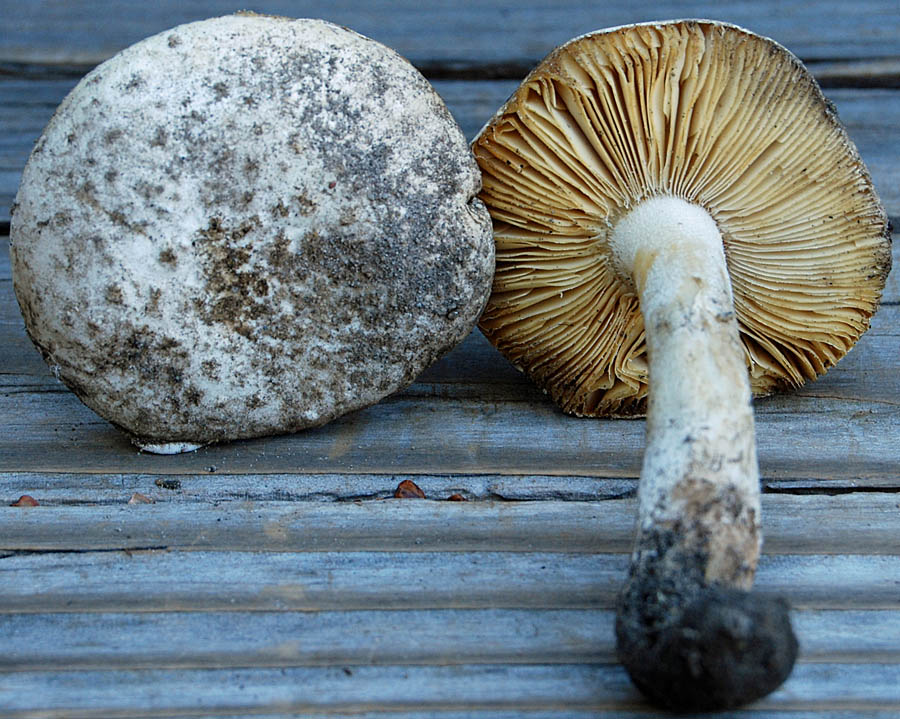
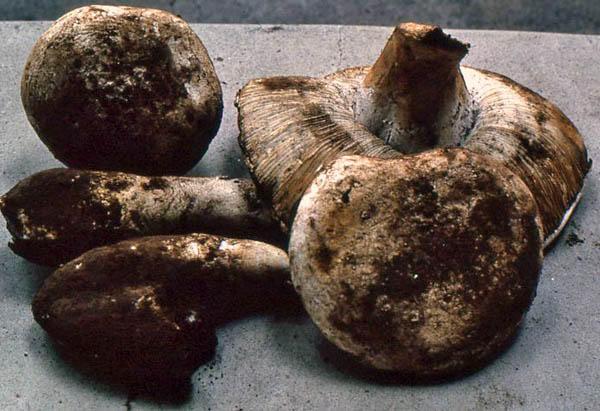
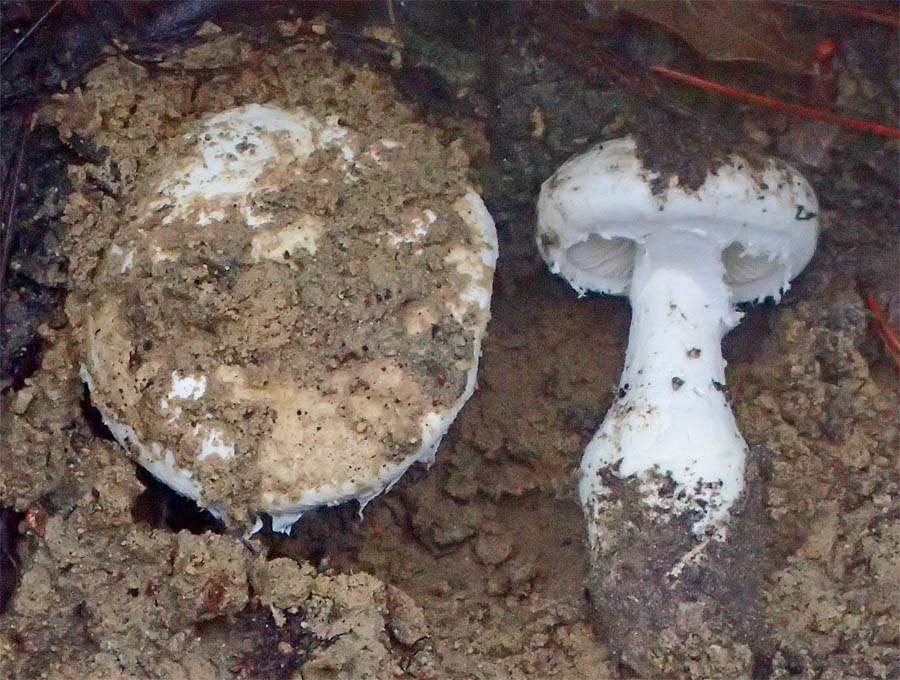
40 - 100 (-120) mm wide, white, unchanging when cut or bruised, sometimes discoloring buff with age, convex in button, then unevenly broadly convex, becoming irregularly subapplanate, with disc eventually somewhat depressed, dull when dry, tacky to viscid when moist; context white, becoming faintly yellowish in old material, soft, 9- - 11 mm thick, thinning evenly to margin; margin appendiculate with flaps of submembranous to subfelted material (becoming more felted with in situ drying), nonstriate; universal veil as white mealy to powdery warts or flat patches, or simply as thin layer of loosely woven fibrils, detersile in age, with cap surface apparently receding from areas covered by warts. |
| lamellae |
narrowly adnate or sinuate, occasionally free, with faint decurrent lines on stipe apex, close, in mass sordid white, in side view sordid pale cream to sordid buff to sordid cream in button and sordid yellowish cream at maturity (distinctly more yellow, less beige, than in button), becoming sordid yellowish in age, drying sordid pale yellow (slightly grayer than 3A3), 9- - 12 mm broad, with flocculent edge slightly paler than hymenium; lamellulae truncate to subtruncate to rounded truncate, plentiful, of diverse lengths unevenly distributed, plentiful, sometimes at least one between each pair of lamellae. |
| stipe |
50 - 82 × 5 - 25 mm, dry, white, sometimes with (yellow or buff stains (sometimes faint and slow to appear), cylindric or slightly narrowing upward, flaring slightly and over some distance at apex, decorated with white fibrillose-floccose to pulverulent material (with upper 1 - 3 mm, densely flocculose at first and striate); context white; bulb 36 - 92 × 11.5 - 38 mm, obclavate to napiform to dauciform (in latter case, often somewhat lumpy), bottom rounded; exannulate or with partial veil poorly defined to subfelted, superior, white, ragged, cottony, attached at lower edge of aforementioned flocculent zone on upper stipe, ephemeral; universal veil not evident in mature material, in buttons as flocculent limb at broadest point of bulb (very close to bulb apex). |
| odor/taste |
RET: Odor mild or slightly pungent, strongly
suggesting A.
subsolitaria (Murrill) Murrill.
Taste not recorded.
G. Wright: Odor ... Taste ... |
macrochemical
tests |
G. Wright: 10% KOH soln. - negative on pileus
surface and
context, negative on lamellae.
UV light - most of pileus, lamellae, and stipe and
small regions (mostly near surfaces) of pileus and
stipe contexts flourescing dull yellow. |
| pileipellis |
?? mm thick; suprapellis
?? mm thick, gelatinized;
subpellis ?? mm thick;
filamentous, undifferentiated hyphae
?? -
?? µm wide,
subradially arranged, interwoven, branching,
sometimes with somewhat expanded terminal cells;
vascular hyphae present. |
| lamella trama |
bilateral, divergent; central stratum broad,
??; filamentous hyphae
??; inflated cells
??; vascular hyphae
2.8 - 7.0 µm wide, very tangled and dense in some
regions; clamps observed. |
| subhymenium |
basidia arising from occasionally branching,
uninflated hyphal segments which arise in turn from
inflated intercalary cells of lamella trama. |
| basidia |
44 - 71 × 8.0 - 11.2 µm, 4-, 2-, and 3-sterigmate,
thin-walled, with sterigmata up to 8.0 µm long;
clamps plentiful. |
| universal veil |
On pileus: filamentous, undifferentiated hyphae
2.4 - 7.3 µm wide, branching, interwoven, abundant;
inflated cells plentiful, irregularly disposed, not
rehydrating well, subglobose to broadly ellipsoid (up
to 53 × 50 µm) to elongate (up to 70 × 35 µm);
vascular hyphae up to 5.9 µm wide. On stipe
base: absent. |
| stipe context |
longitudinally acrophysalidic; filamentous,
undifferentiated hyphae 2.1 - 8.4 µm wide, branching,
??; acrophysalides up to
280 × 35 µm; vascular hyphae up to 16.1 µm wide,
branching, common, mostly? sublongitudinally arranged. |
| lamella edge tissue |
sterile. |
| basidiospores |
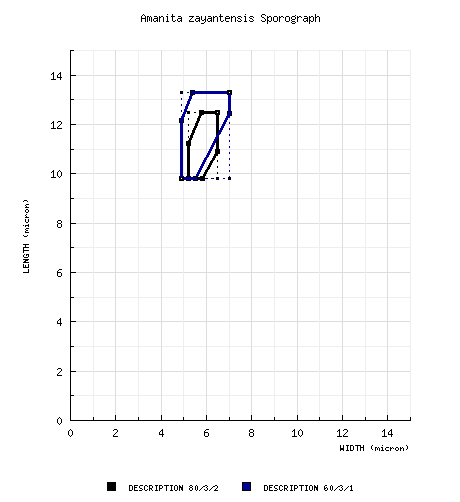
[80/3/2] (8.8-) 9.8 - 12.5 (-15.8) × (4.8-)
5.2 - 6.5 (-8.5) μm, (L = 10.6 - 11.7 μm;
L' = 11.1 μm; W = 5.6 - 6.3 μm;
W' = 5.8 μm; Q = (1.54-) 1.68 - 2.16 (-2.56);
Q = 1.80 - 1.98; Q' = 1.90), hyaline,
colorless, smooth, thin-walled, amyloid, elongate
to cylindric, infrequently ellipsoid, occasionally
constricted, sometimes with one end expanded,
??; apiculus
sublateral, cylindric, proportionately small;
contents granular to mono- to multiguttulate;
white in deposit.
From original material of A. sangabrielensis:
[60/3/1] (9.1-) 9.8 - 13.3 (-16.1) × (4.5-) 4.9 -
7.0 (-8.4) µm, (L = 11.5 - 11.9 µm; L’
= 11.6 µm; W = 5.2 - 5.8 µm; W’ =
5.6 µm; Q = (1.66-) 1.78 - 2.48 (-2.56); Q =
2.01 - 2.21; Q’ = 2.10), hyaline, thin-walled,
colorless, ??, amyloid to
weakly amyloid, elongate to cylindric, occasionally
expanded at one end, occasionally constricted;
apiculus sublateral,
??; contents
??;
white in deposit. |
| ecology |
Solitary to scattered. Per Arora
(1986), In
moderately dense brush, by roads, in clearings and
in other relatively open areas. In sand with
Pinus or in sandy soil with some organic
content of rather open brushy area with
Pinus, Quercus, Castanopsis,
and Arctostaphylos. Per Schwarz: At ca. 499 m
elev. In sandy soil of woods
dominated by Pinus, "possibly with some
Quercus." Per Greg Wright:
Subgregarious. At 1000 m elev. In
Pinus plantation (short 2-needle, long
3-needle). |
| material examined |
U.S.A.:
CALIFORNIA—Los Angeles Co. -
San Gabriel Mtns.,
Angeles Crest Hwy., 13 km N of Pasadena,
Switzer Picnic Area, 14.ii.1982 Mick Norihiro s.n.
[G. Wright 2563] (RET 081-3, nrLSU seq'd.).
Santa Cruz Co. - Bonny Doon
Ecological Reserve [37.0494° N/ 122.1315° W,
499 m], 28.xi.2009 Christian Schwarz s.n.
[mushroomobserver
#29246]
(RET 459-2, ITS2-nrLSU seq'd.).
Henry Cowell Redwoods St. Pk., ca. campground, off
Graham Hill Rd. & east of river,
15.i.2003 D. Arora & R. E. Tulloss 1-15-03-A
(RET 366-2, ITS2-nrLSU seq'd.); Henry Cowell
Redwoods St. Pk., Scotts
Valley, 9.xii.2016 Ronald L. Pastorino 12-9-16A
[mushroomoberver
#264027]
(RET 749-6, ITS2-nrLSU seq'd.); ca. Santa Cruz, i.1992
D. Arora s.n. (RET 039-4). Unkn. Co. -
unkn. loc., 8.i.2005 unkn. coll. s.n. (RET 382-9,
nrLSU seq'd.).nbsp; |
| discussion |
At the present writing, there does not seem to be
any recorded close genetic relative to
A zayantensis. When nBLAST was used to
look for similar sequences deposited in GenBank, the
minimum genetic distance to another sequence was
reported as 4.6%— the most similar sequence of
A. magniverrucata [found: 23.xi.2020].
A NAMA foray collection in F (NAMA 2012-205) of
which images were posted on Mushroomobserver
(#189205)
was proposed to belong to the present
species. Good photos are included in the cited
MO observation. The sequence (GenBank MK580666)
derived from the above collection is a good match
for the sequence derived from RET 459-2.
While
the spore sample size is rather small in both the
material formerly called sangabrielensis and
other collections of the present species that we
have examined, we have separated the two spore
sources and display the two data sets in the
sporograph comparison above.
[Note: It was pointed out by Jonathan Frank that the
sequence we
posted under the provisional name Amanita
sangabrielensis was a very good match to
MK580666.]
It should be noted that the
original material of sangabrielensis was described
by Greg Wright as
having a greenish or yellowish tint on much of the
basidiome when collected.
In the past on this site and in RET's keys and Mss.,
A. zayantensis has been called not only "A.
baccata sensu Arora" and A.
sangabrielensis," but also "A. sp-C3",
A. sp-C16, and "A. sp-C33." |
| citations |
—R. E. Tulloss |
| editors |
RET |
|




 Spore data sets and their composite