| name |
Amanita xanthogala |
| author |
Bas. 1969. Persoonia 5: 490, figs. 250-255. |
| name status |
nomen acceptum |
| english name |
"Yellow Milk Lepidella" |
| MycoBank nos. |
308601 |
| GenBank nos. |
Due to delays in data processing at GenBank, some accession numbers may lead to unreleased (pending) pages.
These pages will eventually be made live, so try again later.
|
| holotypes |
L (in liquid p.p.) |
| intro |
The following text may make multiple use of each data field.
The field may contain magenta text presenting data from a type study
and/or revision of other original material cited in the protolog of the present taxon.
Macroscopic descriptions in magenta are a combination of data from the protolog and
additional observations made on the exiccata during revision of the cited original
material.
The same field may also contain black text, which is data from a revision of the present
taxon (including non-type material and/or material not cited in the protolog).
Paragraphs of black text will be labeled if further subdivision of
this text is appropriate.
Olive text indicates a specimen that has not been
thoroughly examined (for example, for microscopic details) and marks other places in the text
where data is missing or uncertain.
The data below is derived from the protolog.
from the protolog: The basidiome is medium to large and robust. |
| pileus |
from the protolog: 60 - 140 mm wide, whitish or yellowish to pale fulvo-cinnamon, hemispheric at first, then convex to planar, finally plano-concave, dry; context white, turning pale to deep yellow on exposure, 7 - 12 mm thick near center, firm when young, rather soft in mature specimens, exuding abundant oily bright yellow "latex"; margin nonsulcate, appendiculate; universal veil as two forms of warts—large (pyramidal, radially fibrillose, closely set, fulvo-cinnamon to rufo-cinnamon, up to 5 × 7 mm) and small (subconic, subflocculose)—with small flocculose patches between warts. |
| lamellae |
from the protolog: free, crowded to moderately crowded, cream to pale yellow, with yellow more intense toward edge, 7 - 17 mm broad; lamellulae attenuate. |
| stipe |
from the protolog: 100 - 160 × 15 - 25 mm, yellowish-whitish to whitish or pale pinkish fawn, narrowing upward; bulb subclavate to clavate, 20 - 35 mm wide, often tapering to root-like extension; contents solid, similar to that in pileus except with latex scanty and with basal region red-brown where eaten by insect larvae; partial veil floccose-membranous, thick and broad, white above, with edge and underside pallid (cinnamon to rusty fawn), tearing and deciduous with age; universal veil as pruinose-furfuraceous covering gradually passing into fawn brown to rufo-cinnamon floccose warts arranged in more or less transerse rows, without concentration of such material at stipe base. |
| odor/taste |
neither recorded. |
macrochemical
tests |
none recorded. |
| pileipellis |
from the protolog: barely differentiated; filamentous undifferentiated hyphae 3 - 10 μm wide, nongelatinized, some with yellowish refractive contents. |
| pileus context |
not described. |
| lamella trama |
from the protolog: bilateral, probably without terminal inflated cells, with divergent hyphae up to 25 μm wide, with abundant lacticferous hyphae with yellow refractive contents occasionally projecting through hymenium as scattered "pseudocystidia" (3 - 8 μm wide, filiform, sometimes branching, thin-walled, not or barely projecting beyond basidia, with yellow refractive contents). |
| subhymenium |
from the protolog: ramose to irregularly inflated. |
| basidia |
from the protolog: 45 - 60 × 9 - 10 μm, 4-sterigmate; clamps abundant. |
| universal veil |
from the protolog: On pileus: yellow to yellow-brown in alkaline solution, all elements anticlinally oriented; filamentous hyphae inconspicuous and somewhat difficult to detect at first, 2 - 8 μm wide, branching, very thin-walled, most abundant in wart base and in tufts between warts; inflated cells dominating, in long erect chains, ellipsoid to pyriform to (occasionally) globose or elongate or irregularly shaped, up to 80 × 50 μm; vascular hyphae scattered, yellowish. On stipe: similar to tissue on cap, but with larger proportion of filamentous hyphae and larger proportion of elements with yellowish contents including some inflated cells. |
| stipe context |
from the protolog: longitudinally acrophysalidic; filamentous hyphae 3 - 10 μm wide, branching; acrophysalides slenderly clavate, up to 400 × 70 μm, sometimes subtended by single similar cell or short chain of similar cells. |
| partial veil |
not described. |
| lamella edge tissue |
from the protolog: inflated cells mainly clavate, also pyriform to ellipsoid, up to 50 × 30 μm. |
| basidiospores |
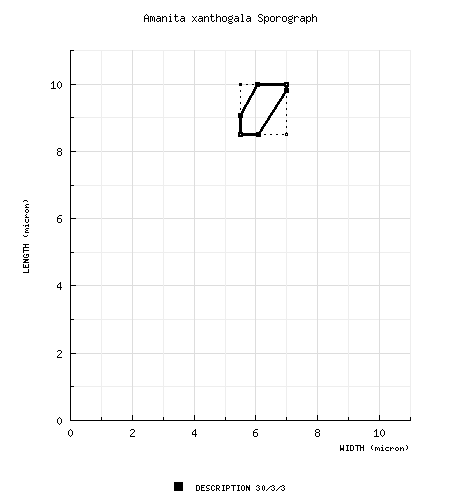
from protolog: [30/3/3] 8.5 - 10.0 (-10.5) × 5.5 - 7.0 μm, (Q = 1.40 - 1.65; Q = 1.45 - 1.55), colorless, thin-walled, amyloid, ellipsoid to elongate; apiculus not described; contents "mostly" as one large refractive body; color in deposit not recorded. |
| ecology |
from protolog: Terrestrial. At 1400-1500 m elev. In "mountain oak forest"—forest in which "highly speciose" Quercus and Lithocarpus and some Castanopsis replace the dipterocarps of lower altitudes [see http://www.eoearth.org/article/Borneo_montane_rain_forests]. |
| material examined |
from protolog: MALAYSIA: SABAH (Isl. Borneo)—Kinabalu Nat. Pk. [KNP], Mt. Kinabalu, Kundasan [ca. 6°00' N/ 116°32' E, ca. 1500 m], 5.ix.1961 E. J. H. Corner RSNB 2793 (paratype, L); KNP, Mt. Kinabalu, Mesilau Camp [ca. 6°00 N/ 116°36' E, ca. 1400 m], 2.iv.1964 E. J. H. Corner RSNB 8053a (holotype, L, dried specimens, fragments in liquid, color slides), 9.iv.1964 E. J. H. Corner RSNB 8053b (paratype, L). |
| discussion |
more protolog: "The most remarkable feature of A. xanthogala is undoubtedly the presence of an oily, yellow latex, given out whenthe fruit-body is damaged. However, the other characters of this species so strongly suggest those of species of subsection Solitareae that I do not hesitate to place it there.
"In his field-notes Corner mentioned a general resemblance between A. xanthogala and A. virginea. It is only the lactescent flesh that keeps me from placing A. xanthogala in stirps Virginea.
"In the same field-notes Corner stated that A. virginea is also a very sappy species (he did not mention this feature in his field-notes on A. virginea). But I hae found vascular hyphae in abundance only in the gills of that species. Nevertheless young, fresh fruit-bodies of A. virginea should be carefully examined for this character.
"Fundamentally the lacticiferous hyphae of A. xanthogala are probably not different from the oleiferous [vascular—ed.] hyphae in related species. Those in the pileipellis of A. timida showed the same set of reactions as described above for the lacticiferous hyphae of the present species, except for paler yellow colors in KOH and NH4OH.
"In young specimens of A. xanthogala the coloured, lacticiferous hyphae in the volval tissue are sometimes so abundant that they more or less conceal the colourless elements. To my way of thinking, however, the lacticiferous hyphae in the olva should in the first instance be ignored, if volva structures are compared for possible relationships."
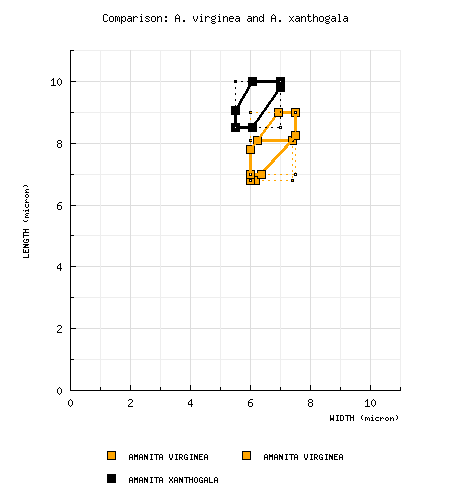
The following image provides a comparison of the spore shape and size for the present species and A. virginea:
more |
| citations |
—R. E. Tulloss |
| editors |
RET |
|


 Spore data sets and their composite