| name |
Amanita virgineoides |
| author |
Bas. 1969. Persoonia 5: 435, figs. 167-169. |
| name status |
nomen acceptum |
| english name |
"False Virgin's Lepidella" |
| MycoBank nos. |
308600 |
| GenBank nos. |
Due to delays in data processing at GenBank, some accession numbers may lead to unreleased (pending) pages.
These pages will eventually be made live, so try again later.
|
| holotypes |
L |
| revisions |
Z. L. Yang. 1997. Biblioth. Mycol. 170: 137, figs. 111-115. |
| intro |
The following text may make multiple use of each data field.
The field may contain magenta text presenting data from a type study
and/or revision of other original material cited in the protolog of the present taxon.
Macroscopic descriptions in magenta are a combination of data from the protolog and
additional observations made on the exiccata during revision of the cited original
material.
The same field may also contain black text, which is data from a revision of the present
taxon (including non-type material and/or material not cited in the protolog).
Paragraphs of black text will be labeled if further subdivision of
this text is appropriate.
Olive text indicates a specimen that has not been
thoroughly examined (for example, for microscopic details) and marks other places in the text
where data is missing or uncertain.
The following material is derived from the protolog of the present taxon and the revision of the species by Yang (1997)
NOTE: Spore measurements from papers by Z. L. Yang use his "Times New Roman" face for "Q"
and "Q'"—respectively, "Q" and
"Q." |
| basidiospores |
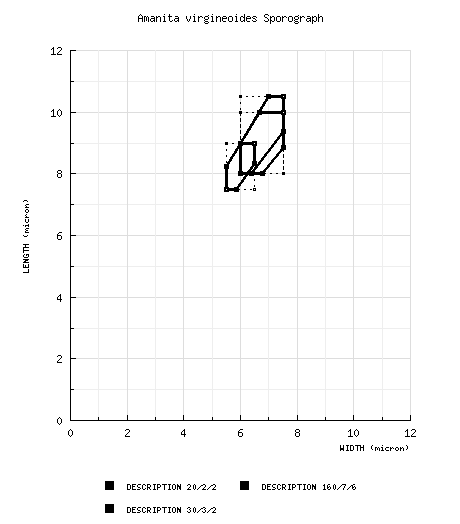
from the protolog (Bas 1969): [20/2/2] 8.0 - 10.5 × 6.0 - 7.5 μm, (Q = 1.25 - 1.50; Q = 1.35 - 1.40), broadly ellipsoid to ellipsoid, thin-walled, colourless, [hyaline,—ed.] with refractive contents, amyloid.
from the revision of Yang (1997): [160/7/6] (7.5-) 8.0 - 10.0 (-11.5) × (5.5-) 6.0 - 7.5 (-8.5) μm, (Q = (1.07-) 1.18 - 1.50 (-1.67); Q = 1.34 ± 0.11), broadly ellipsoid to ellipsoid, amyloid, rarely subglobose or elongate, colorless, hyaline, smooth, thin-walled; apiculus small.
from Yang (2000): [30/3/2] 7.5 - 9.0 (-10.0) × (5.0-) 5.5 - 6.5 (-7.0) μm,
(Q = (1.25-) 1.28 - 1.50 (-1.60); Q = 1.41 ± 0.09), hyaline, colorless, smooth, thin-walled, amyloid, broadly ellipsoid to ellipsoid. |
| ecology |
from Bas (1969): Japan: Terrestrial in Castanopsis and Pinus-Quercus forest.
from Yang (1997): Solitary or in small groups. China: At 700 - 2000 m elev. In coniferous and mixed forests with Pinus species and representatives of the Fagaceae. |
| material examined |
Bas (1969): JAPAN: HONSHU—Ôtsu-shi - Mii-dera, 6.ix.1953 T. Hongo 750 (paratype, L); Terabe, 30.viii.1966 T. Hongo 3293 (holotype, L).
from revision of Yang (1997): CHINA: GUIZHOU—Qianxinan Buyei and Miao Autonomous Prefecture - Anlong Co., unkn. loc., 15.vii.1993 F. L. Zou 3897 (HKAS 29265). SICHUAN—Neijiang (prefectural level) City - Weiyuan Co., unkn. loc., 12.vii.1985 M. S. Yuan 1030 (HKAS 18572). Liangshan Yi Autonomous Prefecture - Xichang City, Lojishan, 2000 m elev., 9.vii.1986 M. S. Yuan 1248 (HKAS 18394). YUNNAN—Dehong Prefecture - Mang (county level) City (formerly Luxi City), unkn. loc., 29.vii.1979 W. K. Zhong 79080 (1) (HKAS 4850). Dali Bai Autonomous Prefecture - Binshuan Co., Jizushan, 5.viii.1989 Y. C. Zong & Y. Lu Y108 (MHAS 54126, as Amanita solitaria in Ying & Zang, 1994: 138), Y141 (HMAS 53948, as Amanita solitaria in Ying & Zang, 1994: 138).
from Yang (2000): CHINA: JIANGSU—Nanjing (sub-provincial) City - former city of Nanjing, unkn. loc., 22.vi.1932 S. C. Teng 951 (formerly "IBN 5503"; BPI 751031 & 751059; CUP-CH 2144, as "A. solitaria"), 12.vii.1937 S. C. Li 278 (formerly "IBN" s.n.; BPI 751045; CUP-CH 1960, as "A. solitaria"). |
| citations |
—Z. L. Yang |
| editors |
RET |
|



 Spore data sets and their composite