| name |
Amanita umbrinidisca |
| author |
(Murrill) Murrill. 1912. Mycologia 4: 262. |
| name status |
nomen acceptum |
| english name |
"Dark-Eyed Panther" |
| synonyms |
≡ Venenarius umbrinidiscus Murrill. 1912. Mycologia 4: 242.
The editors of this site owe a great debt to Dr. Cornelis Bas
whose famous cigar box files of Amanita nomenclatural information
gathered over three or more decades were made available to RET for computerization
and make up the lion's share of the nomenclatural information presented on this site.
|
| MycoBank nos. |
169143, 199974 |
| GenBank nos. |
Due to delays in data processing at GenBank, some accession numbers may lead to unreleased (pending) pages.
These pages will eventually be made live, so try again later.
|
| holotypes |
NY |
| type studies |
Jenkins. 1979. Mycotaxon 10: 195. |
| intro |
The following text may make multiple use of each data field.
The field may contain magenta text presenting data from a type study
and/or revision of other original material cited in the protolog of the present taxon.
Macroscopic descriptions in magenta are a combination of data from the protolog and
additional observations made on the exiccata during revision of the cited original
material.
The same field may also contain black text, which is data from a revision of the present
taxon (including non-type material and/or material not cited in the protolog).
Paragraphs of black text will be labeled if further subdivision of
this text is appropriate.
Olive text indicates a specimen that has not been
thoroughly examined (for example, for microscopic details) and marks other places in the text
where data is missing or uncertain.
The following material not directly from the protolog of the present taxon and not cited as the work of Dr. Z. L. Yang or another researcher is based on original research by R. E. Tulloss.
The macroscopic part of the following is based on the protolog of the present species. Data from microscopic observation will be based on the research of Tulloss, unless otherwise noted in the text. |
| pileus |
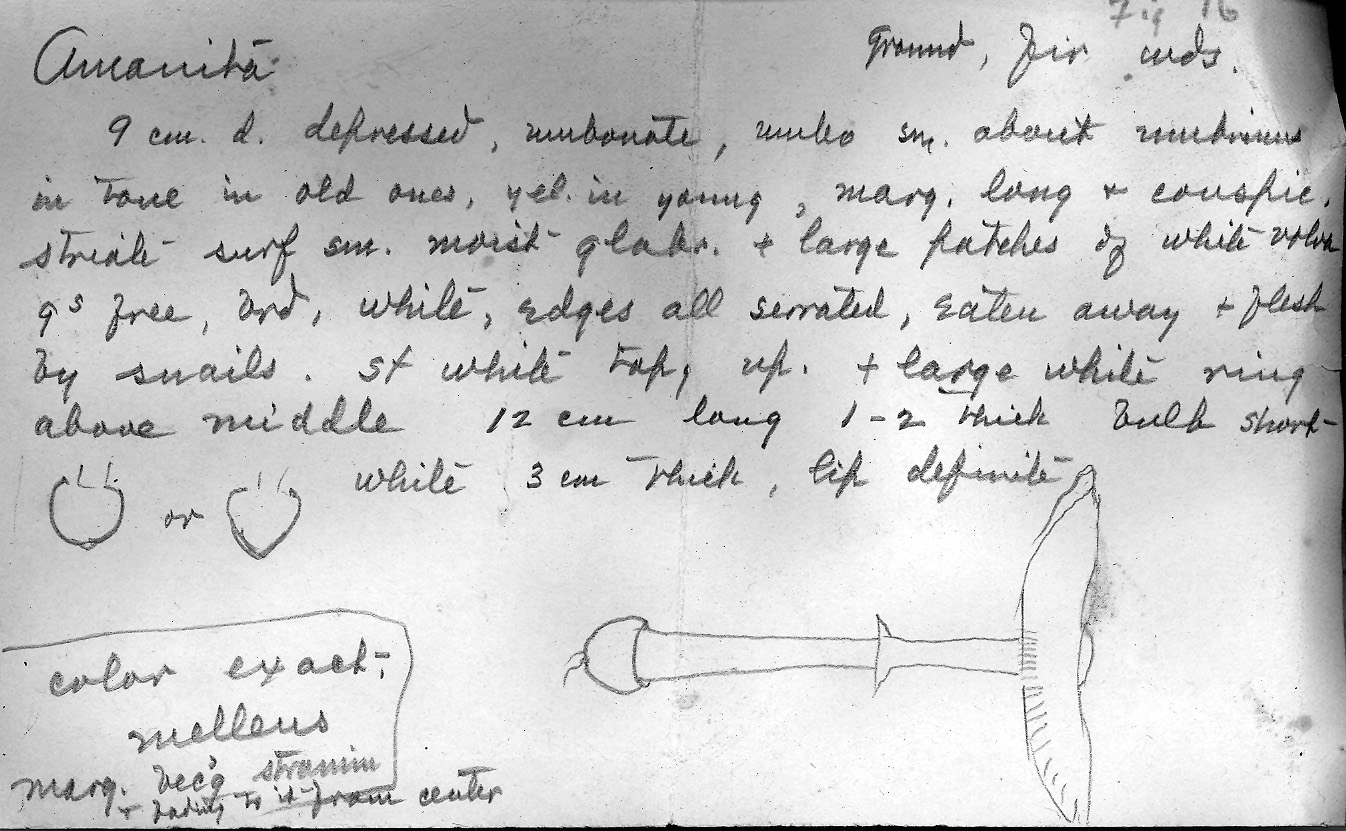
from protolog: up to 100 mm wide, melleous fading to stramineous over the striae, with umbo yellow in young plants and becoming umbrinous with age, convex to planoconvex, at length depressed, umbonate, moist, glabrous; context fleshy, but drying very thin; margin long?? [drawing deposited with type shows rather short striations—ed.] striate, nonappendiculate; universal veil as large patches, membranous(??), white, irregular. |
| lamellae |
from protolog: free, not crowded, white, broad; lamellulae not described. |
| stipe |
120 × 10 - 20 mm, white or slightly yellowish, narrowing upward; bulb ?, 30 mm across; context not described; partial veil subsuperior, white, ample, skirt-like, persistent; universal veil as limbate volva, white, with limb rather short, tough, subentire. |
| odor/taste |
not recorded. |
macrochemical
tests |
none recorded. |
| basidiospores |
from type study of Jenkins (1977, 1979): [-/-/1]
10.2 - 11.7 × 7.0 - 7.8 (-8.6) μm, (Q = 1.31 - 1.56; Q' = 1.46),
hyaline, thin-walled, nonamyloid, ellipsoid, often adaxially flattened; apiculus sublateral, cylindric; contents guttulate;
color in deposit not recorded. |
| ecology |
Solitary. In Picea [or Abies?] forest. |
| material examined |
from type study of Jenkins (1977, 1979):
U. S. A.: WASHINGTON— King Co. - Seattle,
1.xi.1911 W. A. Murrill F 414 (holotype, NY).
U.S.A.: WASHINGTON—King Co. - ca. Seattle, 20.x-1.xi.1911 W. A. Murrill 414 (holotype, NY), s.d. S. M. Zeller 100 (paratype, ??). |
| discussion |
This species is not well-understood at present. The honey colors attributed to the pileus call to mind other poorly known Murrill taxa from the Pacific Northwest of the U.S. and (probably) southwestern Canada—A. pantherinoides (Murrill) Murrill and A. praegemmata (Murrill) Murrill (which, following Jenkins (1977) for the present time, is treated herein as a synonym of A. pantherinoides).
Jenkins did not compare the above cited taxa with A. umbrinidisca because he did not consider the latter to be assignable to Amanita sect. Amanita. |
| citations |
—R. E. Tulloss |
| editors |
RET |
|




 Spore data sets and their composite