| name |
Amanita umbilicata |
| name status |
nomen provisorum |
| english name |
"Dimpled Amanita" |
| GenBank nos. |
Due to delays in data processing at GenBank, some accession numbers may lead to unreleased (pending) pages.
These pages will eventually be made live, so try again later.
|
| intro |
Olive text indicates a specimen that has not been thoroughly examined (for example, for microscopic details) and marks other places in the text where data is missing or uncertain.
The following material is based on original research of R. E. Tulloss and C. Rodríguez Caycedo. |
| pileus |
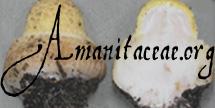
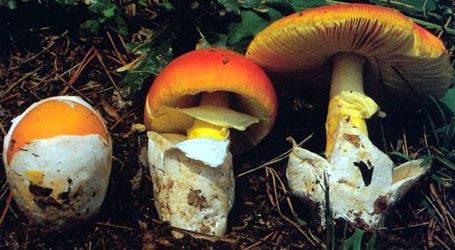
30 - 57 mm wide, yellow-brown (5-6D5, 10YR5-6/6) over
disc, grayish yellow (4B4, 10YR6-8/4) or light
orangish yellow (4A3) toward margin, convex to broadly
convex to plano-concave, with shallow distinct
umbilicus in all stages of expansion, dry;
context yellowish white, 2 mm thick above
stipe,
unstaining, in older material thinning to a membrane
5 - 6 mm from margin; margin nonstriate,
nonappendiculate, sometimes short-striate (.05 - .1R)
in age; universal veil as membranous flat
irregular patches, pale yellowish gray to yellowish
gray to grayish yellow to light grayish tan
(10YR7-8/2-3), sometimes becoming more like pileus
coloring where drying has occurred over disc. |
| lamellae |
adnate with decurrent line on stipe apex, relative
distance not recorded, pale yellow-cream in mass,
off-white in side view, without staining/bruising, 4
mm broad, broadest at mid-length; lamellulae
rounded truncate to attenuate, unevenly distributed,
of diverse lengths, plentiful. |
| stipe |
42 - 72 × 2.5 - 8 mm, pale yellow-white to pale
yellow, from handling becoming reddish brown to
golden brown to brownish gray, narrowing upward,
flaring over notable distance at apex, decorated with
minute longitudinally oriented fibrils; bulb
12 - 6 × 7 - 11 mm, shape not recorded;
context hollow, probably whitish, not
bruising/staining, with larval tunnels concolorous,
with central cylinder 4.0 - 4.5 mm wide (rounded and
broadened at top, sometimes with reddish brown
interior surface); partial veil apical to
nearly median, membranous or submembranous,
sometimes cracking irregularly near attachment and
separating from stipe and then found on bulb
(giving impression of limbate volva), sometimes
with subdentate free edge, yellowish white to pale
yellow above, sometimes becoming golden yellow
toward free edge, with lower surface pale
yellowish cream; universal veil absent. |
| odor/taste |
Odor indistinct, but pleasant, with older
specimens having slight odor of sodium
hypochloride. Taste none or faintly
like a rubber balloon. |
macrochemical
tests |
none recorded. |
| lamella edge tissue |
sterile. |
| basidiospores |
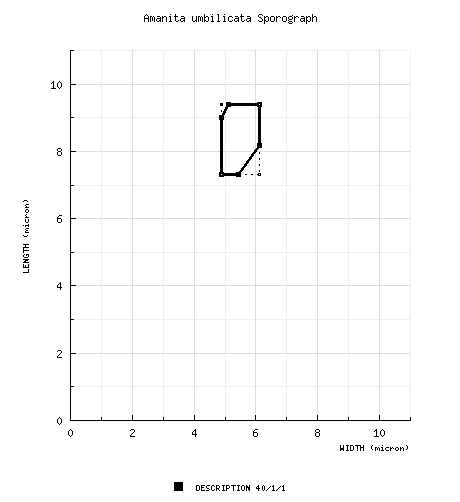
[40/1/1] (7.0-) 7.3 - 9.4 (-10.2) × (4.8-) 4.9 - 6.1
(=6.4) μm, (L = 8.2 μm; W = 5.4 μm;
Q = (1.33-) 1.34- 1.84 (-2.12); Q = 1.52),
??,
??,
??, smooth, amyloid,
ellipsoid to elongate, rarely cylindric, adaxially
flattened; apiculus sublateral, cylindric;
contents ??; ?? in deposit. |
| ecology |
New Jersey: In deep sandy soil of Pinus
rigida-Quercus barrens. |
| material examined |
NEW JERSEY—Burlington Co. - ca. Chatsworth,
Franklin Parker Preserve, 19.viii.2011 Nina &
John Burghardt s.n. (RET 486-10, nrITS seq'd.),
17.viii.2014 Nina & John Burghardt s.n. (RET 647-1,
nrITS seq'd.); ca. Chatsworth, Franklin Parker Preserve,
north ("airport") gate. 23.viii.2014 Igor Safonov s.n.
(RET 647-6, nrITS-LSU seq'd.). |
| discussion |
This species is known from a single site at which it
has been collected infrequently since 2013. |
| citations |
Note: gelasinos (Gr., "dimple")—R. E. Tulloss and C. Rodríguez Caycedo |
| editors |
RET |
|