| name |
Amanita
toxica |
| author |
Lazo "ex" Garrido & Bresinsky nom. inval. in Bresinsky & Besl. 1985. Giftpilze. (Stuttgart): 110.
[Lacking full and direct reference to basionym. Taxon remains untypified. ICBN §33.2, §37.1] |
| name status |
nomen invalidum |
| english name |
"Lazo's Deadly Amanita" |
| synonyms |
≡ Amanita gemmata var. toxica Lazo nom. inval. 1982. Bol. Inst. Salud Publica Chile 23(1-2): 123. [No type designated. ICBN §37.1]
The editors of this site owe a great debt to Dr. Cornelis Bas
whose famous cigar box files of Amanita nomenclatural information
gathered over three or more decades were made available to RET for computerization
and make up the lion's share of the nomenclatural information presented on this site.
|
| MycoBank nos. |
114788, 116783 |
| GenBank nos. |
Due to delays in data processing at GenBank, some accession numbers may lead to unreleased (pending) pages.
These pages will eventually be made live, so try again later.
|
| holotypes |
none |
| intro |
The following text may make multiple use of each data field.
The field may contain magenta text presenting data from a type study
and/or revision of other original material cited in the protolog of the present taxon.
Macroscopic descriptions in magenta are a combination of data from the protolog and
additional observations made on the exiccata during revision of the cited original
material.
The same field may also contain black text, which is data from a revision of the present
taxon (including non-type material and/or material not cited in the protolog).
Paragraphs of black text will be labeled if further subdivision of
this text is appropriate.
Olive text indicates a specimen that has not been
thoroughly examined (for example, for microscopic details) and marks other places in the text
where data is missing or uncertain.
The macroscopic description is pieced together from diverse sources; microscopic data is from original research of R. E. Tulloss. |
| pileus |
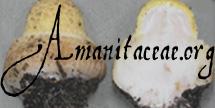
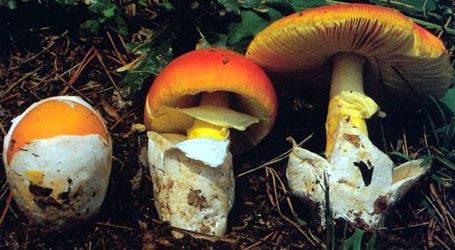
50–80 mm wide, yellowish cream (old ivory), beige over disc, hemispheric at first, becoming planar, eventually depressed, viscid when moist; context near pileipellis ocher to old ivory, elsewhere white, very firm; margin inflexed at first, later curved upward and undulant, striate; universal veil as white scales or patches, most common over disc. |
| lamellae |
free, crowded, straight, whitish, oblong-subventricose, with edge fimbriate to cottony; lamellulae present. |
| stipe |
50–150 × 7–22 (–30) mm, yellowish white, pruinose, squamulose, finely striatulate; bulb proportionately rather large, bearing many fine hyphal filaments on its bottom; context white, solid or hollow; partial veil membranous, white, pendent, very fragile; universal veil as ring of small warts around base of stipe just above bulb (but called “collar of phalloides type” in protolog, inconsistent with accompanying illustration), white. |
| odor/taste |
Odor like potato peelings; taste insipid. DEADLY POISON (Lazo 1982). |
macrochemical
tests |
Formaldehyde - negative; AgNO3 - Clay-dun on pileipellis, context, lamellae, and stipe; KOH - clay-dun on pileipellis, context, lamellae, and stipe; FeSO4 - pale blue on context and surface of lamellae and stipe.
Saez et al. (1981) reported finding an ouabain-like compound and proposed it to be a possible cause of deaths from ingestion of A. toxica. |
| pileipellis |
25–30?? µm thick, not or barely gelatinizing at interface to universal veil, with gelatinization zone 20±?? µm thick apparently restricted to basal tissue of universal veil, with partially gelatinized or barely gelatinized hyphae still visible in gelatinized zone connecting pileipellis and universal veil after basidiome maturity; filamentous, undifferentiated hyphae ?? µm wide, ??; vascular hyphae ?? µm wide, ??. |
| subhymenium |
wst-near = ?? µm; wst-far = ?? µm; ??; comprising interwoven and frequently branching short uninflated hyphal segements, with basidia arising from such segements. |
| basidia |
40–48 (–56) × 6.0–10.4 µm, 4- and 2-sterigmate, with sterigmata up to ?? × ?? µm; clamps observed. |
| basidiospores |
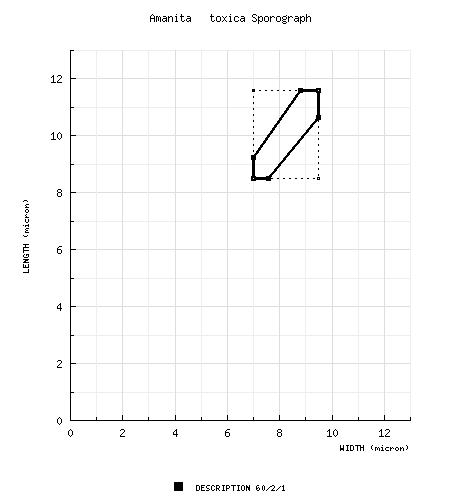
[60/2/1] (8.0–) 8.5–11.6 (–13.5) × (6.6–) 7.0–9.5 (–10.0) µm, (L = 9.4–10.1 µm; L' = 9.7 µm; W = 7.7–8.4 µm; W' = 8.0 µm; Q = (1.09–) 1.12–1.32 (–1.69); Q = 1.21; Q' = 1.21), hyaline, colorless, thin-walled, smooth, inamyloid, metachromatic in Cresyl Blue???, “acinófilas,” adaxially flattened, subglobose to broadly ellipsoid, infrequently ellipsoid; apiculus sublateral, cylindric, often quite prominent; contents dominantly monoguttulate with additional small granules; white in deposit. |
| ecology |
Solitary or rarely in small groups. Chile: In plantations of Pinus radiata or in humus under Pinus radiata [La Union] or in native forest (Garrido et al. 1982, Garrido 1986) or from humus under Nothofagus dombeyi and Myrceugenia obtusa. |
| material examined |
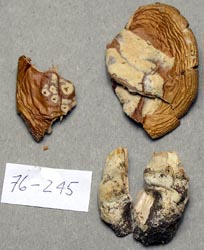
CHILE: BÍO BÍO—Concepcion, Laguna San Pedro, 5.ix.1976 Oehrens ZT 76-245 (ZT, in herb. Horak); Monte Aguila, 18.iv.1979 N. Garrido 152 (CONC), 27.vi.1979 N. Garrido 67 (CONC), 24.vii.1979 N. Garrido 119 (CONC).
LOS LAGOS—La Unión, Tres Tambores, 17.vii.1990 ?? AH 13945. Valdivia, Cufeo, 14.iv.1980 N. Garrido 221 (CONC); Valdivia, Rebellín, 15.v.1990 ?? AH 13946.
UNKN. REG.—Fundo las Palmas, 22.iv.1982 N. Garrido 410 (CONC).
UNKN. REG.—Chaimávida, 4.vii.1979 N. Garrido 83 (CONC), 30.viii.1979 N. Garrido 166 (CONC). |
| discussion |
(t.b.d.)
The presence of clamps at the bases of basidia excludes the present entity from the gemmatoid and pantherinoid groups in Amanita section Amanita. |
| citations |
—R. E. Tulloss |
| editors |
RET |
|


 Spore data sets and their composite