
| name | Amanita tainaomby |
| name status | nomen acceptum |
| author | R. Heim |
| english name | "Sickening Ringless Amanita" |
| cap | The cap of Amanita tainaomby is 20 - 70 mm wide, expanded-convex, with a depressed center, grayish to mouse-gray, with a strongly striate margin. The volval remnants are few, more or less fragmentary, friable, whitish to grayish, and powdery. The flesh is firm, thin, white. |
| gills | The gills are rather crowded, free, broad, silvery-white to cream, with a marginate edge with brownish black cells. |
| stem | The stem is 30 - 80 (-150) × 15 mm, cylindric, narrowing upward, white, exannulate, initially cottony-fibrillose, then becomes patterned with brown to mouse-gray fibrils, with brown striations in the upper part. The volva is in the form of an elongated cup, the upper portion is cream colored, the lower part is ochraceous buff or ochraceous orange, rather thick, and friable. A part of the volva remains as a collar which is ochraceous at first, becoming brown on the lower stem. The volval material is occasionally lost rapidly. |
| odor/taste | The mushroom lacks both odor and taste. |
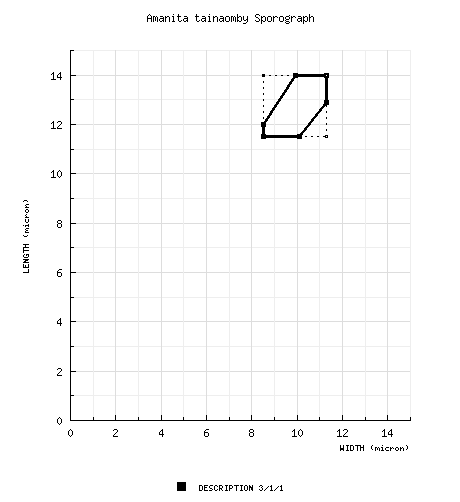
| spores | In Gilbert's text, he cites the spores as measuring 9.5 - 10.5 × 8.5 - 10 µm and are globose to subglobose and inamyloid. However, Gilbert points out that similarity to Amanita calopus Beeli which is particularly known for having ellipsoid and elongate spores and his drawing of the spores of A. tainaomby show broadly ellipsoid to ellipsoid spores. The three illustrated spores, which are in appropriate orientation for measurement, measure 11.6 - 14 × 8.5 - 11.2 µm. |
| discussion |
This species was originally described from Madagascar. The type might be taken implicitly as the sole specimen mentioned by Gilbert (collected in Fénérive, 10.xii.1934); however, Gilbert says that he was unable to find spores on what he considered the type. Hence, the specimen mentioned (in the caption for the spore drawings) cannot be considered the type, but the issue is moot. The type collection was probably originally split between Madagascar and Paris (in the herbarium of E. J. Gilbert). Any specimens in the Madagascar National Herbarium have been destroyed by fire and Gilbert's herbarium has been lost. This species is reasonably believed to have no type. The only thing said of its habitat by Heim was that it grew near cow manure. Heim reported that this species was considered "very toxic" by indigenous peoples of Madagascar. This is very odd because there is no other toxic species confirmed for section Vaginatae, especially within the group of taxa with a weakly structured volva. The belief should be further investigated.—R. E. Tulloss and L. Possiel |
| brief editors | RET |
| name | Amanita tainaomby | ||||||||||||||||||||
| author | R. Heim ex E.-J. Gilbert. 1941. Iconogr. Mycol. (Milan) 27, suppl. (2): 229. | ||||||||||||||||||||
| name status | nomen acceptum | ||||||||||||||||||||
| english name | "Sickening Ringless Amanita" | ||||||||||||||||||||
| synonyms |
≡Amanita tainaomby R. Heim nom. inval. in Curasson. 1936. Pathol. Exot. Vét. Comp. 3: 297. [Lacking Latin diagnosis. ICBN §36.1]
≡Amanitopsis tainaomby (R. Heim) E.-J. Gilbert nom. inval. 1940. Iconogr. Mycol. (Milan 27, suppl.: 76, tab. 7 (fig. 2). [Basionym invalid. Latin diagnosis not supplied.]
[Additional reference: Dujarric de la Rivière, R. and R. Heim. 1983. Champ. Toxiques: 39.] The editors of this site owe a great debt to Dr. Cornelis Bas whose famous cigar box files of Amanita nomenclatural information gathered over three or more decades were made available to RET for computerization and make up the lion's share of the nomenclatural information presented on this site. | ||||||||||||||||||||
| MycoBank nos. | 479211, 284117 | ||||||||||||||||||||
| GenBank nos. |
Due to delays in data processing at GenBank, some accession numbers may lead to unreleased (pending) pages.
These pages will eventually be made live, so try again later. Search:
Showing 0 to 0 of 0 entries | ||||||||||||||||||||
| holotypes | in herb. E.-J. Gilbert (lost) | ||||||||||||||||||||
| intro |
The following text may make multiple use of each data field. The field may contain magenta text presenting data from a type study and/or revision of other original material cited in the protolog of the present taxon. Macroscopic descriptions in magenta are a combination of data from the protolog and additional observations made on the exiccata during revision of the cited original material. The same field may also contain black text, which is data from a revision of the present taxon (including non-type material and/or material not cited in the protolog). Paragraphs of black text will be labeled if further subdivision of this text is appropriate. Olive text indicates a specimen that has not been thoroughly examined (for example, for microscopic details) and marks other places in the text where data is missing or uncertain. The following material is derived from the protolog of the present species and Heim (1936). | ||||||||||||||||||||
| pileus | from protolog: 20 - 70 mm wide, intense mouse-gray, convex, with central depression; context thin, firm, white; margin strongly striate; universal veil as scattered fragments, whitish or grayish, tomentose, detersile. | ||||||||||||||||||||
| lamellae | from protolog: free, somewhat crowded, silver white or cream, broad, with margin marked by closely placed brown-black punctations. | ||||||||||||||||||||
| stipe | from protolog: 30 - 80 (-150) × ca. 15 mm, cylindric or narrowing upward, white, initially with woolly decoration then punctate with brown to mouse-gray crumb-like scales, with brown striations above; context white, firm; exannulate; universal veil as cupulate volva; cream above, ochraceous yellow (Ochraceous Buff, Ochraceous-orange) below, thick, tomentose, adnate, with [?limbus internus] as separate irregularly circular ochraceous yellow (becoming brown) collar on lower stipe. | ||||||||||||||||||||
| odor/taste | from protolog: Odor and taste lacking. | ||||||||||||||||||||
| macrochemical tests |
none described. | ||||||||||||||||||||
| pileipellis | not described. | ||||||||||||||||||||
| pileus context | not described. | ||||||||||||||||||||
| lamella trama | not described. | ||||||||||||||||||||
| subhymenium | not described. | ||||||||||||||||||||
| basidia | not described. | ||||||||||||||||||||
| universal veil | not described. | ||||||||||||||||||||
| stipe context | not described. | ||||||||||||||||||||
| partial veil | absent. | ||||||||||||||||||||
| lamella edge tissue | from protolog: inflated cells with brown contents. | ||||||||||||||||||||
| basidiospores | from protolog: [3/1/1] 11.5 - 14.0 × 8.5 - 11.3 μm, (L = 12.8 μm; W = 9.9 μm; Q = 1.14 - 1.41; Q = 1.30), hyaline, smooth, inamyloid, subglobose to broadly ellipsoid to ellipsoid, at least sometimes adaxially flattened; apiculus sublateral (per figure); contents not recorded; color in deposit not recorded. [Note: From measurement of spores in approximately lateral view from Gilbert (1940: tab. VII (fig. 2)).—ed.] | ||||||||||||||||||||
| ecology | from protolog: near cattle excrement. | ||||||||||||||||||||
| material examined |
from protolog: MADAGASCAR, REPUBLIC OF: UNKN. REGION—Fénérive | ||||||||||||||||||||
| discussion |
Gilbert states that the material that he considered to be the type of A. tainaomby lacked mature spores. He doesn't provide any other information about this collection. The collection from which he derived his spore measurements was not the type. Gilbert indicates A. calopus as a similar taxon. | ||||||||||||||||||||
| citations | —R. E. Tulloss | ||||||||||||||||||||
| editors | RET | ||||||||||||||||||||
Information to support the viewer in reading the content of "technical" tabs can be found here.
| name | Amanita tainaomby |
| bottom links |
[ Keys & Checklists ] |
| name | Amanita tainaomby |
| bottom links |
[ Keys & Checklists ] |
 Spore data sets and their composite
Each spore data set is intended to comprise a set of measurements from a single specimen made by a single observer; and explanations prepared for this site talk about specimen-observer pairs associated with each data set. Combining more data into a single data set is non-optimal because it obscures observer differences (which may be valuable for instructional purposes, for example) and may obscure instances in which a single collection inadvertently contains a mixture of taxa.

Text and User-Generated Sporographs are published under the Creative Commons License.

In the case of a taxon page, image credits are on the 'image' tab.