

| name | Amanita subnigra |
| name status | nomen provisorum |
| author | Lamoureux |
| english name | "Lamoureux's Dark-capped Ringless Amanita" |
| images | |
| intro | The information on this page is derived from (Lamoureux 2006) and from original research of RET. |
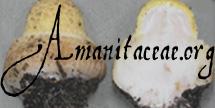
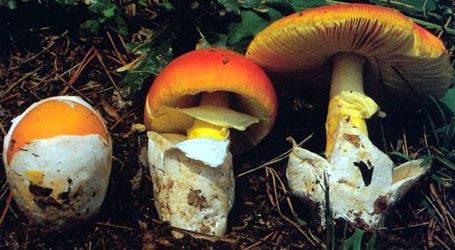
| cap | The cap of Amanita subnigra is 40 - 80 mm wide and dark yellowish brown to ochraceous brown to somewhat olivaceous dark brown to brown black. Sometimes darkest over the center and in a zone at the inner ends of the marginal striations. At first it is ovoid to rounded-conic to bell-shaped; it becomes flattened convex and umbonate. Its flesh is white except for a brown line below the cap's skin (most noticeable above the stem); the flesh does not stain or bruise. Its edge bears long radial grooves that extend for 35 to 45% of the cap's radius. No remnants of the volval are present on the cap. |
| gills | The gills of this species are free, crowded, pale grayish to whitish to cream to slightly orangish cream in mass and cream in side view. They do not stain or bruise; the are up to about 4 mm broad at three-quarters of the gill length from the stem. They have a white minutely powdery edge. The plentiful short gills are truncate to subtruncate, unevenly distributed, and of diverse lengths. |
| stem | The off-white to cream, ringless stem of A. subnigra is 60 - 140 × 5 -15 mm, narrows upward, and is smooth to satiny or decorated with scattered fibrils. Its flesh is white to off-white and stuffed becoming hollow (with central cylinder 5+ mm wide). The soft, membranous, sack-like volva (35 × 33 mm) is white and sometimes bears scattered brown or ochraceous spots on its exterior. |
| truffle-like fruiting body | double click in markup mode to edit. |
| odor/taste | This species is odorless. Its taste has not been recorded. |
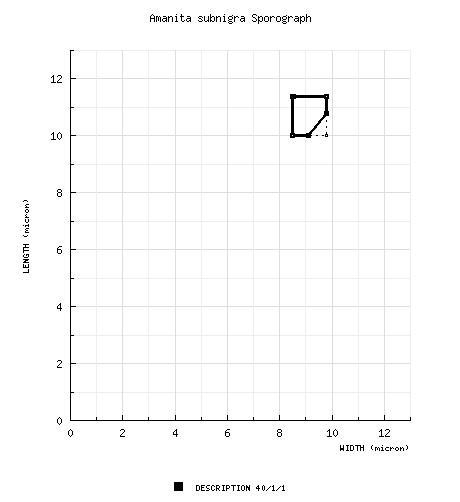
| spores | The spores of A. subnigra measure 10.0 - 11.4 (-12.4) × (8.1-) 8.5 - 9.8 (-11.0) μm and are subglobose to broadly ellipsoid to ellipsoid and inamyloid. Clamps are absent from bases of basidia. |
| discussion | This species is known from the Island of Newfoundland, the Province of Québec, and the U.S. state of Minnesota. Lamoureux reports it from Spruce (Picea) plantations. It also is found on limestone barrens possibly associated with Balsam Fir (Abies balsamica) or Spruce and in humus of mixed forest including Red Pine (Pinus resinosa), Birch (Betula), and Poplar (Populus), with some Black Spruce (Picea mariana) bogs.—Y. Lamoureux and R. E. Tulloss |
| brief editors | RET |
| name | Amanita subnigra | ||||||||||||||||||||||||||||||||
| author | Lamoureux nom. prov. 2006. Champignons du Québec 2: 41, fig. 6. | ||||||||||||||||||||||||||||||||
| name status | nomen provisorum | ||||||||||||||||||||||||||||||||
| english name | "Lamoureux's Dark-capped Ringless Amanita" | ||||||||||||||||||||||||||||||||
| etymology | sub-, nearly + niger, black | ||||||||||||||||||||||||||||||||
| GenBank nos. |
Due to delays in data processing at GenBank, some accession numbers may lead to unreleased (pending) pages.
These pages will eventually be made live, so try again later. Search:
Showing 1 to 4 of 4 entries | ||||||||||||||||||||||||||||||||
| intro |
Olive text indicates a specimen that has not been thoroughly examined (for example, for microscopic details) and marks other places in the text where data is missing or uncertain. The following material is derived from (Lamoureux 2006) and original research by R. E. Tulloss and Linas Kudzma. | ||||||||||||||||||||||||||||||||
| pileus |
Lamoureux
(2006):
40 - 80 mm wide, dark yellowish brown to brown black,
sometimes darkest over the disc and in a zone at the
inner ends of the marginal striations, ovoid to
rounded-conic at first, umbonate when expanded
(plano-convex); context white; margin
long-striate; universal veil absent. RET: 55 mm wide, dark brown (somewhat olivaceous?) over disc surrounded by ochraceous brown (10YR 6/4) zone, dark brown over striae at first (fading to a lighter brown), campanulate becoming broadly campanulate; context white except brown line below pileipellis (especially noticeable in disc), sometimes with watery line at juncture with lamellae, unchanging when cut or bruised, 3 mm thick, thinning evenly for 75 - 90% of gill length, then membranous to margin; margin nonappendiculate, striate (0.35 - 0.4R); universal veil absent. | ||||||||||||||||||||||||||||||||
| lamellae |
Lamoureux (2006): whitish to pale grayish. RET: free without decurrent line on stipe apical region, crowded, cream to slightly orangish cream in mass, cream in side view, unchanging when cut or bruised, 4 mm broad, broadest at three-quarters gill length from stipe, with white minutely pulverulent edge; lamellulae truncate to subtruncate, unevenly distributed, of diverse lengths, plentiful. | ||||||||||||||||||||||||||||||||
| stipe |
Lamoureux (2006): 60 - 140 × 5 -15 mm, whitish, smooth or slightly fibrillose; context white, stuffed becoming hollow; exannulate; universal veil as membranous saccate volva, white, sometimes scattered brown spots on exterior. RET: 117 × 10 mm, off-white to cream, staining/bruising not observed, narrowing upward, not or barely flaring at apex, somewhat satiny, faintly longitudinally striatulate (10× lens); context off-white except gray at very base, unchanging when cut or bruised, hollow with some regions lightly packed with white cottony fibrils, with central cylinder 5+ mm wide, no insect tunnels observed; exannulate; universal veil as saccate volva white, soft, firm, membranous, 35 × 33 mm,1 mm thick at mid-height of limb, with strong ochraceous staining in numerous spots, cross-section revealed no distinct limbus internus. | ||||||||||||||||||||||||||||||||
| odor/taste |
Lamoureux (2006): Odor indistinct. Taste not recorded. RET: Odorless. Taste not recorded. | ||||||||||||||||||||||||||||||||
| macrochemical tests |
none recorded. | ||||||||||||||||||||||||||||||||
| pileipellis | t.b.d. | ||||||||||||||||||||||||||||||||
| pileus context | t.b.d. | ||||||||||||||||||||||||||||||||
| lamella trama | t.b.d. | ||||||||||||||||||||||||||||||||
| subhymenium | t.b.d. | ||||||||||||||||||||||||||||||||
| basidia | ?? × ?? μm, 4-sterigmate, ??, clamps not observed. | ||||||||||||||||||||||||||||||||
| universal veil | t.b.d. | ||||||||||||||||||||||||||||||||
| stipe context | t.b.d. | ||||||||||||||||||||||||||||||||
| partial veil | absent. | ||||||||||||||||||||||||||||||||
| lamella edge tissue | sterile; t.b.d. | ||||||||||||||||||||||||||||||||
| basidiospores |
Lamoureux (2006): 10.5 - 12.0 × 8.5 - 11.0 μm, inamyloid. composite of data from all material revised by RET: [40/1/1] 10.0 - 11.4 (-12.4) × (8.1-) 8.5 - 9.8 (-11.0) μm, (L = 10.7 μm; W = 9.0 μm; Q = (1.08-) 1.10 - 1.34 (-1.36); Q = 1.20), hyaline, colorless, smooth, thin-walled, inamyloid, subglobose to broadly ellipsoid to ellipsoid, adaxially flattened; apiculus sublateral, cylindric; contents granular to mono- to multiguttulate, with additional mall granules; white in deposit. | ||||||||||||||||||||||||||||||||
| ecology |
Lamoureux
(2006):
Prov. Québec: Under Picea, particularly in
plantations. Sometimes the sole species of
section Vaginatae in such plantations.
July to September. Rare. RET: Prov. Newfoundland and Labrador, Canada: On limestone barrens, possibly associated with Abies balsamica or Picea. Minnesota, U.S.A.: Solitary. In humus of mixed forest including Pinus resinosa, Betula, and Populus, with some Picea mariana bogs. | ||||||||||||||||||||||||||||||||
| material examined |
RET: CANADA:
NEWFOUNDLAND & LABRADOR—St. John
Island, 12-13.viii.2003 Andrus Voitk #10 (RET 369-5;
nrITS seq'd.).
QUÉBEC—Le Val-Saint-Francois Reg. Co.
Mun. - Bonsecours, 25.vii.1994 Y. Lamoureux 2197
(CMMF; RET 522-2, nrITS seq'd.).
U.S.A.:
MINNESOTA—Beltrami Co. - Movil Maze Ski
Area, 26.viii.1995 participant NAMA1995 s.n.
[Tulloss 8-26-95-D] (RET 155-9, nrITS seq'd.).
| ||||||||||||||||||||||||||||||||
| discussion |
Lamoureux
(2006):
"The dark coloring of the cap is very typical; gray
caps have never been seen on this
taxon. ... Renée Lebeuf photographed this
species in 2005 among spruce; the cap color in her
photographs is in perfect accord with [the cap
color] in our own collections." RET: The nrITS sequences derived from all non-Québec collections (Tulloss ) are very good matches to the sequence derived from Lamoureux 2197. Further data is being sought. For a short time, the temporary code Amanita sp-MN04 was used on this site—based on the Minnesota collection of the present species. The following collection has an nrITS sequence that is an identical match for that of A. subnigra. However, its nrLSU sequence is not a good match for that of the present species. This raises the question of whether the data suggests that multiples species could share the same nrITS sequence or whether there has been a failure of the nrLSU locus to homogenize in the present species. Further research is required. COLORADO—Summit Co. - Holy Cross View, 16.viii.1997 M. Horman s.n. [Tulloss 8-16-97-A] (DBG; F; RET 266-5, nrITS and nrLSU seq'd.). | ||||||||||||||||||||||||||||||||
| citations | Translation from French by RET, who is responsible for all errors.—R. E. Tulloss, Y. Lamoureux, and L. V. Kudzma. | ||||||||||||||||||||||||||||||||
| editors | RET | ||||||||||||||||||||||||||||||||
Information to support the viewer in reading the content of "technical" tabs can be found here.
| name | Amanita subnigra |
| name status | nomen provisorum |
| author | Lamoureux |
| english name | "Lamoureux's Dark-capped Ringless Amanita" |
| images | |
| photo |
Britt Bunyard - (1-2) Uhrenholdt Memorial Forest, Sawyer Co., Wisconsin, U.S.A.(RET 849-1) [Note: Untrimmed and unedited images may be found at mushroomobserver.org/320618] |
 Spore data sets and their composite
Each spore data set is intended to comprise a set of measurements from a single specimen made by a single observer; and explanations prepared for this site talk about specimen-observer pairs associated with each data set. Combining more data into a single data set is non-optimal because it obscures observer differences (which may be valuable for instructional purposes, for example) and may obscure instances in which a single collection inadvertently contains a mixture of taxa.

Text and User-Generated Sporographs are published under the Creative Commons License.

In the case of a taxon page, image credits are on the 'image' tab.