| name |
Amanita submaculata |
| author |
Peck. 1900. Bull. Torrey Bot. Club 27: 609. |
| name status |
nomen acceptum |
| english name |
"Ball Gown Amanita" |
| MycoBank nos. |
MB152831 |
| GenBank nos. |
Due to delays in data processing at GenBank, some accession numbers may lead to unreleased (pending) pages.
These pages will eventually be made live, so try again later.
|
| holotypes |
NYS (implicit) |
| type studies |
Jenkins. 1978a. Mycotaxon 7: 42. |
| intro |
Olive text indicates a specimen that has not been
thoroughly examined (for example, for microscopic details) and marks other places in the text
where data is missing or uncertain.
The following material not directly from the protolog of the present taxon and not cited as the work of another researcher is based on original research by R. E. Tulloss. |
| pileus |
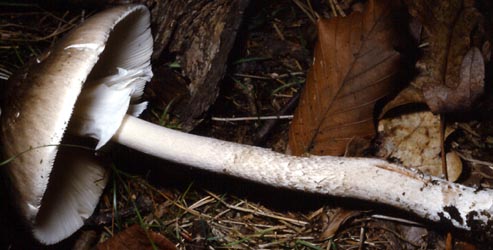
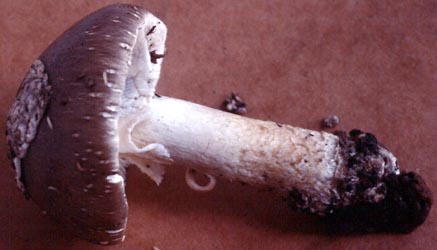
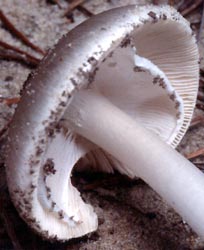
48 - 192 mm wide, grayish brown to dark brown (e.g.,
5F7-8) over disc, grayish-brown to brownish or
umbrinous gray to umbrinous elsewhere (e.g., 5C-D5),
pallid at margin, sometimes entirely white when
immature
(mushroomobserver
#320743),
staining reddish-brown in streaks and in older insect
bites or staining brick red and becoming dark
red-brown with time, virgate (with brown or gray-brown,
apparently innate, radial fibrils), at first often
irregularly rounded conic, then irregularly convex to
plano-convex to plane, with broad umbo, sometimes
slightly undulate, sometimes splitting at margin,
subshiny to shiny when dry, tacky to waxy when
moist; context mostly white, often with
grayish area in disc, staining pale rust to brick
red to ochraceous in larva tunnels, 4 - 15 mm thick,
thinning evenly to within 4 - 5 mm of margin, then
membranous to margin; margin nonstriate
becoming striate in age (0.15R), incurved at first,
then downcurved to straight, nonappendiculate;
universal veil absent or as irregular warts
of varying sizes or filamentous thin squamules,
white or off-white or pallid becoming grayish or
brown or brownish gray, often over disc only,
minutely verrucose (10× lens), pulverulent, friable,
detersile. |
| lamellae |
free to very narrowly adnate, some with decurrent tooth at stipe apex, with or without decurrent line on stipe, subcrowded to crowded, rounded on outer end, with even width for most of length, off-white to white to pale cream to cream in mass and in side view, staining brick red, 4 - 8.5 mm broad, sometimes forking near margin; lamellulae truncate to subtruncate to rounded truncate to subattenuate to attenuate in steps, rather narrow,
common, of diverse length, some free from both stipe and margin. |
| stipe |
(38-) 105 - 198 × (5.5-) 11.5 - 26 mm, satiny white to whitish to pale ground to blackish to brownish, pale orange-brown with handling, sometimes with vertical red-brown dashes of staining on lower stipe and upper bulb, slightly narrowing upward, flaring at apex, sometimes sinuous, sparsely pulverulent above partial veil, satiny or fibrillose (sometimes coarsely squamulose) below partial veil, with fibrils white or pallid in the topmost 1/4 of stipe, brown to gray brown below, with some fibrils becoming darker from handling, becoming faintly longitudinally striatulate at maturity; bulb (13-) 36 - 45 × (13-) 24 - 44 mm, irregularly ovoid to fusiform to napiform to subnapiform, sometimes very small and slender, staining brick red in old insect damage or taking on superficial red-brown marks; context whitish to pale grayish cream, staining as in other tissues, solid, with larva tunnels concolorous to watery brown to brick red or ochraceous; partial veil white, browning with age or staining brick red, subapical to apical, superior, membranous, skirt-like, copious, striate above, with outer half becoming free first and creating fold around the ring at about mid-radius and (consequently) resembling a great mid-19th Cent. ball gown when full free, eventually collapsing on stipe, often tearing; universal veil absent or as one or two thin whitish to gray rings around top of bulb or as loose limb against stipe or loose patches easily overlooked in substrate, more membranous and more likely to be collected attached to specimen than in the volva of (e.g.) A. flavoconia. |
| odor/taste |
Odor Pleasant, fruity or flowery or strongly anise-like, rarely with an additional chlorine-like odor or like an automobile tire. |
macrochemical
tests |
L-tyrosine (aqueous sat. sol.) - positive on stipe surface and stipe context (spot testing only). Voucher collections: Tulloss 7-21-85-F, 8-1-86-F, and 8-16-85-E. |
| lamella trama |
bilateral, divergent, with shallow angle of divergence, with subhymenial base comprised of narrow elements (clavate to subcylindric to narrowly subfusiform, up to 64 × 26 µm) often in chain of two between central stratum and subhymenium; wcs =
?? µm;
??; filamentous, undifferentiated hyphae
?? µm wide,
??, occasionally with yellowish subrefractive walls; terminal, inflated cells,
??; vascular hyphae
?? µm wide,
??. |
| subhymenium |
wst-near =
?? µm; wst-far =
?? µm; pseudoparenchymatous, 3 to 4 cells deep, with smallest cells nearest basidia, with largest cells (globose to clavate) up to 28 × 15.5 µm, with basidia arising from
??. |
| basidiospores |
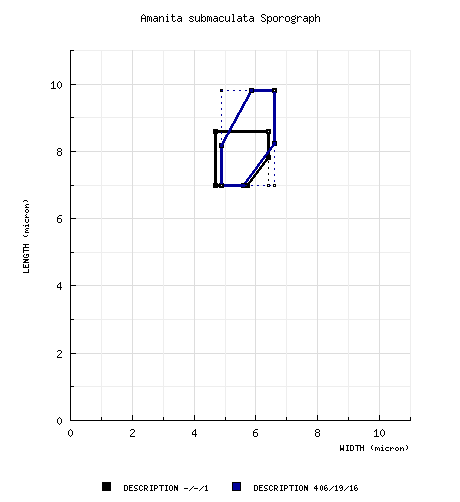
from type study of Jenkins (1978a): [-/-/1]
7.0 - 8.6 × 4.7 - 6.4 μm, (Q = 1.22 - 1.83; Q' = 1.59),
hyaline, thin-walled, amyloid, broadly ellipsoid to elongate, often adaxially flattened; apiculus sublateral, cylindric; contents guttulate;
color in deposit not recorded.
composite data from all material revised by RET: [406/19/16] (6.3-) 7.0 - 9.8 (-13.3) × (4.5-) 4.9 - 6.6 (-8.4) µm, (L = (7.2-) 7.8 - 8.8 (-8.9) µm; L’ = 8.4 µm; W = (5.2-) 5.5 - 6.2 µm; W’ = 5.7 µm; Q = (1.18-) 1.25 - 1.67 (-2.02); Q = (1.32-) 1.36 - 1.56 (-1.64); Q’ = 1.47), hyaline, colorless, thin-walled, smooth, amyloid, broadly ellipsoid to ellipsoid to elongate, rarely cylindric, often adaxially flattened, infrequently adaxially indented, infrequently expanded at one end; apiculus sublateral, cylindric; contents monoguttulate; white in deposit. |
| ecology |
Connecticut: In sandy loam. Kentucky: In dry loam of lawn/ with Quercus alba L., Q. stellata Wangenh., and other Quercus spp. and Tsuga canadensis (L.) Carr. New Jersey: In dark loam of Quercus-Fagus-Carya forest or dark sand (having significant organic matter) in mixed forest or in sand of Pinus-Quercus barrens. New York: In loamy clay. South Carolina: In dark moist loam with Quercus muehlenbergii Engelm. and Pinus. |
| material examined |
from type study of Jenkins
(1978a):
U. S. A.:
NORTH CAROLINA—Unkn. Co. - unkn. loc.,
1899 Miss M. L. Wilson s.n.
(holotype, NYS).
U.S.A.:
CONNECTICUT—Middlesex Co. -
East Haddam, Devil’s Hopyard
St. Pk. [41°28'32" N/ 72°20'25" W, 72 m],
31.viii.1997 David Rose s.n. [Tulloss 8-31-97-L]
(RET 269-9); Ivoryton 22.ix.1987 S. S.
Ristich s.n. [Tulloss 9-27-87-SSR2] (RET 021-6);
Middleton Twp., 25.vii.1992
Faith Hurd s.n. [Tulloss 7-25-92-M] (RET 067-8),
25.vii.1992 NEMF participant s.n. [Tulloss
7-25-92-G] (RET 064-8). New London Co. -
Mystic, Pequot Woods, ca. Mystic
Seaport, 2.viii.2008 Janet Blanchard s.n.
[Tulloss 8-2-08-B] (RET 446-3).
GEORGIA—Forsyth Co. - unkn. loc.,
7.v.2011 Timothy Kewin s.n. [mushroomobserver
#94176]
(RET 509-3).
INDIANA—Monroe Co. - Bloomington,
Griffey Lk. [], 9.ix.2012 Stephen Russell s.n.
[mushroomobserver #110440]
(RET 531-7, nrITS & nrLSU seq'd.).
Owen Co. - Spencer, McCormick’s Creek St. Pk.
[39.2982° N/ 86.7217° W, 218 m], 5.ix.2012 S.
Russell s.n. [mushroomobserver
#109802]
(RET 531-6, nrITS & nrLSU seq'd.).
KENTUCKY—Greenup Co. - unnamed loc.
[38.5652° N / 82.9166° W, 226 m], 2.vii.2021 Kevin Moore
s.n. [mushroom observer no.
457946]
(RET 943-3, rpb2 seq'd.).
Laurel Co. - Levi Jackson
Wilderness Trail St. Pk., 20.vii.1987 D. C.
& R. E. Tulloss 7-20-87-B
(RET 149-9).
MAINE—Cumberland Co. - Falmouth, 10.vii.1984 S. S. Ristich s.n. [RET 7-10-84-SSR]
(RET ??);
N. Yarmouth, Nanovic Woods,
9.vii.1997 S. S. Ristich s.n. (RET 262-9).
Stratford Co. - Sanford, 22.vii.1988 S. S.
Ristich s.n. [Tulloss 7-22-88-SSR]
(RET 119-8).
MASSACHUSETTS—Berkshire Co. - Adams,
15.viii.1986 NEMF1986 participant s.n. [Tulloss
8-15-86-H] (RET 466-5); Hopkins Memorial Forest,
16.viii.1986 participant NEMF1986 s.n. [Tulloss
8-16-86-D] (RET 668-5). Middlesex Co. -
Granton Conservation Area, 19.viii.1989 Peter
ukle s.n. [Tulloss 8-19-89-C]
(RET 245-2).
MISSOURI—Saint Louis Co. - West
Tyson Co. Pk. [38.5207° N/ 90.5723° W, 220 m],
24.vi.2018 Patrick Harvey s.n. [mushroomobserver
#320618]
(RET 825-5, nrITS-LSU seq'd.)
NEW JERSEY—
Burlington Co. - Wharton St.
For., Batsto Village, 12.vii.1985 D. C. & R. E.
Tulloss 7-12-85-F (RET 202-8).
Hunterdon Co. - Lebanon, Oakmoss Mycological
Preserve [40°38'50.07" N/ 74°47'50.92" W],
25.vii.2007 Richard Balsley s.n. (in herb. Balsley;
RET 409-7); Tewksbury Twp., 26.vii.1984 M. Hacker
s.n. [Tulloss 7-26-84-S] (RET 243-8).
Mercer Co. - Hopewell Twp.,
3.vii.1991 R. E. Tulloss 7-3-91-B (RET 112-2);
Hopewell Twp., off Carter Road, woods behind
AT&T/Lucent research labs [40°21’39” N/
74°43’29” W, 63 m], 1.viii.1985 R. E. Tulloss
8-1-85-F (RET 223-1). Middlesex Co. -
Jamesburg Twp., Jamesburg Twp. Pk., ca. Helmetta
[40°23’07” N/ 74°25’48” W],
21.viii.1983 M. A. King & R. E. Tulloss
8-21-83-E (RET 469-6), 29.vii.1984 R. E. Tulloss
7-29-84-F (RET 011-7), -J (RET 242-7), -K
(RET 243-6), 16.viii.1984 R. E. Tulloss
8-16-84-E (RET 232-5),
14.vii.1996 B. 24.vii.1996
Britt Carlson & R. E. Tulloss [Tulloss]
7-24-96-H (RET 200-3).
Monmouth Co. - Upper
Freehold Twp., Assunpink Wildlife Mgmt. Area
[40°12’36” N/ 74°28’42” W], 10.viii.1986 M. A.
King & R. E. Tulloss 8-10-86-C (RET 222-10);
Shark River Co. Pk. [40°12’18” N/ 74°05’44” W, 16 m], 17.vii.1988 Robert Hosh s.n. [Tulloss 7-17-88-B] (RET 124-3). Morris Co. - Hackettstown Reservoir, 26.vii.1984 G. Kibby, R. Peabody, J. Richards, & R. E. Tulloss [Tulloss] 7-26-84-O (RET 242-6); Mendham, Meadowood Twp. Pk. [40°47'31" N/ 74°38'43" W, 214 m], 22.vii.1984 NJMA foray participant s.n. [Tulloss 7-22-84-G] (RET 243-4),
19.vii.1992 Hanna
Tschekenow s.n. [Tulloss 7-19-92-C]
(RET 063-3).
NEW YORK—
Cayuga Co. - Fair Haven St. Pk.,
4.viii.1995 NEMF participant s.n. [Tulloss 8-4-95-C]
(RET 154-7). Dutchess Co. - Pine Plains, Thompson
Pond Preserve [41°57’52” N/ 73°40’57” W, ca. 140-410 m
elev.], 6.vii.2011 Wm. Bakaitis s.n.
(RET 480-10). Otsego Co. - Gilbert Lake St.
Pk., 16.viii.1985 E. Cherniack [Tulloss 8-16-85-E] (RET
??). Tompkins Co. -
Ithaca, 27.viii.1981 S. S. Ristich s.n. [Tulloss
8-27-81-RB] (RET 166-8).
NORTH CAROLINA—McDowell Co. - Little
Switzerland, ca. Wildacres Retreat, Armstrong Crk.
[35º48’41.69” N/ 82º04’24.22” W], 26.ix.2009 NAMA foray
participant s.n. [Justice NC-AM-21] (RET 452-9).
PENNSYLVANIA—Union Co. -
R. B. Winter St. Pk., 13.viii.1984 D. C., M. H., &
R. E. Tulloss 8-13-84-E (RET 242-10).
SOUTH CAROLINA—Greenville Co. - Roper Mtn.
Pk., 23.viii.1991 Emily & Erin Luetkemeier &
R. E. Tulloss 8-23-91-B (RET 032-2).
Wake Co. - Raleigh, Umstead St. Pk.
[35.8725° N/ 78.761° W, 121 m], 28.v. 2018 Geoff Balme s.n.
[mushroomobserver no.
317683]
(RET 905-2, nrLSU & rpb2 seq'd.).
TEXAS—Newton Co. - Bleakwood, Co. Rd. 3062,
Lewis prop. [30°42.509’ N/ 93°49.630’ W], 9.viii.2009
David P. Lewis 9172 (RET 461-2), 26.ix.2009 David P.
Lewis 9277 (RET 462-1). Tyler Co. - Big Thicket
Nat. Preserve, Beech Creek Unit, 25.x.1986 Jay Justice
s.n. [Tulloss 10-25-86-G] (RET 467-3).
WEST VIRGINIA—Greenbrier Co. - Monongahela
Nat. For., Lake Sherwood Recreation Area [38°00'24" N/
80°06'40" W, 825 m], 2.ix.1982 M. H. & R. E. Tulloss
9-2-82-A (RET 214-6). Tucker Co. - Fernow Exp.
For., 4.ix.1992 S. L. Stephenson, R. P. Bhatt & A.
Kumar WS13-110 (FWVA).
|
| citations |
—R. E. Tulloss |
| editors |
RET |
|




 Spore data sets and their composite