

| name | Amanita subfrostiana |
| name status | nomen acceptum |
| author | Zhu L. Yang |
| english name | "False Frost's Amanita" |
| images |
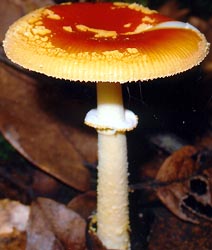 1. Amanita subfrostiana, China. |
| cap |
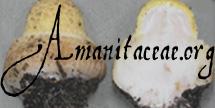
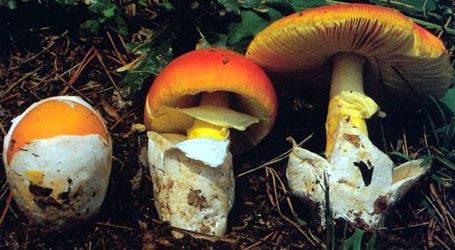
The cap of A. subfrostiana is 40 - 70 mm wide, convex to applanate, red over disc, and becoming pale orange towards the margin. The volval remnants on pileus are floccouse to felty, yellow to yellowish or orange; the margin has long striations. |
| gills |
The lamellae are white to cream-colored, and the short lamelullae are usually truncate. |
| stem |
The stem is 60 - 100 × 10 - 15 mm, subcylindric or tapering upwards. The basal bulb is subglobose to ovoid, 10 - 30 mm wide; its upper part is covered with yellowish floccose volval remnants often forming a short limb. The ring is membranous, its upper surface is whitish and its lower surface is yellowish. |
| odor/taste | double click in markup mode to edit. |
| spores |
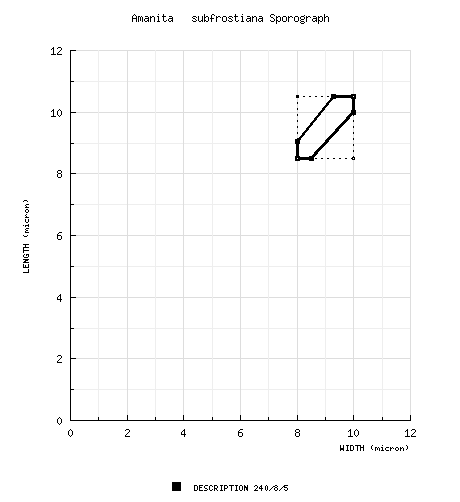
The spores of A. subfrostiana are (8.0-) 8.5 - 10.5 (-12.0) x (7.0-) 8.0 - 10.0 (-10.5) µm, globose to subglobose, inamyloid, colorless, hyaline, thin-walled, smooth. There are clamps at bases of basidia. |
| discussion |
Amanita subfrostiana grows in coniferous or mixed forests. To date it has been found only in southwestern China. Amanita frostiana (Peck) Sacc. is similar to the present species. However, A. frostiana, originally described from North America, usually has a less saturated, yellow-orange to orange-yellow cap, shorter striations along the cap margin, and paler-colored volval remnants on the cap.—Zhu L. Yang |
| brief editors | RET |

 Spore data sets and their composite