

| name | Amanita spretella |
| name status | nomen acceptum |
| author | (Murrill) Murrill |
| english name | "Florida False Caesar" |
| intro |
The following description is based on the original description by Murrill (1948). |
| cap |
The cap of A. spretella is 50 mm wide, gray, darker over the center, convex to broadly convex, slightly umbonate, smooth, viscid when moist, with striate margin (60% of the radius). Volval remnants are absent. The flesh is thin and white. |
| gills |
The gills are crowded, narrow, adnexed, white, unchanging when damaged, with a smooth edge. |
| stem |
The stem is 85 × 6 - 8 mm, slightly tapering upward, hollow, fibrillose, white above the ring, pale rosy-cream below. The ring is skirt-like, pure white, unchanging, and attached 25 mm below the top of the stem. The saccate volva is baggy, lobed, white, unchanging, membranous, not fragile, and 30 × 20 mm. |
| spores |
In his study of the type collection, Jenkins (1979) reported the following spore measurements: 11.7 - 13.3 × (6.7-) 7.0 - 7.8 µm. They are ellipsoid to elongate and inamyloid. |
| discussion |
This species was originally described from
a single specimen in northern Florida (Alachua County) in oak dominated
upland in an otherwise wetland area. Murrill emphasizes among other things the delicate coloring of the stem and a possible relationship to Amanita spreta (Peck) Sacc. The general appearance of this species suggests it might be a member of Amanita stirps Hemibapha, however, that is not the case; neither is it related to Amanita spreta which is a member of stirps Caesarea. The present species cannot belong in either of these groups because the subhymenium is not cellular. With some hesitation, RET suggests the possibility of a relationship to A. calyptroderma Peck. At any rate we will use the phrase "False Caesar" in our proposed English name for this species. New material of this species is very much desired and is necessary for a proper understanding of it.—R. E. Tulloss and L. Possiel |
| brief editors | RET |
| name | Amanita spretella | ||||||||||||||||||||
| author | (Murrill) Murrill. 1948. Lloydia 2(2): 105. | ||||||||||||||||||||
| name status | nomen acceptum | ||||||||||||||||||||
| english name | "Florida False Caesar" | ||||||||||||||||||||
| synonyms |
≡Venenarius spretellus Murrill. 1948. Lloydia 2(2): 105. The editors of this site owe a great debt to Dr. Cornelis Bas whose famous cigar box files of Amanita nomenclatural information gathered over three or more decades were made available to RET for computerization and make up the lion's share of the nomenclatural information presented on this site. | ||||||||||||||||||||
| MycoBank nos. | 284074, 291954 | ||||||||||||||||||||
| GenBank nos. |
Due to delays in data processing at GenBank, some accession numbers may lead to unreleased (pending) pages.
These pages will eventually be made live, so try again later. Search:
Showing 0 to 0 of 0 entries | ||||||||||||||||||||
| holotypes | FLAS | ||||||||||||||||||||
| type studies | Jenkins. (1979). Mycotaxon 10: ??. | ||||||||||||||||||||
| intro |
The following text may make multiple use of each data field. The field may contain magenta text presenting data from a type study and/or revision of other original material cited in the protolog of the present taxon. Macroscopic descriptions in magenta are a combination of data from the protolog and additional observations made on the exiccata during revision of the cited original material. The same field may also contain black text, which is data from a revision of the present taxon (including non-type material and/or material not cited in the protolog). Paragraphs of black text will be labeled if further subdivision of this text is appropriate. Olive text indicates a specimen that has not been thoroughly examined (for example, for microscopic details) and marks other places in the text where data is missing or uncertain. The following material not directly from the protolog of the present taxon and not cited as the work of Dr. Z. L. Yang or another researcher is based on original research by R. E. Tulloss. The following material is based on the protolog and the type study by Jenkins (cited above). | ||||||||||||||||||||
| pileus | 50 mm wide, gray, darker on disc, convex to subexpanded, slightly umbonate, viscid; context white, thin; margin striate (0.6R), with entire edge; universal veil not described. | ||||||||||||||||||||
| lamellae | adnexed, crowded, white, unchanging when cut or bruised, narrow, with entire edge; lamellulae not described. | ||||||||||||||||||||
| stipe | 85 × 6 - 8 mm, white above, with lower half rosy cream, furfuraceous, slightly narrowing upward; context hollow; partial veil superior, fixed 25 mm from apex, entire, deflexed, pure white, unchanging; universal veil as saccate volva, white, unchanging, lobed, baggy, not fragile, 30 × 20 mm. | ||||||||||||||||||||
| odor/taste | not recorded. | ||||||||||||||||||||
| macrochemical tests |
none recorded. | ||||||||||||||||||||
| basidiospores | From (Jenkins, 1979): [-/-/-] 11.7 - 13.3 × (6.7-) 7.0 - 7.8 μm, (Q = 1.50 - 1.88; Q' = 1.66), hyaline, thin-walled, inamyloid, ellipsoid to elongate, often adaxially flattened; apiculus sublateral, cylindric; contents guttulate; color in deposit unknown. | ||||||||||||||||||||
| ecology | Solitary. In fairly good soil, at edge of high hammock. "Hammock" is a term used in Florida for relatively high land surrounded by a low, wet area. Hammocks have distinct vegetation (including large woody plants) in comparison to the surrounding, lower land. | ||||||||||||||||||||
| material examined | from type study of Jenkins (1979): U. S. A.: FLORIDA— Alachua Co. - Gainesville, 19.viii.1948 W. A. Murrill F 40841 (holotype, FLAS). | ||||||||||||||||||||
| discussion | Neither of the editors have examined the type of this rather briefly described species. | ||||||||||||||||||||
| citations | —R. E. Tulloss | ||||||||||||||||||||
| editors | RET | ||||||||||||||||||||
Information to support the viewer in reading the content of "technical" tabs can be found here.
| name | Amanita spretella |
| bottom links |
[ Keys & Checklists ] [ Draft description of, & key to, sect. Caesareae ] |
| name | Amanita spretella |
| bottom links |
[ Keys & Checklists ] [ Draft description of, & key to, sect. Caesareae ] |
 Spore data sets and their composite
Each spore data set is intended to comprise a set of measurements from a single specimen made by a single observer; and explanations prepared for this site talk about specimen-observer pairs associated with each data set. Combining more data into a single data set is non-optimal because it obscures observer differences (which may be valuable for instructional purposes, for example) and may obscure instances in which a single collection inadvertently contains a mixture of taxa.
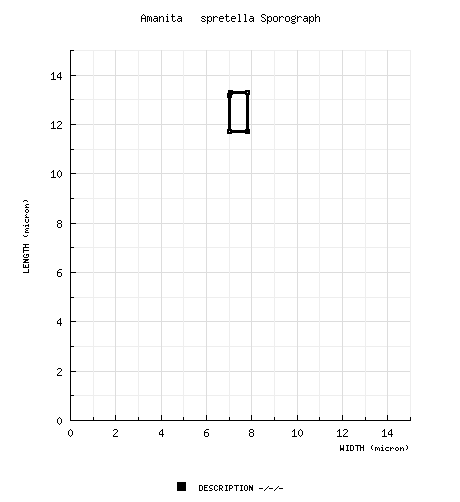

Text and User-Generated Sporographs are published under the Creative Commons License.

In the case of a taxon page, image credits are on the 'image' tab.