

| name | Amanita sp-T36 |
| name status | cryptonomen temporarium |
| author | Tulloss, D. P. Lewis & J. Justice |
| images |
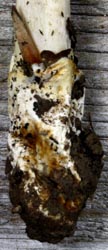 1. Amanita sp-T36, Ha Ha Tonka St. Pk., Missouri, U.S.A. : (RET 443-7) 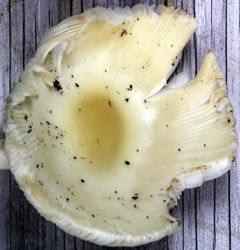 2. Amanita sp-T36, Ha Ha Tonka St. Pk., Missouri, U.S.A. : (RET 443-7) 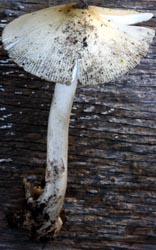 3. Amanita sp-T36, Ha Ha Tonka St. Pk., Missouri, U.S.A. : (RET 443-3) 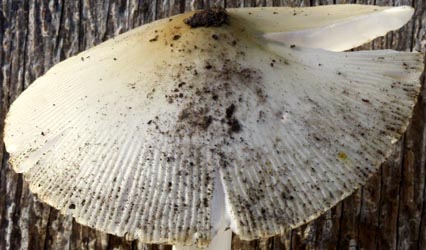  4. Amanita sp-T36, Ha Ha Tonka St. Pk., Missouri, U.S.A. : (RET 443-3) |
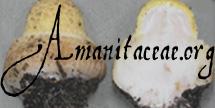
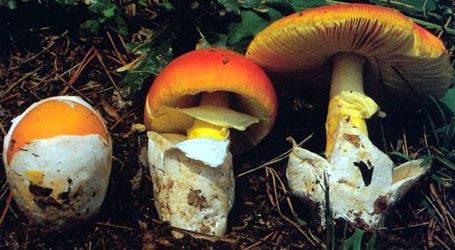
| cap | The cap is 58 - 74 mm wide, whitish to cream to yellowish cream, with light brown or sordid yellow or yellowish tan in the center, moist, and umbonate. Its flesh is white, 4 - 7 mm thick over the stem. The cap's margin flares upward with age and is striate (with striations (30%-) 40 - 50% of pileus radius). The volva appears infrequently on the cap as a white patch over the center. |
| gills | The gills are free, close, 4.5 - 6 mm broad, with fimbriate margins. We have no information on short gills at this time. |
| stem | The stem is 91 - 143 × 7 - 10 mm, dull whitish, and lacks a ring. The volva at the stem base is sack-like (e.g., 35 × 13.5 mm), ample, white (in one specimen, with some golden yellow patches, especially toward the base), with the sack's limb 0.5 - 2 mm thick, and with no internal limb of the volva observed. |
| odor/taste | Odorless. |
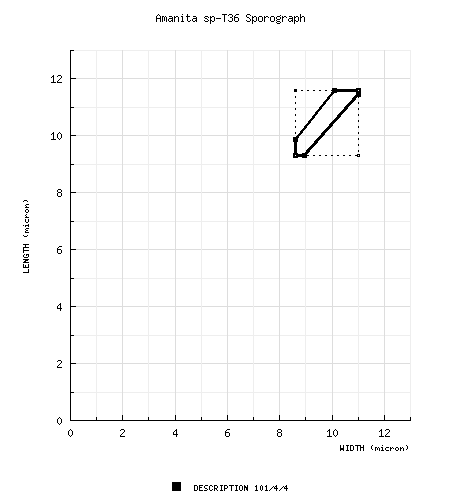
| spores | The spores measure (8.5-) 9.3 - 11.6 (-14.5) × (8.0-) 8.6 - 11.0 (-12.6) µm, and are globose to subglobose (rarely ellipsoid) and inamyloid. No clamps are present at bases of basidia. |
| discussion |
This species occurs solitarily, with Pine (Pinus) or in Oak-Hickory (Quercus-Carya) forest. This species has been found from the sandy forests of eastern Texas to as far north as Ha Ha Tonka St. Pk., Missouri. For purposes of comparison, see Amanita sp-T05.—R. E. Tulloss, D. P. Lewis, and J. Justice |
| brief editors | RET |

 Spore data sets and their composite