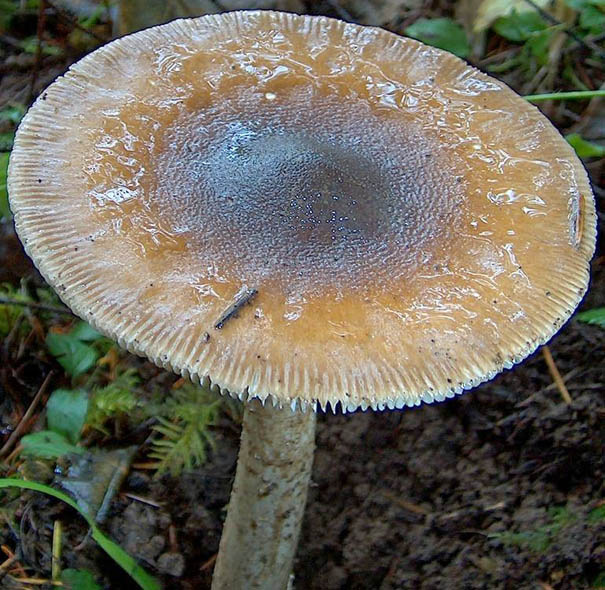
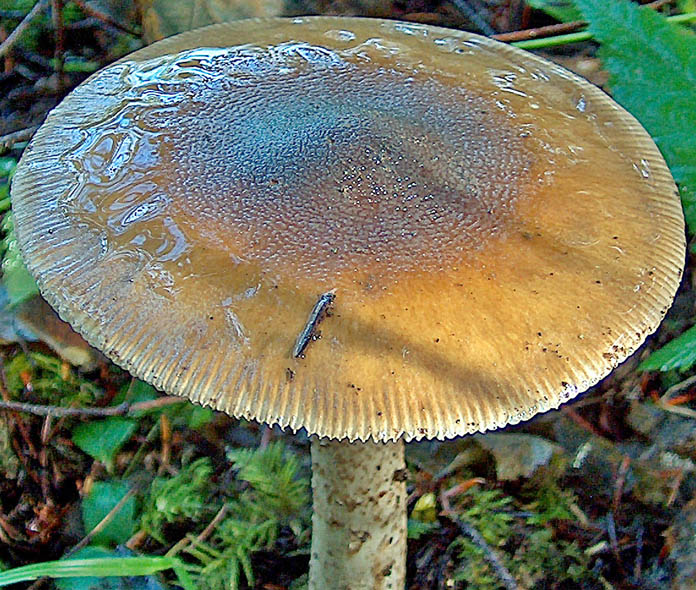
3. Amanita sp-ORO2, note variable cap texture, Lebanon, Linn Co., Oregon, U.S.A. (RET 457-2)
intro
For the time being, please see the technical tab of this page for developing data on this species.
discussion
—R. E. Tulloss
brief editors
RET
name
Amanita sp-OR02
author
Tulloss
name status
cryptonomen temporarium
GenBank nos.
Due to delays in data processing at GenBank, some accession numbers may lead to unreleased (pending) pages.
These pages will eventually be made live, so try again later.
Olive text indicates a specimen that has not been
thoroughly examined (for example, for microscopic details) and marks other places in the text
where data is missing or uncertain.
The following material is based on information and images from the collector, DNA sequences derived by L. V. Kudzma, and from other original research of R. E. Tulloss.
PAGE CONSTRUCTION BEGINNING 12.xi.2014.
macrochemical tests
none recorded.
lamella edge tissue
sterile.
ecology
Solitary. Oregon: In young Pinus plantation (originated 1998) with multiple species of Pinus and scattered decidous trees.
3. Amanita sp-ORO2, note variable cap texture, Lebanon, Linn Co., Oregon, U.S.A. (RET 457-2)
photo
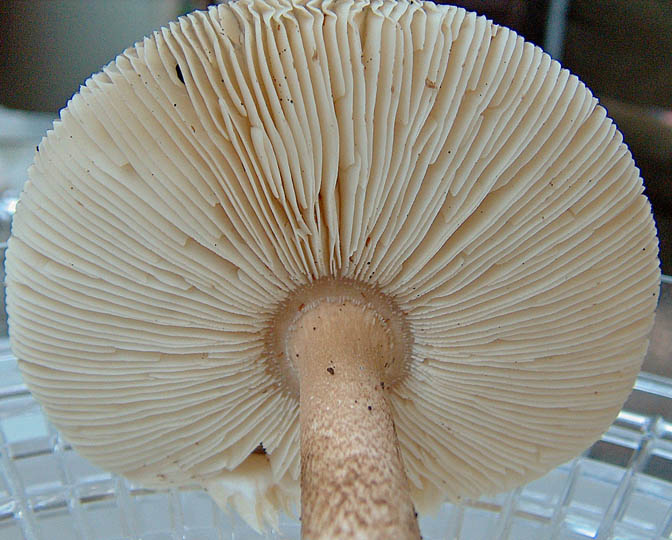
Britney Ramsey - (1-3) Lebanon, Linn County, Oregon, U.S.A. (RET 457-2) [Note: Original full size photographs can be viewed at www.mushroomobserver.org here.]
name
Amanita sp-OR02
name
Amanita sp-OR02
Spore data for collections provisionally identified as: Amanita sp-OR02 Tulloss
Each spore data set is intended to comprise a set of measurements from a single specimen made by a single observer;
and explanations prepared for this site talk about specimen-observer pairs associated with each data set.
Combining more data into a single data set is non-optimal because it obscures observer differences
(which may be valuable for instructional purposes, for example) and may obscure instances in which
a single collection inadvertently contains a mixture of taxa.




 Spore data sets and their composite