1. Amanita sp-NFL09, Prov. Newfoundland and Labrador, Canada
cap
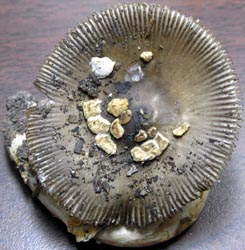
The cap's umbo and the ridges between the cap's marginal striations are dark brown, with remainder of the cap a slightly paler grayish brown and more or less virgate. The cap's marginal striations occupy about 25% of the cap's radius. The volva remnants on the cap are rather thick, large warts or small patches which are dirty white, become more sordid or (sometimes) more yellowish gray with time.
stem
The volva on the stem's base is a cup-like volva with irregular limbs and leaving irregular patches several cm higher on stipe. The outer surface of the volva is white in its lowest portion, the upper portion may be white at first, and becomes ocher-yellow. Both inner and outer surfaces and the volval limbs appear sponge-like under 10× lens.
spores
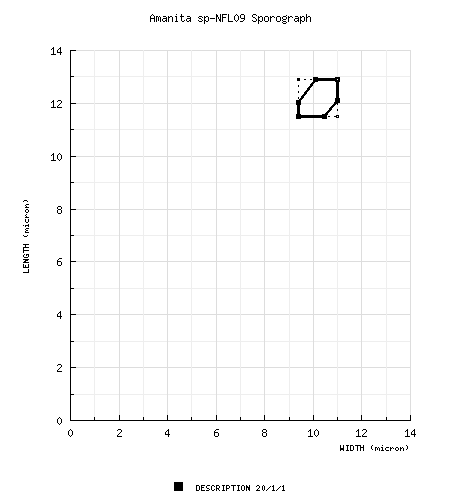
The spores measure (11.0-) 11.5 - 12.9 (-13.5) × (8.5-) 9.4 - 11.0 (-11.7) µm and are subglobose to broadly ellipsoid (infrequently ellipsoid) and inamyloid. Clamp information t.b.d.
discussion
—R. E. Tulloss
brief editors
RET
name
Amanita sp-NFL09
name status
cryptonomen temporarium
GenBank nos.
Due to delays in data processing at GenBank, some accession numbers may lead to unreleased (pending) pages.
These pages will eventually be made live, so try again later.
31.viii.2005 Maria Voitk s.n. [Tulloss 8-31-05-B] (RET 388-8)
L. Nagy, Agaricales Diversification, Szeged Univ.
Showing 1 to 1 of 1 entries
intro
Olive text indicates a specimen that has not been
thoroughly examined (for example, for microscopic details) and marks other places in the text
where data is missing or uncertain.
The following material is based on original research of R. E. Tulloss.
Each spore data set is intended to comprise a set of measurements from a single specimen made by a single observer;
and explanations prepared for this site talk about specimen-observer pairs associated with each data set.
Combining more data into a single data set is non-optimal because it obscures observer differences
(which may be valuable for instructional purposes, for example) and may obscure instances in which
a single collection inadvertently contains a mixture of taxa.



 Spore data sets and their composite