

| name | Amanita sp-N48 |
| author | Tulloss |
| name status | cryptonomen temporarium |
| GenBank nos. |
Due to delays in data processing at GenBank, some accession numbers may lead to unreleased (pending) pages.
These pages will eventually be made live, so try again later. |
| intro |
Olive text indicates a specimen that has not been
thoroughly examined (for example, for microscopic details) and marks other places in the text
where data is missing or uncertain. The following material is based on original research of R. E. Tulloss. |
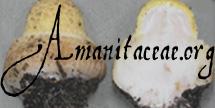
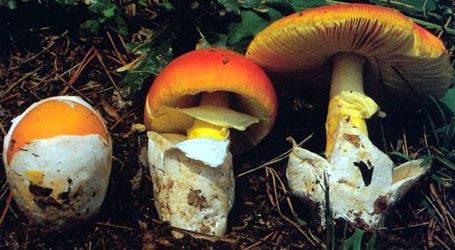
| pileus | 65 mm wide, brownish yellow, with gray-brownish tan over umbo; context ??; margin nonappendiculate, striate (0.3±R); universal veil absent. |
| stipe | exannulate; universal veil saccate, rather robust, gray on inner surface, white on exterior surface and not graying when crushed. |
| odor/taste | neither recorded. |
| macrochemical tests |
none recorded. |
| basidiospores | [20/1/1] (9.1–) 9.4–11.0 (–12.2) × (7.6–) 8.0–9.8 (–10.2) µm, (L = 10.2 µm; W = 8.8 µm; Q = (1.06–) 1.11 – 1.20 (–1.22); Q = 1.14), hyaline, colorless, ??-walled, smooth, inamyloid, subglobose to broadly ellipsoid, ??; apiculus sublateral, ??; contents ??; ?? in deposit. |
| ecology | Solitary. At ca. 135 m elev. After a period of heat between 30° and 40° C followed by several days of drenching rains, in deciduous woods. |
| material examined | U.S.A.: CONNECTICUT—New London Co. - Colchester, Day Pond St. Pk. [41°33'25" N/ 72°25'06" W, 134 m], 25.viii.2007 Noah Siegel s.n. [Tulloss 8-25-07-A] (RET 438-5, nrITS fragment & nrLSU seq'd.). |
| discussion |
The pileus is somewhat suggestive of A.
sinicoflava; however, the saccate volva is
membranous and not graying. For sporograph comparison with A. sp-N45, see techtab for A. sp-N44. |
| citations | —R. E. Tulloss |
| editors | RET |
Information to support the viewer in reading the content of "technical" tabs can be found here.
 Spore data sets and their composite
Each spore data set is intended to comprise a set of measurements from a single specimen made by a single observer; and explanations prepared for this site talk about specimen-observer pairs associated with each data set. Combining more data into a single data set is non-optimal because it obscures observer differences (which may be valuable for instructional purposes, for example) and may obscure instances in which a single collection inadvertently contains a mixture of taxa.
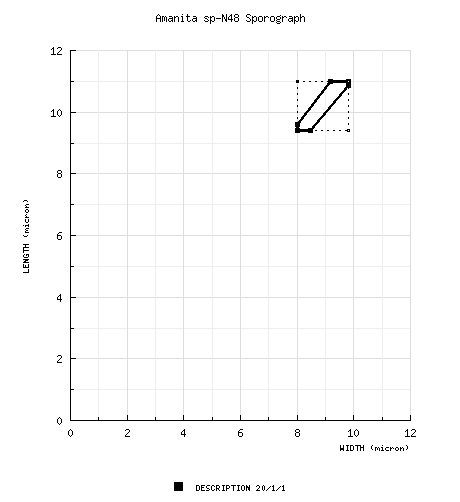

Text and User-Generated Sporographs are published under the Creative Commons License.

In the case of a taxon page, image credits are on the 'image' tab.