| name |
Amanita sp-N35 |
| author |
Tulloss |
| name status |
cryptonomen temporarium |
| GenBank nos. |
Due to delays in data processing at GenBank, some accession numbers may lead to unreleased (pending) pages.
These pages will eventually be made live, so try again later.
|
| intro |
Olive text indicates a specimen that has not been
thoroughly examined (for example, for microscopic details) and marks other places in the text
where data is missing or uncertain.
The following text is based on original research of R. E. Tulloss. |
| pileus |
91 - 124 mm wide, pale cream, becoming olive-cream with brown disc in age, ovoid at first, then campanulate, finally broadly campanulate with broad umbo, viscid when wet, tacky and dull; context white with waterly lines below pileipellis and above lamellae, 5 - 7.5 mm thick at stipe, thinning evenly for two-thirds to three-fourths of radius, then a membrane to margin; margin striate (R), nonappendiculate; universal veil absent. |
| lamellae |
free, with decurrent line on stipe, crowded, white in mass and in side view, unchanging with age or when cut or bruised, drying orangish pink, 5.5 - 9.5 mm broad; lamellulae truncate, of diverse lengths, plentiful, unevenly distributed. |
| stipe |
118 - 188 × 14 - 17 mm, white to pallid ground color with some regions pale orange fading to pale ocher, rapidly gray from handling and becoming gray from base up in age, drying sordid, narrowing upward, very slightly flaring at apex, pulverulent to punctate (concolorous) in upper third, fibrillose below (at first fibrils concolorous, then gray to black); context very firm, white, unchanging when cut or bruised, hollow, with white pithy cross walls and with white cottony fibrils sometimes also forming crosswalls, with central cylinder 5 - 7 mm wide, with larva tunnels concolorous; exannulate; universal veil as saccate volva, white, smooth, soft, membranous, becoming easily separable from stipe with age, about 1 mm thick halfway between attachment and tip of limb, 40 - 50 × 24 - 28 mm, with limbus internus placed quite low on interior of limb and small or merely shelf-like. |
| odor/taste |
Odor none. Taste not recorded. |
macrochemical
tests |
Spot test for laccase: positive in stipe stuffing in young and intermediate age specimens; positive in very bottom of volval sac in young specimen and in limb (only) of volval sac in specimen of intermediate age; completely negative in specimens with pigmented pileus. Spot test for tyrosinase (paracresol): positive throughout except in spots on faces of lamellae in specimens of all ages and in spots in pileus context in specimen of intermediate age. |
| basidiospores |
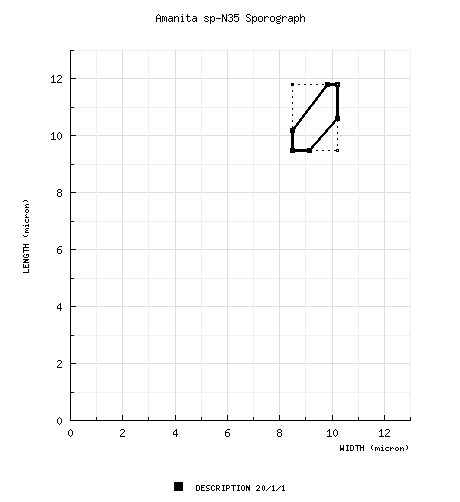
[20/1/1] (8.5-) 9.5 - 11.8 × (8.2-) 8.5 - 10.2 (-10.5) µm, (L = 10.6 µm; W = 9.6 µm; Q = 1.04 - 1.20; Q = 1.10), hyaline, thin-walled, smooth, ??, globose to subglobose to broadly ellipsoid, often adaxially flattened, sometimes expanded at one end; apiculus sublateral, cylindric to slendery truncate-conic; contents granular or monoguttulate with or without small additional granules; ? in deposit. |
| ecology |
Subgregarious. In fine loam under mixed hardwoods including Quercus. |
| material examined |
U.S.A.: CONNECTICUT—Middlesex Co. - Middleton Twp., Connecticut For. & Parks Assoc., 25.vii.1992 Arlene Rainis Bessette s.n. [Tulloss 7-25-92-F] (RET 064-6). |
| discussion |
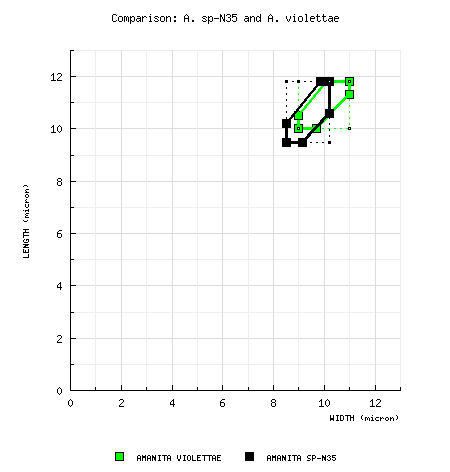
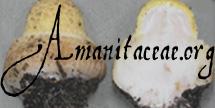
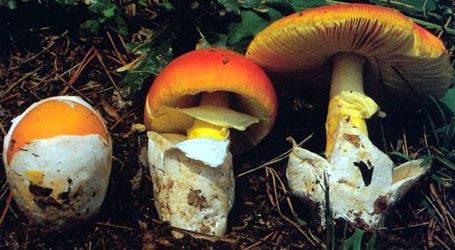
Could this be Amanita violettae? Also compare sp-N47. The Bessettes provided a photograph.
The figures that follow provide comparisons of sporographs for the taxa mentioned above:

|
| citations |
—R. E. Tulloss |
| editors |
RET |
|


 Spore data sets and their composite