

| name | Amanita sp-N19 |
| name status | cryptonomen temporarium |
| author | Tulloss |
| intro | This provisional taxon was originally based on a collection from the northeastern U.S., and all collections that have been placed in it since have been from a region extending from Connecticut to New Hampshire. Collections attributed to another provisional taxon A. sp-S01 have been made in the same region, and the question arises as to whether an inappropriate distinction has been made. See also ?Amanita russuloides. |
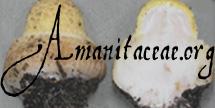
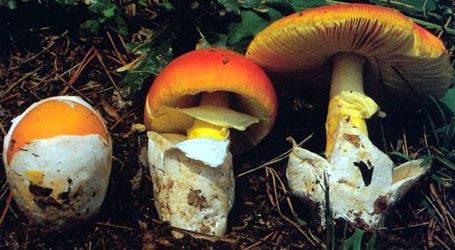
| cap | The cap of this species is 38 - 62 mm wide, yellowish with darker disc, tacky to viscid, and shiny. The striations on the cap margin extend to about 20 to 30% of the cap's radius. The cap often bears thin and narrow patches of white or whitish volva. |
| gills | The gills are free to narrowly adnate, subcrowded to crowded, pale yellowish white to cream in mass, and white in side view. The short gills are truncate to rounded truncate. |
| stem | The stuffed or solid stem of A. sp-N19 is 54 - 87 × 6 mm, white and may turn brown from handling. Its flesh is white and unchanging when cut or bruised. It bears a bulb that is 15 - 19 × 11 - 14 mm and is ovoid to ellipsoid. There is a small, whitish, membranous ring on the stem somewhere between mid-stem and about one-third of the stem's length from its top. The ring usually collapses on the stem or disappears completely. The white volva takes the form of a very narrow thin collar or a membranous flap of tissue arising from the bulb with the flap's upper tip up to 25 mm above the bottom of the bulb. |
| odor/taste | The odor has been described as "fungoid" or lacking. |
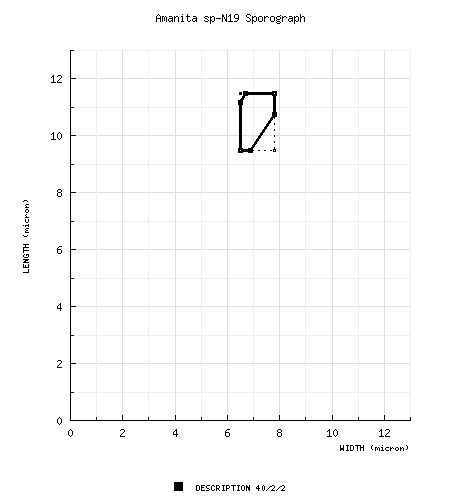
| spores | The spores of A. sp-N19 measure (8.8-) 9.5 - 11.5 (- 13.2) × (6.0-) 6.5 - 7.8 (-8.0) µm and are ellipsoid to elongate and inamyloid. Clamps are probably absent from bases of the basidia. |
| discussion | On the taxon page for A. russuloides, the reader will find a brief discussion of the problem of the actual number of gemmatoid taxa in eastern North America.—R. E. Tulloss |
| brief editors | RET |
Information to support the viewer in reading the content of "technical" tabs can be found here.
 Spore data sets and their composite
Each spore data set is intended to comprise a set of measurements from a single specimen made by a single observer; and explanations prepared for this site talk about specimen-observer pairs associated with each data set. Combining more data into a single data set is non-optimal because it obscures observer differences (which may be valuable for instructional purposes, for example) and may obscure instances in which a single collection inadvertently contains a mixture of taxa.

Text and User-Generated Sporographs are published under the Creative Commons License.

In the case of a taxon page, image credits are on the 'image' tab.