| name |
Amanita sp-N09 |
| author |
Tulloss |
| name status |
cryptonomen temporarium |
| GenBank nos. |
Due to delays in data processing at GenBank, some accession numbers may lead to unreleased (pending) pages.
These pages will eventually be made live, so try again later.
|
| intro |
|
| pileus |
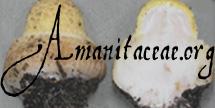
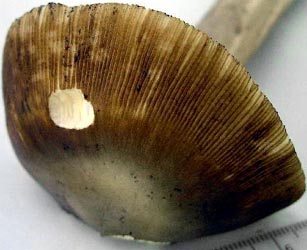
20 - 55 (-70) mm wide, pale brownish gray to brownish gray to darker brown over disk (5B2, 5C3) to browner than 5E7, but not nearly as dark as 5F7, often maculate with irregular pale yellowish marks irregularly distributed, sometimes zonate, often with depigmented region near center (especially if universal veil absent), ovate, than campanulate, then broadly conic, then convex, umbonate, subshiny to shiny (when wet), tacky to viscid (when wet); context white, sometimes grayish in disk in larger basidiomes, with faint watersoaked line at interface to lamellae, 1 - 2 (-4.5) mm thick above stipe, thinning evenly to a membrane in about three quarters of radius; margin striate (0.25 - 0.35 (-0.45)R) to tuberculate striate, nonappendiculate; universal veil absent or as a detersile patch, subverruculose, membranous, not changing color when cut or bruised. |
| lamellae |
free to narrowly adnate or adnate by a mere line, without decurrent line on stipe apex, subcrowded to crowded, whitish to off-white to cream to a dingy variant of these colors both in mass and in side view, occasionally dark brown in old wounds, 2 - 4.5 (-6) mm broad; lamellulae truncate to subtruncate to rounded truncate, to truncate with attenuate tooth at pileus context, length very variable, common. |
| stipe |
51 - 88 (-123) × 3 - 8 (-10) mm, white to very pale brown to white with grayish tints in lower half, browning or becoming grayer from handling, sometimes with a small, subradicating projection on base of stipe, narrowing upward slightly, not flaring at apex or flaring only very close to apex, surface minutely pulverulent above, minutely fibrillose (10× lens) below, finely longitudinally striatulate; context< off white with a faint brownish tint or grayish white, concolorous in larva tunnels, stuffed to hollow, with stuffing of white to grayish white cottony to felted material, with 2.5 - 6 mm wide central cylinder; exannulate; universal veil as saccate volva, white on inner and external surfaces, external surface browning in age especially on edge, soft, smooth, leathery, tough, membranous, 1- - 2 mm thick at midpoint between connection to stipe and tip of limb, adnate to stipe for one half to two thirds (rarely one third) of distance from stipe base to tip of limb, sometimes with raised narrow exterior ring just below point of attachment, with tip of limb 23 - 44 (-55) mm from stipe base. |
| odor/taste |
Odorless. Taste not recorded. |
macrochemical
tests |
Spot test for tyrosinase (L-tyrosine ): rapidly positive on surface, and in context, of stipe. Test voucher: ??. |
| lamella trama |
bilateral; ??; vascular hyphae quite frequent, branching, 2.8 - 7.0 µm wide. |
| basidia |
e.g., 55 × 14.0 - 16.1 µm, clavate, thin-walled, 4-sterigmate; sterigmata large, up to 1.5 µm wide at base; clamps ??probably absent. |
| basidiospores |
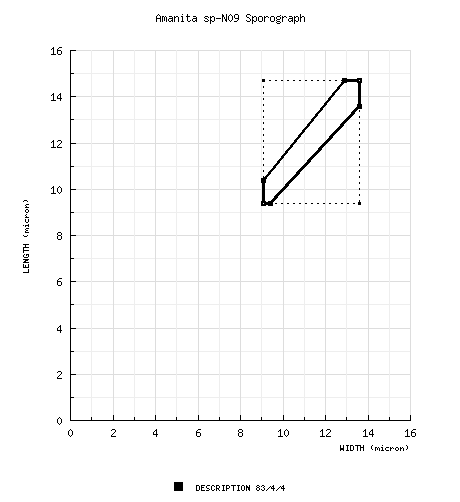
[83/4/4] (8.0-) 9.4 - 14.7 (-17.1) × (7.0-) 9.1 - 13.6 (-16.8) µm, (L = 10.8 - 12.2 µm; L’ = 11.5 µm; W = 10.0 - 11.4 µm; W’ = 10.7 µm; Q = 1.0 - 1.14 (-1.20); Q = 1.06 - 1.08; Q’ = 1.07), inamyloid, smooth, thin-walled, hyaline, globose to subglobose to broadly ellipsoid; contents ??-guttulate, often with additional small granules; apiculus sublateral, truncate conic, to 1.7 µm long; ?? in deposit. |
| ecology |
Solitary. New Jersey: In humus associated with ??. New York: In loam or loamy clay under Tsuga canadensis or in very wet woods under Carya spp. including Carya ovata with Acer sp. |
| material examined |
U.S.A.: NEW JERSEY—Hunterdon Co. - Lebanon, Oakmoss Mycol. Preserve [40°38'50.07" N/ 74°47'50.92" W], 25.vii.2007 Richard Balsley s.n. (in herb. R. Balsley; RET 409-6).
NEW YORK—Delaware Co. - Emmon’s Bog, 17.viii.1985 Ms. G. Van Matre s.n. [Tulloss 8-17-85-C] (RET 101-10). Otsego Co. - Oneonta, College Camp, 16.viii.1985 Ursula Hoffman s.n. [Tulloss 8-16-85-G] (RET 102-1). Schenectady Co. - Mariaville, 18.viii.1986 M. A. King & R. E. Tulloss 8-18-86-A (RET 468-8), -B (RET 468-3). Unkn. Co. - Pine Lake Campus, ca. border of Otsego & Delaware Cos., 17.viii.1985 Richard Youst s.n. [Tulloss 8-17-85-B] (RET 101-9). |
| discussion |
This mall species can be distinguished by its size, its sepiaceous brown pileus spotted irregularly with paler yellow or olivaceous yellow and by its bearing a notable depigmented area or small patch of universal veil near or at the center of the disc. |
| citations |
—R. E. Tulloss |
| editors |
RET |
|




 Spore data sets and their composite