Due to delays in data processing at GenBank, some accession numbers may lead to unreleased (pending) pages.
These pages will eventually be made live, so try again later.
Search:
accession
locus
voucher
source
No data available in table
Showing 0 to 0 of 0 entries
intro
Olive text indicates a specimen that has not been
thoroughly examined (for example, for microscopic details) and marks other places in the text
where data is missing or uncertain.
The following material is based on original research of R. E. Tulloss.
pileus
brown-gray; universal veil dominantly pulverulent, with subpyramidal warts over disc.
[45/1/1] (9.1-) 10.1 - 14.0 (-15.0) × 6.6 - 9.8 (-10.1) µm, (L = 12.1 µm; W = 8.1 µm; Q = (1.21-) 1.25 - 1.80 (-1.85); Q = 1.49), hyaline, colorless, smooth, thin-walled, amyloid, ellipsoid to elongate, occasionally broadly ellipsoid, often adaxially flattened, occasionally expanded at one end; apiculus sublateral; contents guttulate; ?? in deposit.
material examined
MÉXICO: VERACRUZ—ca. Xalapa, 1.vii.1983 participant in 1ra. Exposición de Hongos del INIREB y 4a. de la Universidad Veracruzana s.n. [Gastón Guzmán 23203] (RET 121-6; XAL).
discussion
This possible taxon (if it proves distinct) would be the only one in the genus Amanita other than A. pelioma that can exhibit a blue-green color in its volval material (usually on the stipe). Hence, it is of interest to see a comparison of the sporographs of the two "taxa," below.
citations
—R. E. Tulloss
editors
RET
Information to support the viewer in reading the content of "technical" tabs
can be found here.
name
Amanita sp-M34
name status
cryptonomen temporarium
author
Tulloss
name
Amanita sp-M34
name
Amanita sp-M34
Spore data for collections provisionally identified as: Amanita sp-M34 Tulloss
Each spore data set is intended to comprise a set of measurements from a single specimen made by a single observer;
and explanations prepared for this site talk about specimen-observer pairs associated with each data set.
Combining more data into a single data set is non-optimal because it obscures observer differences
(which may be valuable for instructional purposes, for example) and may obscure instances in which
a single collection inadvertently contains a mixture of taxa.



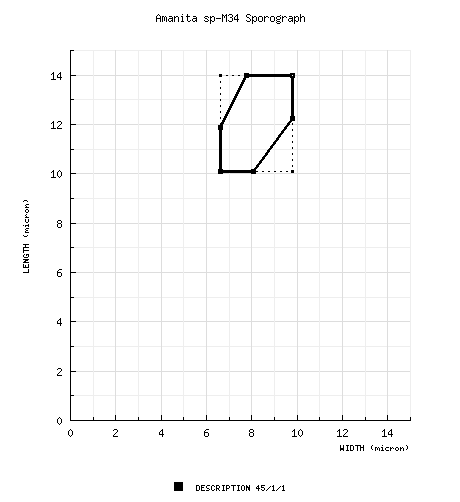
 Spore data sets and their composite