| name |
Amanita sp-M15 |
| name status |
cryptonomen temporarium |
| GenBank nos. |
Due to delays in data processing at GenBank, some accession numbers may lead to unreleased (pending) pages.
These pages will eventually be made live, so try again later.
|
| intro |
Olive text indicates a specimen
that has not been thoroughly examined (for example,
for microscopic details) and marks other places in the
text where data is missing or uncertain.
The following material is based on molecular studies
of Drs. Jozsef Geml and Linas Kudzma and other original
research by R. E. Tulloss. |
| pileus |
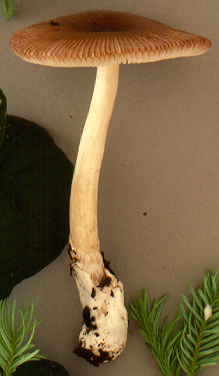
up to 75 mm wide, orange-brown to brown, darkest over disc and (occasionally) over striations, unchanging when cut or bruised, subvirgate, convex with distinct umbo, becoming planoconvex with umbo in depression, tacky, subshiny; context white with sordid line over lamellae, 4 mm thick over stipe, thinning evenly for 0.65R, then membranous to margin; margin striate (0.4 - 0.45R), nonappendiculate; universal veil absent. |
| lamellae |
free, ??, pale cream in mass, off-white in side view, up to 8.5 mm broad, broadest at about 0.75 distance from stipe to margin; lamellulae subtruncate to rounded truncate, unevenly distributed, of diverse lengths, infrequent. |
| stipe |
up to 161 × 11.5 mm, off-white, becoming faintly brown from handling, narrowing upward, flaring at apex, subsatiny above, finely fibrillose below; context off-white except sordid in region of lower stipe not including base, unchanging when cut or bruised, hollow, with central cylinder 4.5 mm wide and lined with wispy white fibrils; exannulate; universal veil as saccate volva, membranous, white on surface and throughout interior, soft, up to 57 × 21 mm, up to 1+ mm thick, with point of attachment about 0.35 distance from stipe base to highest point of limb, with small limbus internus place approximately at point of attachment. |
| odor/taste |
Odor indistinct. Taste not recorded. |
macrochemical
tests |
Spot test for laccase (syringaldazine) - completely negative throughout basidiome. Test voucher: Tulloss 8-31-94-A. |
| ecology |
Solitary. At 2800 m elev. In dark loam of mixed forest dominated by Quercus spp. with Pinus patula, Abies religiosa, Baccharis conferta, and Arbutus xalapensis. |
| material examined |
MÉXICO:
EDO. MÉXICO—Mpio.
Toluca - km 22 Toluca-Temacaltepec Rd., El Mapa
[3150 m], 4.vii.1996 Adriana Montoya Esquivel 1544
(RET 252-3, nrITS seq'd.; TLXM). Mpio. Unkn. - Llano Grande,
18.viii.1998 C. E. Skovnik s.n. [Tulloss 8-18-98-C]
(RET 293-1, nrITS seq'd.; TLXM).
TLAXCALA—Mpio.
Huamantla - El Volcán La Malintzi, La Cañada Grande
[19°14’45” N/ 97°54’56” W, 3110 m], 16.vii.1996 A.
Montoya Esquivel & R. E. Tulloss [Tulloss
7-16-96-C] (RET 256-4, nrITS seq'd.; TLXM), [Tulloss
7-16-96-D] (RET 256-5, nrITS seq'd.; TLXM).
Mpio. Panotla - 1 km E of San
Francisco Temezontla [19°20’41” N/ 98°16’31” W,
2640 m], 17.vii.1996 A. Montoya Esquivel & R.
E. Tulloss [Tulloss] 7-17-96-D (RET 255-7,
nrITS seq'd.; TLXM),
14.viii.1998 unkn. colls. s.n. [Tulloss 8-14-98-??]
(RET ??; TLXM).
Mpio. San Luis Teolocholco - Parq. Nac. La Malinche,
SW slope of La Malintzi volcano [19°13’53” N/ 98°03’59” W,
3250-3290 ], 14.viii.1998 A. Kong Luz s.n. [Tulloss
8-14-98-A] (RET 292-9, nrITS seq'd.; TLXM).
Mpio. Tlaxco - El
Rodeo, Cerro El Peñon [19°41'19" N/ 98°14'02"W,
2775 m], 31.viii.1994 A. Estrada Torres & L.
Varela Fregoso p.p. [Tulloss 8-31-94-A]
(RET 133-9; TLXM),
[Tulloss 8-31-94-G] (RET 133-10; TLXM), [Tulloss
8-31-94-K] (RET 133-6; TLXM), 14.vii.1996 A.
Estrada Torres et al. [Tulloss 7-14-96-C]
(RET 254-3; TLXM).
|
| discussion |
This species has also been called "Amanita
species M24" by RET in species lists and draft keys. |
| citations |
—R. E. Tulloss |
| editors |
RET |
|




 Spore data sets and their composite