
| name | Amanita sp-M13 | ||||||||||||||||||||
| name status | cryptonomen temporarium | ||||||||||||||||||||
| GenBank nos. |
Due to delays in data processing at GenBank, some accession numbers may lead to unreleased (pending) pages.
These pages will eventually be made live, so try again later. Search:
Showing 1 to 1 of 1 entries | ||||||||||||||||||||
| intro | |||||||||||||||||||||
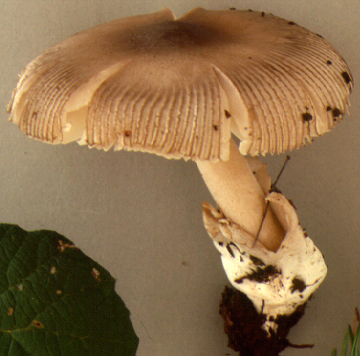
| pileus | 80 mm wide, gray at first, taking on brownish tint, darkest over disc and over marginal striations, virgate, dull; context ??; margin tuberculate, striate (0.4R - 0.45R), nonappendicuate; universal veil absent. | ||||||||||||||||||||
| stipe | 49 × 5 - 6 mm, pallid, ??; context ??; exannulate; universal veil as saccate volva, with upper third of limb becoming gray, with limbus internus rather long and attached near point of limb's attachment to stipe. | ||||||||||||||||||||
| odor/taste | not recorded. | ||||||||||||||||||||
| macrochemical tests |
Spot test for laccase (syringaldazine) - negative throughout (older) basidiocarp. Test voucher: Tulloss 8-31-94-D. | ||||||||||||||||||||
| ecology | Solitary. At 2800 m elev. In dark loam of mixed forest dominated by Quercus spp. and including Pinus patula, Abies religiosa, Baccharis conferta, and Arbutus xalapensis. | ||||||||||||||||||||
| material examined | MÉXICO: TLAXCALA—Mpio. Tlaxco - km 4-5 camino El Rosario a El Rodeo, Cerro El Peñón [2800 m], 31.viii.1994 A. Estrada Torres & L. Varela Fregoso s.n. [Tulloss 8-31-94-D] (RET 135-8; TLXM); Parq. Nac. La Malintzi volcano above IMSS Malintzi just below tree line on peak, 19.viii.1998 Paula J. Brooks s.n. [Tulloss 8-19-98-C] (RET 292-8, nrITS & nrLSU seq'd.). | ||||||||||||||||||||
| citations | —R. E. Tulloss | ||||||||||||||||||||
| editors | RET | ||||||||||||||||||||
Information to support the viewer in reading the content of "technical" tabs can be found here.
 Spore data sets and their composite
Each spore data set is intended to comprise a set of measurements from a single specimen made by a single observer; and explanations prepared for this site talk about specimen-observer pairs associated with each data set. Combining more data into a single data set is non-optimal because it obscures observer differences (which may be valuable for instructional purposes, for example) and may obscure instances in which a single collection inadvertently contains a mixture of taxa.

Text and User-Generated Sporographs are published under the Creative Commons License.

In the case of a taxon page, image credits are on the 'image' tab.