
| name | Amanita sp-GSM03 |
| author | Tulloss |
| name status | cryptonomen temporarium |
| GenBank nos. |
Due to delays in data processing at GenBank, some accession numbers may lead to unreleased (pending) pages.
These pages will eventually be made live, so try again later. |
| intro |
Olive text indicates a specimen that has not been thoroughly examined (for example, for microscopic details) and marks other places in the text where data is missing or uncertain. The following material is based on original research of R. E. Tulloss. |
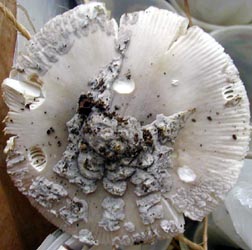
| pileus | dark gray over disc, pale gray elsewhere; context ??; margin short striate (0.15 - 0.25R), nonappendiculate; universal veil as thick floccose-felted warts, pale gray, probably darkening with age,at times confluent unevenly distributed. |
| lamellae | white in side view. |
| gleba | double click in markup mode to edit. |
| stipe | with gray surface layer breaking up into dark fibrils after handling; exannulate; universal veil originally saccate and white, sometimes breaking up into patches and becoming gray to dark gray with age. |
| odor/taste | not recorded. |
| macrochemical tests |
none recorded. |
| material examined | U.S.A.: TENNESSEE—Sevier Co. - GSMNP, Cherokee Orchard trailhead [35.6811° N/ 83.4625° W, 780 m], 12.vii.2004 R. E. Halling s.n. [Tulloss 7-12-04-G] (RET 374-10, nrITS & nrLSU seq'd.). |
| discussion | The present taxon has some similarity to A. sp-N28 Tulloss cryptonom. temp.. |
| citations | —R. E. Tulloss |
| editors | RET |
Information to support the viewer in reading the content of "technical" tabs can be found here.
 Spore data sets and their composite
Each spore data set is intended to comprise a set of measurements from a single specimen made by a single observer; and explanations prepared for this site talk about specimen-observer pairs associated with each data set. Combining more data into a single data set is non-optimal because it obscures observer differences (which may be valuable for instructional purposes, for example) and may obscure instances in which a single collection inadvertently contains a mixture of taxa.

Text and User-Generated Sporographs are published under the Creative Commons License.

In the case of a taxon page, image credits are on the 'image' tab.