| name |
Amanita sp-CHI01 |
| author |
Tulloss |
| name status |
cryptonomen temporarium |
| GenBank nos. |
Due to delays in data processing at GenBank, some accession numbers may lead to unreleased (pending) pages.
These pages will eventually be made live, so try again later.
|
| intro |
|
| pileus |
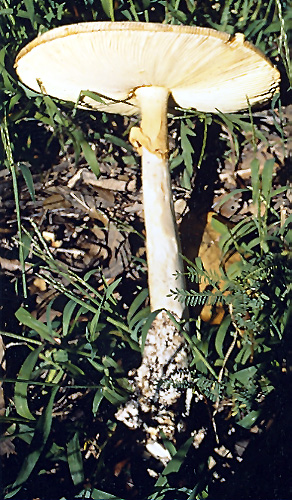
100 - 180 mm wide, white to cream, becoming pale tan with age [per collector's photos], planoconvex to planar at maturity, with low broad umbo at maturity or in age, subviscid when moist; context white, ??, thinning ?? to margin, not changing when cut or bruised; margin short striate (??R), nonappendiculate; universal veil absent. |
| lamellae |
free, crowded, pale yellow in mass and in side view, becoming ?? in exsiccata, with edges ?? and becoming ?? at maturity, ?? mm broad; lamellulae truncate to subtruncate or rounded truncate, of diverse lengths, plentiful, unevenly distributed. |
| stipe |
120 - 180 × 15± mm, white or whitish, narrowing upward, flaring at apex; context ??, hollow, with central cylinder ?? mm wide; partial veil superior, thin, membranous, persistent, pale yellow, becoming darker and slightly brownish yellow with age, collapsing on stipe in age; universal veil saccate, lobed, white, with limb reaching up to 30 - 75 mm from base of stipe. |
| odor/taste |
not recorded. |
macrochemical
tests |
none recorded. |
| pileipellis |
90 - 100 µm thick (in mature specimen), gelatinized at surface, with 25± µm thick colorless suprapellis of gelatinized to partially gelatinized hyphae, with 65 - 75 µm thick brownish yellow ungelatinized subpellis; filamentous, undifferentiated hyphae 1.5 - 4.5 (-6.4?) µm wide, branching, densely packed vertically and horizontally, dominantly subradially arranged; vascular hyphae not observed (with refractive hyphae of hyphomycete present in RET isotype). |
| pileus context |
filamentous, undifferentiated hyphae 2.5 - 12.7 µm wide, branching, plentiful, singly and in narrow fascicles, interwoven forming open lattice structure; acrophysalides plentiful, thin-walled, narrowly clavate to clavate to broadly clavate, up to 183 × 51 µm; vascular hyphae 7.6 - 17.8 µm wide, rare. |
| lamella trama |
poorly rehydrating in available material; bilateral; vascular hyphae 3.9 - 10.6 µm wide, branching, frequency unclear. |
| subhymenium |
poorly rehydrating in available material; pseudoparenchymatous, with inflated cells in 4 to 5 irregular layers below bases of longest basidia, with larger cells up to 20 × 15.0 µm, with basidia arising from inflated cells. |
| basidia |
35 - 44 (-52) × 7.8 - 10.8 (-11.5) µm, thin-walled, 4- and occasionally 1- or 2-sterigmate, with sterigmata to 9.0 × 2.5 µm long; clamps occasional??, unevenly distributed, sometimes prominent. |
| universal veil |
On pileus: absent. At stipe base, exterior surface layer: filamentous undifferentiated hyphae branching, partly gelatinized to gelatinized, collapsed, in fascicles and singly, interwoven leaving gaps through which interior tissue visible, lacking dominant orientation. At stipe base, interior layer: filamentous, undifferentiated hyphae 2.3 - 8.9 (-12.7??) µm wide, branching, plentiful, dominantly single, occasionally in narrow fascicles, loosely interwoven in open lattice structure; inflated cells thin-walled, plentiful to locally dominant, terminal singly, clavate to broadly clavate to ovoid (to 108 × 51 µm), ellipsoid to subglobose (to 79 × 74 µm); vascular hyphae not observed. At stipe base, inner surface: often like interior although extensively gelatinized and collapsed, occasionally with superficial broad fascicles of gelatinized filamentous, undifferentiated hyphae. |
| stipe context |
longitudinally acrophysalidic; filamentous, undifferentiated hyphae 2.5-12.5 µm wide, branching, dominant near surfaces, plentiful in interior; acrophysalides with walls thin or slightly thickened, ranging from rather broad (up to 184 × 51 µm) to narrow (up to 174 × 29 µm), dominant away from surfaces; vascular hyphae not observed; clamps rare. |
| partial veil |
filamentous, undifferentiated hyphae 1.3 - 11.4 µm wide, branching, singly and in fascicles, interwoven, but with many fascicles subradially arranged, dominating; inflated cells scattered in interior, thin-walled, terminal singly, clavate, up to 41 × 22 µm; vascular hyphae 3.8 - 16.5 µm wide, coiling, sinuous, common, unevenly distributed; clamps moderately common, prominent. |
| lamella edge tissue |
not described. |
| basidiospores |
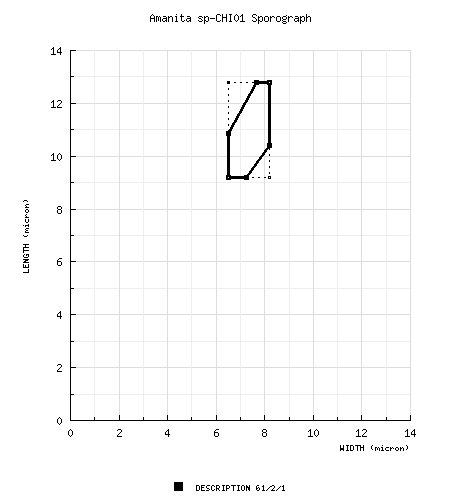
[61/2/1] (7.5-) 9.2 - 12.8 (-15.0) × (5.8-) 6.5 - 8.2 (-9.0) μm, (L = 10.4 - 11.2 μm; L' = 10.7 μm; W
= 7.3 - 7.6 μm; W' = 7.4 μm;
Q = (1.10-) 1.27 - 1.67 (-2.16); Q = 1.43 - 1.47; Q' = 1.45),
hyaline, colorless, smooth, thin-walled, inamyloid, broadly ellipsoid to ellipsoid, occasionally elongate, infrequently subglobose, adaxially flattened, sometimes expanded at one end;
apiculus sublateral, truncate-conic; contents guttulate; white in deposit. |
| ecology |
Solitary to gregarious, at 1800± m elev. In Pinus-Quercus forest of the Sierra Madre Occidental of Chihuahua edo. |
| material examined |
MÉXICO: CHIHUAHUA—Mpio. Temosachi - Nabogame [28°30’N/108°30’W], 23.viii.1987 J. E. Laferrière 927 (ARIZ n.v., BPI n.v., in herb. David T. Jenkins n.v., MEXU n.v., RET 011-2, XAL). |
| discussion |
This taxon is edible and enjoyed by the indigenous people. |
| citations |
—R. E. Tulloss |
| editors |
RET |
|


 Spore data sets and their composite