

| name | Amanita sordidogrisea |
| name status | nomen acceptum |
| author | A. E. Wood |
| english name | "Wood's Dirty Gray Amanita" |
| intro |
The following is largely based on the original description (Wood, 1997). |
| cap |
The cap of Amanita sordidogrisea is up to 50 mm wide, convex then plane, smooth, dry, dull buff to buff-gray, with a nonstriate margin. The volva is present as scattered, flat, thin, membranous scales, distinctly paler than the cap color. |
| gills |
The gills are free, thin, crowded, pale cream, with a concolorous margin. The short gills are present in at least one series. |
| stem |
The stem is up to 90 × 9 mm, expanding downward, white, smooth, exannulate in the only known material, without a volva or remains at the clavate base of the stem. The base is off-white. |
| spores |
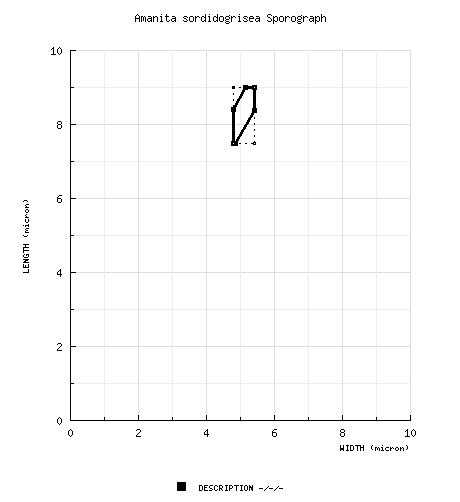
The spores measure (6.6-) 7.5 - 9.0 × (4.2-) 4.8 - 5.4 µm and are elongate and amyloid. Clamps are absent at bases of basidia. |
| discussion |
Wood describes this species as occurring in "tall open forests" from the state of New South Wales, Australia. No potential symbionts are cited. This species is known only from the type collection. Since we have perceived difficulties with the assignment of section Validae of a number of Wood''s species (for example, A. elongatispora) when we see an exannulate species assigned to section Validae our concerns arise again. However, a change in placement is not so clearly required here as in other cases. In this case despite the possibility of understanding Wood's description to the contrary, he draws an ellipsoid cell immediately below a basidium in his illustration. Moreover the taxon lacks clamp connections, and so the argument for excluding it on the grounds of clamp connections being present does not arise. In addition, the basidia are of the size one would expect in section Validae. It seems to us that the simplest line of reasoning entails placement of the species in section Validae under the assumption that in the single collection examined by Wood, the ring on the stem was lost. With regard to Wood's use of the term subhymenium, see our discussion of Amanita elongatispora (link above).—R. E. Tulloss and L. Possiel |
| brief editors | RET |
| name | Amanita sordidogrisea | ||||||||||||||||||||
| author | A. E. Wood. 1997. Austral. Syst. Bot. 10: 818, fig. 50(a-e). | ||||||||||||||||||||
| name status | nomen acceptum | ||||||||||||||||||||
| english name | "Wood's Dirty Gray Amanita" | ||||||||||||||||||||
| MycoBank nos. | 443204 | ||||||||||||||||||||
| GenBank nos. |
Due to delays in data processing at GenBank, some accession numbers may lead to unreleased (pending) pages.
These pages will eventually be made live, so try again later. Search:
Showing 0 to 0 of 0 entries | ||||||||||||||||||||
| holotypes | UNSW | ||||||||||||||||||||
| intro |
The following text may make multiple use of each data field. The field may contain magenta text presenting data from a type study and/or revision of other original material cited in the protolog of the present taxon. Macroscopic descriptions in magenta are a combination of data from the protolog and additional observations made on the exiccata during revision of the cited original material. The same field may also contain black text, which is data from a revision of the present taxon (including non-type material and/or material not cited in the protolog). Paragraphs of black text will be labeled if further subdivision of this text is appropriate. Olive text indicates a specimen that has not been thoroughly examined (for example, for microscopic details) and marks other places in the text where data is missing or uncertain. The following material is based entirely on the protolog of this species, which does not meet contemporary standards for Amanita taxonomy. | ||||||||||||||||||||
| basidiospores |
from protolog: [-/-/-] (6.6-) 7.5 - 9.0 × (4.2-) 4.8 - 5.4 μm, (est. Q = 1.55 - 1.75; Q = 1.73), amyloid, elongate. [Note: When estimating values of Q, the numbers generated suggested that the published value of Q may be too high.—ed.] | ||||||||||||||||||||
| ecology | In tall, open forest. | ||||||||||||||||||||
| material examined | from protolog: AUSTRALIA: NEW SOUTH WALES—Lismore, Whian Whian St. For., 16.iii.1983 J. J. Bruhl s.n. (holotype, UNSW 83/215). | ||||||||||||||||||||
| citations | —R. E. Tulloss | ||||||||||||||||||||
| editors | RET | ||||||||||||||||||||
Information to support the viewer in reading the content of "technical" tabs can be found here.
 Spore data sets and their composite
Each spore data set is intended to comprise a set of measurements from a single specimen made by a single observer; and explanations prepared for this site talk about specimen-observer pairs associated with each data set. Combining more data into a single data set is non-optimal because it obscures observer differences (which may be valuable for instructional purposes, for example) and may obscure instances in which a single collection inadvertently contains a mixture of taxa.

Text and User-Generated Sporographs are published under the Creative Commons License.

In the case of a taxon page, image credits are on the 'image' tab.