

| name | Amanita sepiacea |
| name status | nomen acceptum |
| author | S. Imai |
| english name | "Asian Sepia Amanita" |
| images |
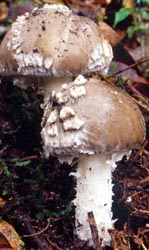 1. Amanita sepiacea, China. |
| intro | This page is based on original research by ZYL. |
| cap |
Fruiting bodies of Amanita sepiacea are medium-sized to large. The cap is 60 - 150 mm wide, convex to applanate, dark grey to brown to blackish, darker in the center, innately fibrillose, covered with dirty white to greyish (often brownish grey at the base) conical to verrucose warts, 1 - 4 mm high and wide; the cap's margin is smooth and non-appendiculate; the cap's context is white. |
| gills |
The gills are free to subfree and white; the short gills are attenuate. |
| stem |
The stipe is 100 - 180 × 10 - 25 mm, subcylindric or attenuate upwards, with its surface white to dirty white—its lower half covered with greyish to grey fibrillose squamules; the stipe's basal bulb is 15 - 50 mm wide, subglobose to spindle-shaped to turnip-shaped, with its upper part covered with white, rarely greyish, verrucose to conical volval remnants in a few concentric incomplete rings. The annulus is apical to subapical, membranous, and white. |
| spores |
The spores measure (7.0-) 7.5 - 9.5 (-11.0) × (5.5-) 6.0 - 7.0 (-8.0) µm and are broadly ellipsoid to ellipsoid, although occasionally subglobose or globose and amyloid. Clamps are absent from the bases of basidia. |
| discussion |
The species was originally described from Japan and occurs also in China. For comparison, see A. tristis Corner & Bas.—Zhu L. Yang |
| brief editors | RET |

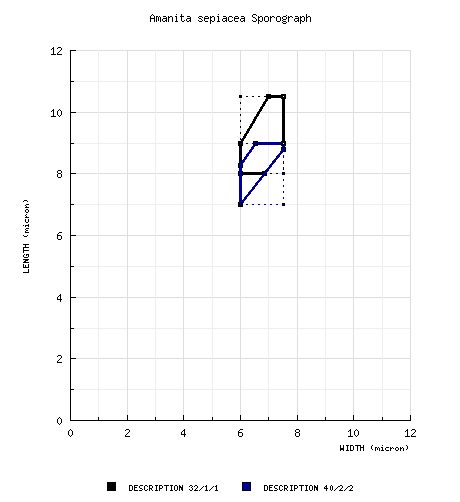
 Spore data sets and their composite