
| name | Amanita sagittaria |
| name status | nomen provisorum |
| GenBank nos. |
Due to delays in data processing at GenBank, some accession numbers may lead to unreleased (pending) pages.
These pages will eventually be made live, so try again later. |
| intro |
Olive text indicates a specimen that has not been
thoroughly examined (for example, for microscopic details) and marks other places in the text
where data is missing or uncertain. The following is based on original research of R. E. Tulloss. |
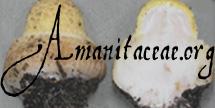
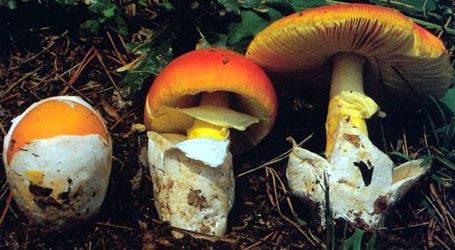
| pileus | 55 - 65 mm, originally white, becoming pale ochraceous to soft reddish brown, dry, shiny to subshiny, hemispherical (with incurved margin) to convex; context 4 - 8 mm thick above stipe, narrowing evenly for three-quarters of radius, then membranous, white to cream, sometimes brownish in disk, sometimes bruising pale pinkish orange rather quickly, oxidizing on exposure to reddish or brick or red-brown; margin nonstriate at first, becoming short striate in age, decurved, appendiculate with small, concolorous, fibrillose to submembranous flakes; universal veil two-layered (probably white at first, then browning), may be present as large leathery easily removed calyptra over disc (impregnated with sand) and/or as distributed thin flakes or small patches of fibrillose, paler, orange-brown (5A4, 6C-D3) inner layer. |
| lamellae | free to narrowly adnate with or without decurrent line on stipe to narrowly adnexed, close to crowded, cream in mass, white to off-white in side view, bruising as in pileus, becoming dingy tannish on drying (e.g., 6D4), 4 - 8.5 mm broad, occasionally forking or reverse forking, with minutely pruinose or flocculose edge; lamellulae truncate and not present between all pairs of lamellae, unevenly distributed, occasionally not connected to pileus margin. |
| stipe | 62 - 94 × 11 - 17.5 mm, cylindric or slightly narrowing upward or downward, barely flaring at apex, white to off-white, decorated with floccose fibrillose material that is at first concolorous and becomes brick colored like the pileus, seems punctate in somewhat dehydrated specimens; context white, somewhat sordid in bulb, changing as in pileus, hollow to stuffed in 3 - 8 mm wide central cylinder, no data on color in larva tunnels; exannulate, but in early development with fugacious zone of compressed flocculose material or with deciduous small submembranous submedian to superior annulus that easily breaks up, in any case with such material browning like all other parts of basidiome; universal veil as saccate volva attached only near base of stipe, with upstanding, 1 mm thick, leathery limb reaching to 39 - 59 mm from stipe base and 25 - 28 mm broad, whitish changing as in rest of basidiome, with base somewhat rounded to inverse conical to fusiform, often subradicating. |
| odor/taste | Odor faint, possibly of the seashore. Taste not recorded. |
| macrochemical tests |
Spot tests for tyrosinase (L-tyrosine) and laccase (syringaldazine) both rapidly positive in all tissues. KOH on context and stipe surface - promotes browning reaction, negative on pileipellis. NH4OH negative except for slight browning in pileus context and slight tint of orange on remnants of inner universal veil layer on pileus. Test vouchers: Tulloss 7-13-85-AN1, 10-25-86-E. |
| pileipellis | 65 - 95 µm thick; filamentous, undifferentiated hyphae 1.8 - 6.0 µm wide, interwoven, randomly arranged in and near disk, gelatinizing at the surface, those of greater diameter farther from surface and some of these with segments inflated to 11.0 µm wide; vascular hyphae 1.0 - 5.0 µm wide, at the surface, locally loosely tangled. |
| pileus context | filamentous, undifferentiated hyphae 1.2 - 10.2 µm wide, branching, in loose weave; acrophysalides terminal, subglobose to subpyriform (to 86 × 62 µm) and ellipsoid to ovoid to elongate to broadly clavate (to 106 × 52 µm) to narrowly clavate; vascular hyphae 1.5 - 3.8 µm wide. |
| lamella trama | bilateral; wcs = 50± µm; central stratum is pronounced; angle of divergence of inflated cells 60± - 90±°; filamentous, undifferentiated hyphae 2.8 - 6.0 µm wide; inflated cells ventricose or sausage-like, terminal, singly or in pairs, up to 55 × 20 µm; vascular hyphae 2.0 - 5.2 µm wide, branching, appearing in subhymenium and occasionally appearing to penetrate hymenium. |
| subhymenium | wst-near = 135 - 140 µm; wst-far = 150 - 155 µm; ramose to inflated ramose to subcellular; contains some small globose and ellipsoid cells, dominated by branching, short-segmented hyphae with some segments inflated and clavate or irregularly clavate; basidia arising from cells of all forms. |
| basidia | 44 - 56 × 6.5 - 12.5 µm, 4-sterigmate, with sterigmata to 6.5 µm long, thin-walled, narrowly and sometimes somewhat irregularly clavate; clamps observed, not common. |
| universal veil | On stipe base, outer surface: gelatinizing tangled filamentous undifferentiated hyphae 2.0 - 13.3 µm wide, about 20 µm below surface small inflated cells begin to appear. On stipe base, interior: filamentous, undifferentiated hyphae 2.8 - 10.0 µm wide, frequently branching, tangled, dominant for most of the region nearest the outer surface, progressively less dominant toward inner surface; inflated cells ellipsoid to elongate to broadly clavate, up to 95 × 78 µm, with walls thin or thickened to 1.0 µm, terminal, usually singly, sometimes possibly in pairs; vascular hyphae 2.5 - 4.5 µm wide, uncommon. On stipe base inner surface: filamentous, undifferentiated hyphae 1.4 - 7.5 µm wide, frequently branching, plentiful; inflated cells plentiful to dominant, thin-walled, ellipsoid to ovoid (up to 86 × 68 µm) to narrowly clavate (up to 171 × 51 µm); vascular hyphae 2.2 - 5.0 (-10.0) µm wide. On pileus: as at base in the outer and interior layers; inner surface also similar to that found at the stipe base with the addition of locally plentiful, inflated hyphal segments up to 27 µm wide, slightly larger, ellipsoid inflated cells than are found at stipe base; vascular hyphae to 11.2 µm wide, uncommon. |
| stipe context | longitudinally acrophysalidic; filamentous, undifferentiated hyphae 3.0 - 7.7 µm wide, plentiful; acrophysalides plentiful to locally dominant, thin-walled or with walls slightly thickened, to 276 × 47 µm; vascular hyphae 2.1 - 10.8 µm wide, branching, locally plentiful and then tangled or knotted; clamps observed. |
| partial veil | not found in material examined. |
| lamella edge tissue | sterile. |
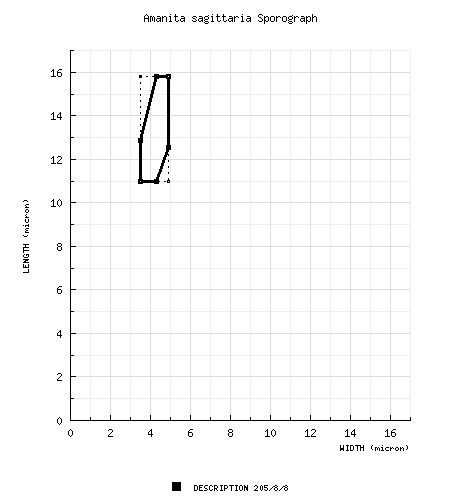
| basidiospores | RET: [205/8/8] (9.1-) 11.0 - 15.8 (-19.0) × (3.1-) 3.5 - 4.9 (-5.5) µm, (L = 11.8 - 16.0 µm; L’ = 12.8 µm; W = 3.9 - 4.7 µm; W’ = 4.2 µm; Q = (1.96-) 2.56 - 3.68 (-4.68); Q = 2.70 - 3.61; Q’ = 3.03), hyaline, colorless, thin-walled, smooth, amyloid, cylindric to bacilliform, usually adaxially flattened; apiculus sublateral, truncate conic, proportionately small; contents granular to mono- or multiguttulate; white in deposit. |
| ecology | Solitary to scattered. Florida: In open Pinus forest, Quercus not noted, but possibly nearby because oak hammocks are encountered on same trail. Georgia: In direct sun within 0.6 km of salt water bay in sandy soil of mixed woods including Q. virginiana, P. elliottii and P. taeda. New Jersey: At 29 m elev. In deep sandy soil of open Pinus forest. Texas: In well drained site consisting of alluvial deposit of sandy clay under Pinus and Quercus. |
| material examined |
U.S.A.:
FLORIDA—Alachua Co. - Gainesville,
|
| discussion |
A sporographic comparison between the present species
and A.
peckiana follows. It seems likely at present (3.v.2016) that this concept may contain as many as three distinct species based on genetic evidence. Much work remains to be done on this issue. One taxon has been separated (as of 30.i.2020)—Amanita texidella. |
| citations | —R. E. Tulloss |
| editors | RET |
Information to support the viewer in reading the content of "technical" tabs can be found here.
| name | Amanita sagittaria |
| bottom links | [ Keys & Checklists ] |
| name | Amanita sagittaria |
| bottom links | [ Keys & Checklists ] |
 Spore data sets and their composite
Each spore data set is intended to comprise a set of measurements from a single specimen made by a single observer; and explanations prepared for this site talk about specimen-observer pairs associated with each data set. Combining more data into a single data set is non-optimal because it obscures observer differences (which may be valuable for instructional purposes, for example) and may obscure instances in which a single collection inadvertently contains a mixture of taxa.

Text and User-Generated Sporographs are published under the Creative Commons License.

In the case of a taxon page, image credits are on the 'image' tab.