| name |
Amanita rufoferruginea |
| author |
Hongo. 1966. J. Jap. Bot. 41(6): 165, fig. 1(d-e). |
| name status |
nomen acceptum |
| english name |
"Rust-Powdered Amanita" |
| MycoBank nos. |
326112 |
| GenBank nos. |
Due to delays in data processing at GenBank, some accession numbers may lead to unreleased (pending) pages.
These pages will eventually be made live, so try again later.
|
| holotypes |
TNS per (Doi. 1991. Bull. Natl. Sci. Mus., Tokyo, Ser. B 17(2): 50) |
| revisions |
Hongo. 1967 ["1966"]. Mem. Fac. Liberal Arts Shiga Univ., Pt. 2, Nat. Sci. 17: 89, fig. 16(1).
Z. L. Yang. 1997. Biblioth. Mycol. 170: 35, figs. 21-23. |
| selected illustrations |
Imazeki and Hongo. 1987. Color. Illus. Mushr. Japan 1: 118, pl. 27 (fig. 198). |
| intro |
The following text may make multiple use of each data field.
The field may contain magenta text presenting data from a type study
and/or revision of other original material cited in the protolog of the present taxon.
Macroscopic descriptions in magenta are a combination of data from the protolog and
additional observations made on the exiccata during revision of the cited original
material.
The same field may also contain black text, which is data from a revision of the present
taxon (including non-type material and/or material not cited in the protolog).
Paragraphs of black text will be labeled if further subdivision of
this text is appropriate.
Olive text indicates a specimen that has not been
thoroughly examined (for example, for microscopic details) and marks other places in the text
where data is missing or uncertain.
The following is derived from (Hongo 1967) and (Yang 1997).
NOTE: Spore data from papers by Z. L. Yang are presented following his use of the "Times New Roman" face for "Q" and "Q'"—respectively, "Q" and "Q." |
| pileus |
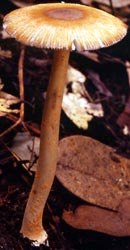
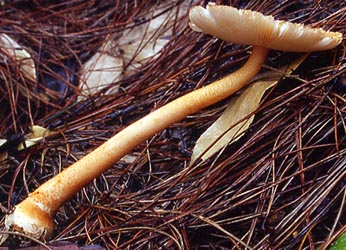
Hongo (1967): 45 - 90 mm wide, fulvous or paler, hemispheric, becoming convex, slightly depressed over disc, dry; context thin, white; margin more or less striate, in age "grooved-striate" or tuberculate-striate; universal veil as detersile pulverulence, Xanthine Orange or Mars Yellow or Amber Brown or Antique Brown.
Yang (1997): 40 - 70 mm wide, yellow-brown, paler toward margin, hemispheric at first, then convex to expanded convex, sometimes flattened or slightly depressed in disc; context whitish, thin; margin striate (0.2 - 0.4R); universal veil pulverulent, sometimes as fine floccose warts, orange-brown or red-brown or leather brown, detersile. |
| lamellae |
Hongo (1967): free, close, white, 4 - 7 mm broad, ventricose, with edge minutely flocculose; lamellulae truncate.
Yang (1997): free, density and color not recorded, 3 - 5 mm broad, narrowing toward stipe, with margin pulverulent to finely flocculose and red-brown; lamellulae truncate, 0-2 between pair of [otherwise adjacent] lamellae. |
| stipe |
Hongo (1967): 90 - 120 × 4 - 10 mm (measured at apex), narrowing upward, with dense covering of pulverulence or farinose particles (brighter than Ochraceous Tawny) both above and below partial veil; bulb obovate to subfusiform, 13 - 20 mm wide; context stuffed to hollow; partial veil at 15 - 25 mm below apex, membranous, pendent, rather large, white and striate above, Ochraceous-Tawny and floccose-pulverulent below, evanescent; universal veil contributing pulverulence and farinose particles below partial veil (see above) and (at stipe base) as 3 - 5 pulverulent pale brownish incomplete rings, evanescent.
Yang (1997): 70 - 100 × 5 - 10 mm, with color not recorded, subcylindric or slightly narrowing upward; bulb ovoid to fusiform, 15 - 20 mm wide; context stuffed or hollow; partial veil superior, fragile, with red-brown edge, white and finely striate above, red-brown to leather brown below; universal veil as pulverulent scales, red-brown to rust-brown to braun, widely distributed, with concentration in incomplete brown to brownish circlets on upper half of bulb. |
| odor/taste |
Hongo (1967): none.
Yang (1997): neither notable. |
macrochemical
tests |
none recorded. |
| pileipellis |
Yang (1997): 30 - 50 μm thick; filamentous hyphae 3 - 7 μm wide, somewhat interwoven, subradially oriented, more or less gelatinized, with yellowish vacuolar pigment; vascular hyphae 3 - 7 μm wide, rare. |
| pileus context |
Yang (1997): not described. |
| lamella trama |
Yang (1997): more or less bilateral; mediostratum 30± broad; filamentous hyphae 2 - 5 μm wide, frequently branched, abundant, interwoven; inflated cells rather abundant, 65 - 85 × 15 - 22 μm, elongate-ellipsoid to fusiform; vascular hyphae rare. |
| subhymenium |
Yang (1997): cellular, 20 - 30 μm thick, with cells in (1-) 2 (-3) layers; inflated cells 10 - 20 × 8 - 18 μm, subglobose to ovoid to broadly doliform. |
| basidia |
Yang (1997): 30 - 48 × 10 - 14 μm, predominatly 4-sterigmate, sometimes 1-, 2-, or 3-sterigmate, with sterigmata 3 - 4 μm long; clamps absent. |
| universal veil |
Yang (1997): On pileus: elements subanticlinal to disordered, loosely organized; filamentous hyphae 2 - 5 μm wide, isolated to rather abundant locally; inflated cells abundant, subglobose to ovoid to pyriform (20 - 30 × 15 - 30 μm) or ellipsoid (20 - 30 × 12 - 18 μm), with brownish or yellowish vacuolar pigment, terminal singly or in chains of 2 - 3; vascular hyphae rare. On stipe: elements disordered; filamentous hyphae 2 - 6 μm wide, abundant, frequently branched; inflated cells rather abundant to abundant, subglobose to ovoid (25 - 35 × 18 - 25 μm) or broadly clavate to pyriform (22 - 35 × 14 - 24 μm), frequently with yellowish vacuolar pigment, terminal singly or in chains of 2 - 3; vascular hyphae rare. |
| stipe context |
Yang (1997): longitudinally acrophysalidic; filamentous hyphae 1.5 - 8 μm wide, rather abundant away from surfaces, dominating near exterior surface; acrophysalides 120 - 250 × 20 - 35 μm, narrowly clavate to elongate ellipsoid, sometimes subtended by one or more similarly shaped cells; vascular hyphae 2 - 5 μm wide, locally frequent. |
| partial veil |
Yang (1997): not found in material examined. |
| lamella edge tissue |
Yang (1997): sterile;150± μm wide, somewhat gelatinized; filamentous hyphae 3 - 7 μm wide; inflated cells abundant, subglobose to ovoid to pyriform to broadly clavate (20 - 40 × 20 - 35 μm), hyaline, nearly colorless or with yellowish vacuolar pigment. |
| basidiospores |
Yang (1997): [60/3/1] 7.0 - 9.0 (-13.0) × 6.5 - 8.5 (-11.5) μm, (Q = (1.0-) 1.04 - 1.16 (-1.23); Q = 1.09 ± 0.04), subglobose, occasionally globose, rarely broadly ellipsoid, inamyloid, colorless, hyaline, smooth, thin-walled; apiculus small; contents not recorded; color in deposit not observed. |
| ecology |
Solitary or in small groups. Japan: In Pinus forest or in Pinus densiflora-Quercus serrata forest (Hongo 1967). China: In dominantly coniferous forest with Pinus spp. and some representatives of the Fagaceae (Yang 1997). |
| material examined |
Hongo (1967): JAPAN: HONSHU—Kyoto-fu - Kyoto-shi, Iwakura, 29.vii.1966 N. Sagara s.n. [Hongo 3122] (holotype, in herb. T. Hongo => TNS F-244373), 1.viii.1966 T. Hongo 3124 (in herb. T. Hongo). Shiga-ken - Ôtsu-shi, Senjô, 11.vii.1966 M. Endo s.n. [Hongo 3249] (in herb. T. Hongo); Ôtsu-shi, Shibara, 8.viii.1966 T. Hongo 3273 (in herb. T. Hongo); Ôtsu-shi, Terabe, 4.viii.1966 T. Hongo 3270 (in herb. T. Hongo), 13.ix.1966 T. Hongo 3310 (in herb. T. Hongo).
Yang (1997): CHINA: GUIZHOU—Unkn. Pref. - Unkn. Co., Wuling Mountains, Fanjingshan National Nature Reserve, viii.1983 X. L. Wu 817 (HKAS 14378). |
| discussion |
The precise placement of this species within section Amanita is not clear to the editors at this time. The "more or less" gelatinized pileipellis seems to suggest separation from the taxa of the provisional series Farinosae. The absence of a limbate limbus internus segregates the present species from the monotypic, provisional series Crenulatae. Nevertheless, the taxon is assignable to the provisional subsection Amanitella; hence, for the moment we assign it to a provisional, monotypic series: Amanita series Rufoferrugineae.
The Japanese name for this species is "kabairo-kona-tengutake" (Doi 1991). |
| citations |
Translation from German by RET.—Zhu L. Yang |
| editors |
RET |
|



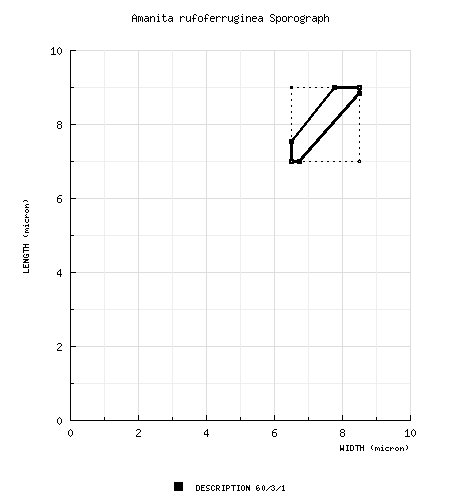
 Spore data sets and their composite