
| name | Amanita robusta |
| name status | nomen acceptum |
| author | Beeli |
| english name | "African False Caesar" |
| intro | The following description is based on the desription of Beeli (1935) and Gilbert (1940 & 1941). |
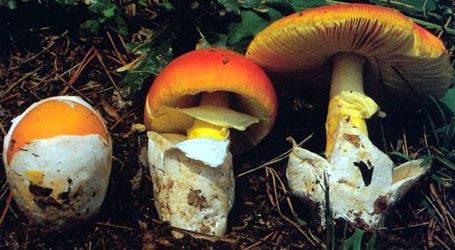
| cap | The cap of Amanita robusta is 120 mm wide, globose then expanded-convex, glabrous, viscid then dry, brick red, center becoming dark violaceous, with a lightly striate margin. The flesh is firm and white. Usually no volval remnants are present. |
| gills | The gills are free, yellowish, and pointed at both ends. The short gills have not been described. |
| stem | Its stem is 130 × 10 - 25 mm, fibrillose, cylindric, and stuffed. The ring is fibrous and ephemeral, leaving some cob-web like debris on the edges of the gills. The volva is ample, membranous, saccate, thick, brownish ochraceous and warted on the outer surface, violaceous? [appears the same color as the cap surface in Mme. Goossens' watercolor—ed.] on the inner surface. The flesh is firm and white. |
| odor/taste | The taste is sweet. No odor was reported. |
| spores | According to the spore drawings of Gilbert (1940), the spores measure 9.1 - 10.1 (-11.2) × 6.6 - 7.7 (-9.2) μm. The spores are ellipsoid and inamyloid. No one has examined the basidia for the presence of clamps. |
| discussion |
The present species was originally described from the Republic of Congo from a forest of Gilbertiodendron. Beeli notes that the species somewhat suggests Amanita caesarea (Scop. : Fr.) Pers.. Indeed it is the case that because of its robust stature, pigments of the cap, short marginal striations of the cap, robust volval sac, and the yellow gills, the similarity is rather strong. However, the presence of a bulb at the base of the stem and cortina-like partial veil exclude the present species from the Caesareae. Well-dried modern collections with good notes on the fresh fruiting body and a photograph are very much needed. Rammeloo and Walleyn (1993) reported a method of cooking of a mushroom close to A. robusta. First it is blanched in boiling water which turns yellow. It is blanched when the the caps are closed. Then the caps may be pealed and are cut into pieces and sautéed in oil with sliced onions, salt, and chilis. The taste of the boiled fungus is described as strongly fishy and "green." When sautéed, the flavor is described as "strong"; and of the flesh it is said that it "leaves a bitter taste in the mouth."—R. E. Tulloss |
| brief editors | RET |
| name | Amanita robusta | ||||||||||||||||||||
| author | Beeli. 1931. Bull. Soc. Roy. Bot. Belgique 63: 105, pl. 8 (fig. 8). | ||||||||||||||||||||
| name status | nomen acceptum | ||||||||||||||||||||
| english name | "African False Caesar" | ||||||||||||||||||||
| MycoBank nos. | 172184 | ||||||||||||||||||||
| GenBank nos. |
Due to delays in data processing at GenBank, some accession numbers may lead to unreleased (pending) pages.
These pages will eventually be made live, so try again later. Search:
Showing 0 to 0 of 0 entries | ||||||||||||||||||||
| holotypes | BR (implicit) | ||||||||||||||||||||
| selected illustrations |
Beeli. 1935. Fl. Champ. Congo 1: pl. 2 (fig. 1). E.-J. Gilbert. 1940. Iconogr. Mycol. (Milan) 27, suppl.: 76, tab. 9 (fig. 3). E.-J. Gilbert. 1941. Iconogr. Mycol. (Milan) 27, suppl.: 237, tab. 13. | ||||||||||||||||||||
| intro |
The following text may make multiple use of each data field. The field may contain magenta text presenting data from a type study and/or revision of other original material cited in the protolog of the present taxon. Macroscopic descriptions in magenta are a combination of data from the protolog and additional observations made on the exiccata during revision of the cited original material. The same field may also contain black text, which is data from a revision of the present taxon (including non-type material and/or material not cited in the protolog). Paragraphs of black text will be labeled if further subdivision of this text is appropriate. Olive text indicates a specimen that has not been thoroughly examined (for example, for microscopic details) and marks other places in the text where data is missing or uncertain. The following material is derived from the protolog of the present taxon, (Beeli 1935), and (Gilbert 1940 & 1941). | ||||||||||||||||||||
| pileus | from protolog: 120 mm wide, brick-red, with disc becoming dark violaceous, flattened ovoid, smooth, viscid then dry; context fleshy, firm, white; margin lightly striate (ca. 0.25R per Gilbert (1941: tab. 13)); universal veil absent. | ||||||||||||||||||||
| lamellae | from protolog: free, density not described, yellowish tinted white, 15 mm broad; lamellulae not described. | ||||||||||||||||||||
| stipe |
from protolog: 130 × 10 - 25 mm, white, cylindric, fibrous, smooth; bulb present at least in button (per figure); context hollow, firm, white; partial veil ephemeral, fibrilloe, leaving cortiniform elements on lamella edges; universal veil saccate, membranous, very thick, fleshy, with brownish verrucose exterior, encompassing ca. one-third of mature stipe per Gilbert (1941: tab. 13). Beeli (1935): universal veil ochraceous-brownish on the exterior surface warts, "violaceous" [concolorous with pileus surface in Mme. Goossens' watercolor—ed.] on inner surface. | ||||||||||||||||||||
| odor/taste | from protolog: Odor not described. Taste sweet. | ||||||||||||||||||||
| macrochemical tests |
none recorded. | ||||||||||||||||||||
| pileipellis | Beeli (1935): filamentous hyphae thin, interwoven. | ||||||||||||||||||||
| peridium micro | double click in markup mode to edit. | ||||||||||||||||||||
| pileus context | not described. | ||||||||||||||||||||
| lamella trama | not described. | ||||||||||||||||||||
| subhymenium | not described. | ||||||||||||||||||||
| basidia | not described. | ||||||||||||||||||||
| universal veil | not described. | ||||||||||||||||||||
| stipe context | not described. | ||||||||||||||||||||
| partial veil | not described. | ||||||||||||||||||||
| lamella edge tissue | not described. | ||||||||||||||||||||
| basidiospores |
from protolog: 7 - 8 × 5 - 6 μm, hyaline, smooth, ellipsoid. Beeli (1935): inamyloid. Gilbert (1940 & 1941): [2/1/1] 9.1 - 10.1 (-11.2) × 6.6 - 7.7 (-9.2) μm, (L = 9.6 μm; W = 7.2 μm; Q = 1.32 - 1.38; Q = 1.35), hyaline, smooth, inamyloid, ellipsoid; apiculus sublateral and subcylindric (per figure); contents not described; white in deposit. [Note: Spore measurements are taken from the two drawings of (Gilbert 1940: tab. IX (fig. 3)) that are in approximately lateral view.—ed.] | ||||||||||||||||||||
| ecology | from protolog: In groups. On soil in Gilbertiodendron (=Macrolobium) dewevrii forest. | ||||||||||||||||||||
| material examined |
from protolog: CONGO, DEMOCRATIC REPUBLIC OF: PROV. EQUATEUR—Territoire Lisala - Binga [2°23'41" N/ 20°25'25" E, 361 m], Beeli (1935): CONGO, DEMOCRATIC REPUBLIC OF: PROV. EQUATEUR—Territoire Lisala - Binga [2°23'41" N/ 20°25'25" E, 361 m], Gilbert (1940 & 1941): CONGO, DEMOCRATIC REPUBLIC OF: PROV. EQUATEUR—Territoire Lisala - Binga [2°23'41" N/ 20°25'25" E, 361 m], | ||||||||||||||||||||
| discussion |
There is only one described species of Amanita that is similar to A. robusta—A. pudica. The following figure compares the sporographs of the two taxa. Unfortunately, the data for the present species is extremely limited at present. | ||||||||||||||||||||
| citations | —R. E. Tulloss | ||||||||||||||||||||
| editors | RET | ||||||||||||||||||||
Information to support the viewer in reading the content of "technical" tabs can be found here.
| name | Amanita robusta |
| bottom links |
[ Keys & Checklists ] [ Draft description of, & key to, sect. Caesareae ] [ Subsaharan List ] |
| name | Amanita robusta |
| bottom links |
[ Keys & Checklists ] [ Draft description of, & key to, sect. Caesareae ] [ Subsaharan List ] |
 Spore data sets and their composite
Each spore data set is intended to comprise a set of measurements from a single specimen made by a single observer; and explanations prepared for this site talk about specimen-observer pairs associated with each data set. Combining more data into a single data set is non-optimal because it obscures observer differences (which may be valuable for instructional purposes, for example) and may obscure instances in which a single collection inadvertently contains a mixture of taxa.

Text and User-Generated Sporographs are published under the Creative Commons License.

In the case of a taxon page, image credits are on the 'image' tab.