| name |
Amanita persicina |
| author |
(Dav. T. Jenkins) Tulloss & Geml in Tulloss et al.
2015.
Amanitaceae 1(2): 3. |
| name status |
nomen acceptum |
| english name |
"Peach-Colored Fly Agaric" |
| synonyms |
≡ Amanita muscaria var. persicina Dav. T. Jenkins. 1977. Biblioth. Mycol. 57: 59, pl. 7, 30.
non Amanita persicina R. N. Hilton & S. Clancy ined. 1988. Conservation Council. W. Austral. Res. Publ. 2: 13.
The editors of this site owe a great debt to Dr. Cornelis Bas
whose famous cigar box files of Amanita nomenclatural information
gathered over three or more decades were made available to RET for computerization
and make up the lion's share of the nomenclatural information presented on this site.
|
| MycoBank nos. |
807939, 517868 |
| GenBank nos. |
Due to delays in data processing at GenBank, some accession numbers may lead to unreleased (pending) pages.
These pages will eventually be made live, so try again later.
|
| holotypes |
in herb. Dr. David T. Jenkins, Univ. of Alabama, Birmingham |
| intro |
The following text may make multiple use of each data field.
The field may contain magenta text presenting data from a type study
and/or revision of other original material cited in the protolog of the present taxon.
Macroscopic descriptions in magenta are a combination of data from the protolog and
additional observations made on the exiccata during revision of the cited original
material.
The same field may also contain black text, which is data from a revision of the present
taxon (including non-type material and/or material not cited in the protolog).
Paragraphs of black text will be labeled if further subdivision of
this text is appropriate.
Olive text indicates a specimen that has not been
thoroughly examined (for example, for microscopic details) and marks other places in the text
where data is missing or uncertain.
The following material not directly from the protolog of the present taxon is based upon
original research by R. E. Tulloss. |
| pileus |
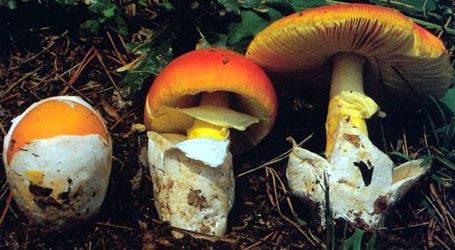
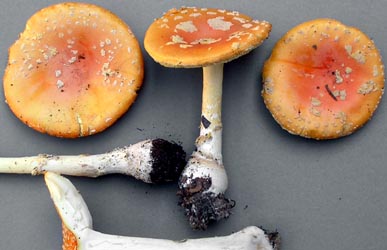
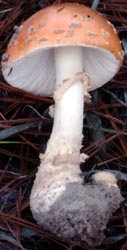
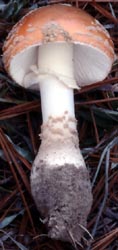
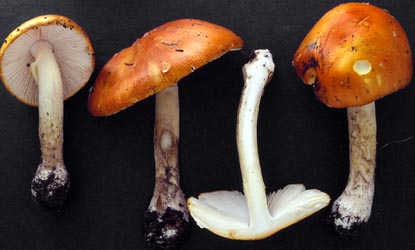
40 - 123 (-195) mm wide, orange-red to pastel red
“M” to light orange “M” or melon “M” or pinkish
orange or brassy (pale brownish) orange on disc to
light orange “M” or pale orange to yellow to
slightly tannish yellow to Maize Yellow to
pale cream on margin, sometimes virgate, in general
fading in sunlight, subviscid to tacky, shiny when
dry, glabrous, hemispherical to truncate-convex when
young, becoming convex to plano-convex to slightly
plano-depressed, with margin sometimes flaring
upward in age; context yellow to orange to
pinkish beneath pileipellis to depth of up to 2.5
mm, becoming white below, not staining or bruising,
8 - 17 mm thick over stipe, thinning evenly to
margin; margin not striate or faintly to
moderately striate (0.0R - 0.10R), downcurved,
sometimes bearing fragments of partial and or
universal veils; universal veil as
irregular warts or thin floccose-fibrillose
patches over disc, pulverulent, finely
matted-fellted (10× lens) to finely verruculose
(10× lens), becoming more fibrillose toward margin,
detersile to relatively detersile to relatively
firmly attached, often in roughly concentric rings,
having pale yellow tint in "buttons," becoming
sordid pale yellowish to sordid cream to tan or
grayish in mature specimens. |
| lamellae |
free to "truncately free," without decurrent line on
stipe, subcrowded to crowded to very crowded,
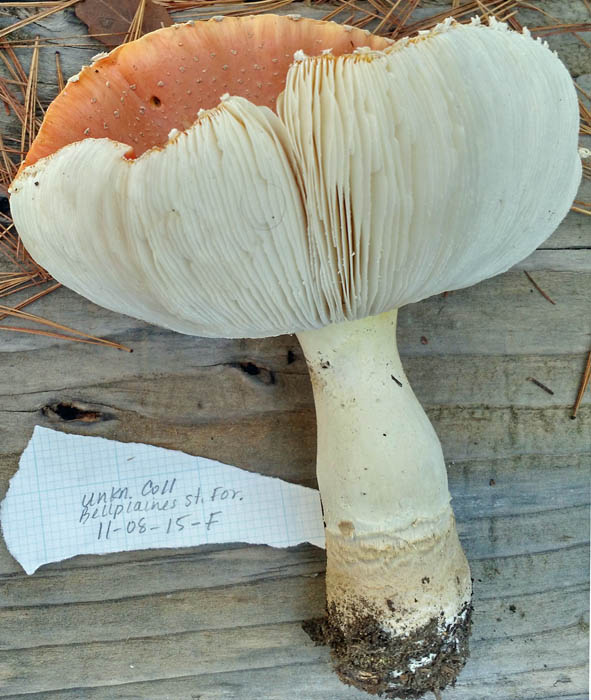
white to creamy with pale pinkish tint in mass,
white to off-white in side view, staining and
bruising not observed, moderately broad (up to
7 - 11.5 (-18.5) mm broad), with strongly
floccose edge; lamellulae abruptly
truncate to truncate, numerous, sometimes separating
nearly all pairs of lamellae, of diverse lengths. |
| stipe |
40 - 105 × 8 - 20 (-38) mm, pale yellow near apex,
with remainder whitish to sordid white to tannish
white to brownish white, cylindric or narrowing
upward or downward, flaring broadly or just at apex
or not at all, often longitudinally striatulate
(sometimes finely so), fibrillose to finely
pulverulent near apex, sometimes satiny or fibrillose
over much of stipe in "flame" or "chevron" or
"snakeskin" pattern, sometimes becoming
fibrillose-lacerate near base; bulb 15 - 51 ×
20 - 45 mm, subglobose to ovoid to subnapiform to
fusiform to clavate, often with short radical,
creamy white to pale buff, bearing white mycelium;
context densely stuffed with firm material
in 4 - 5.5 (-18) mm wide central cylinder, white to
off-white, sometimes turning watery brown or
yellow when cut, larva tunnels concolorous or
brown; partial veil superior to median,
either membranous [delicate, whitish to pale yellow
to yellowish above and yellowish below, with
thickened edge, not striate above, browning to
graying (with age, drying, or handling), skirt-like
at first, often tearing and/or collapsing on
stipe] or as very narrow fine tan rim near stipe
base or absent; universal veil occasionally
as few (frequently up to 6) very fine ringlets on
lower stipe and uppermost part of bulb or raggedly
sublimbate, pale yellow to yellowish tan to sordid
brownish yellow to pale brownish gray to tan to
brownish gray, floccose to (occasionally)
submembranous material, sometimes as thin layer of
pulverulence covering upper part of bulb and
lower stipe. |
| odor/taste |
Odor faintly pleasant or faintly sweetish fungal or indistinct/absent. Taste indistinct. |
macrochemical
tests |
Paracresol test for tyrosinase (basidiome of intermediate development) - positive throughout most of basidiome interior, but negative near surface of stipe base and bulb, near pileus surface, in pileus context adjacent to lamellae, on the lower two-thirds of hymenial surfaces, a in single spots in the stipe context (centered at stipe apex, eccentrically based at join of stipe and bulb). Syringaldazine test for laccase (basidiome of intermediate development) - negative throughout basidiome. Test voucher: Tulloss 12-2-89-B. Presumed to be POISONOUS and to produce the Pantherine Syndrome in humans. |
| lamella trama |
bilateral; wcs = 35 - 40 µm (very good rehydration); ??; subhymenial base ??; filamentous, undifferentiated hyphae ?? µm wide, ??; terminal, inflated cells ??; vascular hyphae ?? µm wide, ??; clamps prominent and rather common. |
| subhymenium |
wst-near = 60 - 80 µm (very good rehydration); wst-far = 85 - 95 µm (very good rehydration); cellular (pseudoparenchymatous), ??; with basidia arising from ??. |
| lamella edge tissue |
sterile. |
| basidiospores |
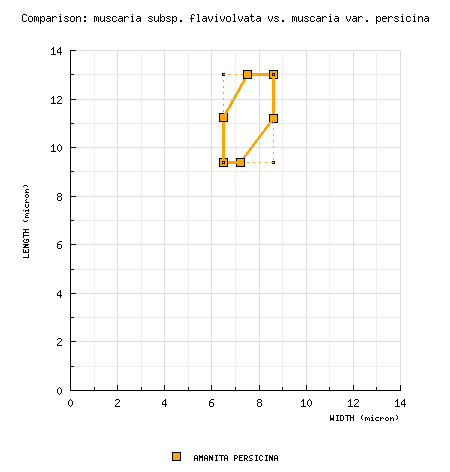
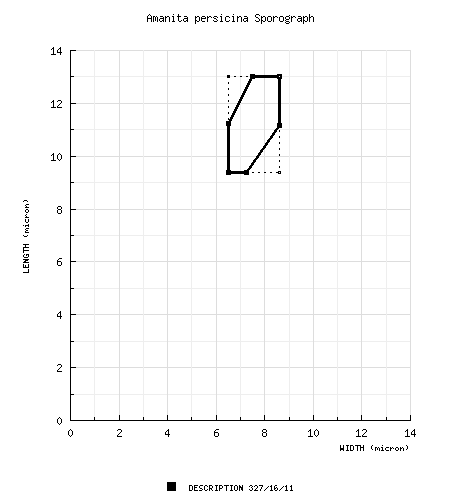
[327/16/11] (8.0-) 9.4 - 13.0 (-18.0) × (5.5-) 6.5 - 8.6 (-11.1) µm, (L = (9.8-) 10.0 - 12.1 (-13.0) µm; L’ = 11.0 µm; W =
(6.8-) 6.9 - 8.0 (-8.1) µm; W’ = 7.4 µm; Q = (1.19-) 1.30 - 1.73 (-2.25); Q = (1.36-) 1.38 - 1.60 (-1.69); Q’ =
1.48), hyaline, colorless, thin-walled, smooth, inamyloid, ellipsoid to (infrequently) elongate, infrequently broadly ellipsoid, usually at least somewhat adaxially flattened, with occasional “giant spores” in immature material; apiculus sublateral, broad, prominent, cylindric to subcylindric to truncate-conic; contents dominantly monoguttulate (often suggesting an “oil drop”) with additional small granules, also granular; white in deposit. |
| ecology |
Solitary to subgregarious to fruitings numbering in
the thousands of basidiomes. From coastal
plain of the Atlantic and Gulf of Mexico coasts to
submontane elevations. Alabama: In open lawn
with Pinus nearby or in dry, exposed habitat
under P. taeda L. & P. virginiana
Mill. or in mixed Quercus-Pinus forest.
Mississippi: In dry, sandy, woods of Ilex,
Quercus, and P. palustris Mill. and
in Pinus plantations. New Jersey: In
Tsuga canadensi-northern hardwood forest and
in P. rigida-Quercus spp. sandy soil
of Pine Barrens. New York: In sandy soil of Quercus-Pinus forest including some Populus. Tennessee: ??. West Virginia: On shale barrens in Quercus-Pinus forest. [Also reported from Georgia and Virginia.] |
| material examined |
U.S.A.: ALABAMA—Shelby Co. - Oak Mtn. St. Pk., Peavine Rd., 21.x.1980, D. T. Jenkins & Miller White [Jenkins] 1596 (in herb. David T. Jenkins; RET 151-5), [Jenkins] 1600 (in herb. David T. Jenkins; RET 151-3), 4.xi.1980 D. T. Jenkins 1617 (in herb. David T. Jenkins; RET 151-7), 1619 (in herb. David T. Jenkins; RET 151-6). Talladega Co. - Childersburg, 8.xii.1975 Karen Andrews s.n. [D. T. Jenkins 1107] (paratype, in herb. David T. Jenkins; paratype, RET 151-4). Unkn Co. - ca. border Jefferson & Shelby Cos., by lake ca. D. T. Jenkins’ home, 29.x.1984, D. T. Jenkins 2592 (in herb. David T. Jenkins; RET 151-8).
GEORGIA—Lumpkin Co. - "outside of Chattahoochee Nat. For.," ca. 28.ix.2009 Stephen Perry s.n. (RET 450-7).
LOUISIANA—Evangeline Parish - Crooked Creek Recreation Area, 27.xi.2009 William Roody s.n. (RET 458-7).
MISSISSIPPI—Harrison Co. - ca. Saucier, Harrison Experimental For., 2.xii.1989 R.E. Tulloss 12-2-89-A (RET 024-3, nrITS seq'd.; in herb. C. Lavorato), -B (RET 112-6, nrITS seq'd.), -C (RET 112-5, nrITS seq'd.).
NEW JERSEY—Cape May Co. - Belleplain St.
For. [39.2477° N/ 74.8583° W, 8 m], 8.xi.2015 NJMA foray participant s.n. [Tulloss
11-8-15-F] (RET 714-4). Sussex Co. - Stokes St. For.,
Struble Rd., 29.x.1998 Hanna Tschekunow s.n.
(RET 289-4).
NEW YORK—Suffolk Co. (Long Isl.) - Edgewood Oak Brush Plains Preserve, 19.x.2002 G. E. Davis s.n. (RET 328-2).
NORTH CAROLINA—Rutherford Co. - 6.5 km NW of Gilkey & N of Rutherton, Painters Gap Rd., 27.ix.2006 Todd Elliott s.n. [Tulloss 9-27-06-L] (RET 400-3).
TENNESSEE—Blount Co. - GSMNP, Cades Cove, 25.ix.1973 Priscella Campbell & D. T. Jenkins [Jenkins 671] (TENN, holotype).
WEST VIRGINIA—Pendleton Co. - unkn. loc., 6.x.1996 W. Roody s.n. (RET 256-9). |
| discussion |
t.b.d.
|
| citations |
—R. E. Tulloss |
| editors |
RET |
|




 Spore data sets and their composite