| name |
Amanita peltigera |
| author |
D. A. Reid. 1978. Victorian Naturalist 95: 49. |
| name status |
nomen acceptum |
| english name |
"Shield-Bearing Death Cap" |
| etymology |
peltus, "shield" + -ger, "-bearing" (adjectival ending); hence, "shield bearing," because of the large patch on the cap of the holotype. |
| MycoBank nos. |
308577 |
| GenBank nos. |
Due to delays in data processing at GenBank, some accession numbers may lead to unreleased (pending) pages.
These pages will eventually be made live, so try again later.
|
| holotypes |
K |
| type studies |
Tulloss (partial) herein |
| revisions |
Reid. 1980. Austral. J. Bot., Suppl. Ser. 8: 47, figs. 31(a-b), 87. |
| intro |
The following text may make multiple use of each data field.
The field may contain magenta text presenting data from a type study
and/or revision of other original material cited in the protolog of the present taxon.
Macroscopic descriptions in magenta are a combination of data from the protolog and
additional observations made on the exiccata during revision of the cited original
material.
The same field may also contain black text, which is data from a revision of the present
taxon (including non-type material and/or material not cited in the protolog).
Paragraphs of black text will be labeled if further subdivision of
this text is appropriate.
Olive text indicates a specimen that has not been
thoroughly examined (for example, for microscopic details) and marks other places in the text
where data is missing or uncertain.
The following material is derived from the protolog of the present taxon and from original research by R. E. Tulloss. Because the partial type study of Tulloss was carried out in 1988 prior to his differentiation of vascular hyphae from other hyphae that appear refractive, the editors choose to use the more general term "refractive hyphae" in reporting his results. |
| pileus |
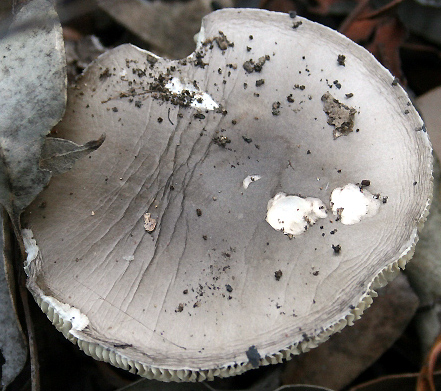
from protolog: 55 mm wide, gray, plano-convex; context not decribed; margin "smooth and naked"; universal veil as single, very large, white, patch, with surface cracking into large separable membranous placques "seated on a continuous felt-like base." |
| lamellae |
not described in protolog. |
| stipe |
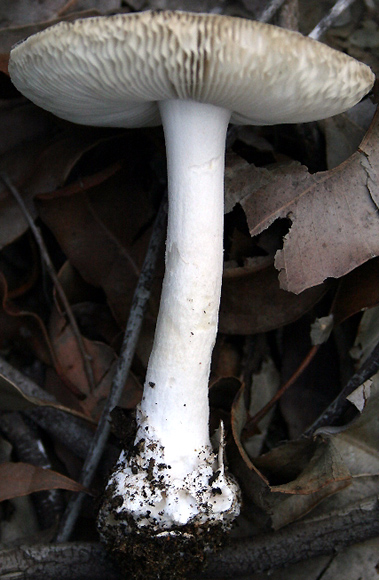
from protolog: 50 × 10 mm, white, with "hint of greyish pencilling"; bulb "swollen rooting," up to to 23 mm wide; context not described; partial veil lacking; universal veil "sheathing," whitish, "saccate." |
| odor/taste |
not recorded. |
macrochemical
tests |
none recorded. |
| pileipellis |
not described in protolog.
from type study of RET: filamentous undifferentiated hyphae 6.2 - 7.3 μm wide, dominant, branching, lacking subradial arrangement; refractive hyphae 3.6 - 8.5 μm wide, branching, rather common. |
| pileus context |
not described in protolog. |
| lamella trama |
not described in protolog.
from study of type by RET: bilateral, divergent; ??; ??; refractive hyphae 2.4 - 5.1 μm wide, branching, rather plentiful. |
| subhymenium |
from protolog: conspicuously pseudoparenchymatous
from study of type by RET: pseudoparenchymatous (cellular); comprising globose to subglobose to ellipsoid inflated cells, ca. 40 μm deep, with some basidioles extending about 20 μm into subhymenium |
| basidia |
from protolog: 30 - 37 × 9 - 10 μm; clamps lacking.
from study of type by RET: 38 - 55 × 10.9 - 15.8 μm, dominantly 4-, also 2- and 3-sterigmate; clamps not observed. |
| universal veil |
from protolog: hyphae 3 - 12 μm wide, predominating, hyaline, branched, with thin but distinct walls, often somewhat inflated; inflated cells extremely scanty, subglobose or ovoid, up to 110 × 90 μm; clamps lacking.
from type study of RET: On stipe base, exterior surface: filamentous undifferentiated hyphae 2.6 - 9.7 μm wide, dense, often longitudinally oriented, dominant; inflated cells (even very near surface), subclavate to ventricose, thin-walled, frequent, up to 57 × 27 μm; refractive hyphae 7.3 - 8.5 μm wide. On stipe base, interior: filamentous undifferentiated hyphae 5.7 - 15.8 μm wide, densely interwoven, thin-walled, curving but not coiling; inflated cells same shapes as at surface, thin-walled, up to 99 × 35 μm, also subglobose (e.g., 27 × 26 μm); refractive hyphae not observered. On pileus, within "placque": Very similar to that on stipe base perhaps with more and larger inflated cells, but still dominated by filamentous undifferentiated hyphae, uniform throughout except for exterior surface; inflated cells up to 124 × 32 μm; refractive hyphae present throughout, 3.5 - 8.5 μm wide. On pileus, from crumbly layer beyond edge of "placque": with hyphae and inflated cells about equally frequent, with many cell walls apparently thickened; tissue as elsewhere (above); filamentous undifferentiated hyphae with walls thin or (apparently) up to 0.7 μm thick; inflated cells occasionally ovoid in addition to previously reported shapes, up to 82 × 75 μm, with walls thin or (apparently) 0.5 - 1.2 μm thick. |
| stipe context |
not described in protolog. |
| partial veil |
absent. |
| lamella edge tissue |
not described in protolog. |
| basidiospores |
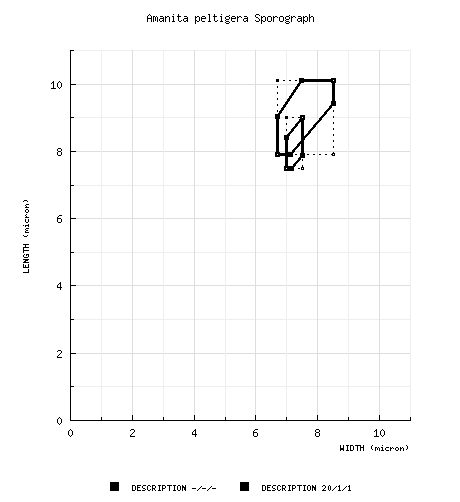
from protolog: [-/-/-] (6.5-) 7.5 - 9.0 × (6.0-) 7.0 - 7.5 (-8.5) μm, (est. Q = 1.05 - 1.20), amyloid, subglobose to broadly ellipsoid; apiculus not recorded; contents not recorded; color in deposit not recorded.
from type study of RET: [20/1/1] (7.6-) 7.9 - 10.1 (-11.9) × (6.3-) 6.7 - 8.5 (-9.1) μm, (L = 9.2 μm; W = 7.5 μm; Q = (1.02-) 1.11 - 1.35 (-1.38); Q = 1.23), ??, smooth, thin-walled, amyloid, subglobose to broadly ellipsoid to ellipsoid, infrequently globose, somewhat adaxially flattened; apiculus sublateral, truncate conic, proportionately small; contents ??; color in deposit unknown. |
| ecology |
not described in protolog. |
| material examined |
from protolog and type study of RET: AUSTRALIA: WESTERN AUSTRALIA—Stirling West, iii.1976 John Randals s.n. (holotype, K). |
| discussion |
Because of the absence of a partial veil in the single specimen of the type, there may be some hesitation to place this species in Amanita sect. Phalloideae; but, at present, that seems to be the best choice considering the microscopic structure that has been reported for the universal veil. A distinct bulb at the stipe base and the lack of multiple, distinct layers in the interior of the universal veil appear to eliminate inclusion of the present species in sect. Amidella.
The word "apparent" is used in reference to thickness of cell walls because collapsed cells can appear to have thickened walls when uncollapsed cells are clearly thin-walled. This fact may not have been clear to RET in 1988. On the other hand, Reid's fig. 87 (1980) shows thickened walls on hyphae in an unidentified location within the universal veil even though the 1980 text seems to imply that he didn't see thickened walls in that tissue. |
| citations |
—R. E. Tulloss |
| editors |
RET |
|




 Spore data sets and their composite