| name |
Amanita pekeoides |
| author |
G. S. Ridl. 1992. Austral. Syst. Bot. 4: 333, fig. 4(a-h). |
| name status |
nomen acceptum |
| english name |
"Maori's Sack Ringless Amanita" |
| MycoBank nos. |
355194 |
| GenBank nos. |
Due to delays in data processing at GenBank, some accession numbers may lead to unreleased (pending) pages.
These pages will eventually be made live, so try again later.
|
| holotypes |
PDD |
| intro |
The following text may make multiple use of each data field.
The field may contain magenta text presenting data from a type study
and/or revision of other original material cited in the protolog of the present taxon.
Macroscopic descriptions in magenta are a combination of data from the protolog and
additional observations made on the exiccata during revision of the cited original
material.
The same field may also contain black text, which is data from a revision of the present
taxon (including non-type material and/or material not cited in the protolog).
Paragraphs of black text will be labeled if further subdivision of
this text is appropriate.
Olive text indicates a specimen that has not been
thoroughly examined (for example, for microscopic details) and marks other places in the text
where data is missing or uncertain.
The following material not directly from the protolog of the present taxon is based on original research by R. E. Tulloss. |
| pileus |
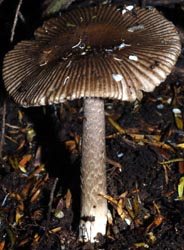
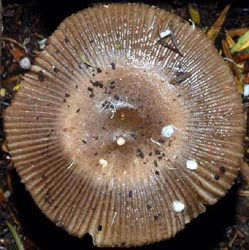
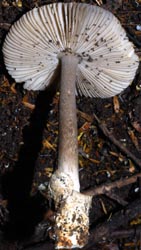
type study of RET: 32 - 82 mm wide, hazel to dark grayish sepia, paling to grayish sepia at margin, with sulcate ridges concolorous with disc, with furrows pale grayish sepia or vinaceous buff, convex to plano-convex, then plano-depressed, slightly viscid when wet, quickly drying; context white, with pale brown vinaceous to pale sepia region below pileipellis in disc; margin sulcate (0.15 - 0.35R), entire, occasionally splitting along furrows; universal veil absent. |
| lamellae |
type study of RET: free, crowded, pale buff to buff when fresh, orangish brown in exsiccata (lacking gray tint), 6 - 10 mm broad, with entire pallid edge; lamellulae truncate. [Note: The fact that the lamellae are not marginate (contrary to the protolog) was kindly confirmed by Dr. Ridley (pers. corresp.).] |
| stipe |
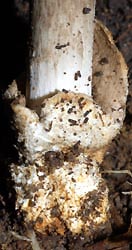
type study of RET: 70 - 120 × 7 - 10 (-17) mm, pale grayish sepia, decorated with hazel to grayish sepia striate bands (becoming finer and more numerous toward apex), narrowing upward; context white, hollow, with central cylinder diameter about one-half to one-third of stipe diameter; exannulate; universal veil as saccate volva, fleshy when young, membranous in age, 1 - 3 mm thick, 30 - 58 mm high, usually bilobate, buff with ochraceous to fulvous stains, attached only at stipe base, with limbus internus small and placed one-fifth to one-quarter of way up volval limb. |
| odor/taste |
not recorded. |
macrochemical
tests |
none reported. |
| pileipellis |
type study of RET: 70 - 100 µm thick, orange-brown in 3% KOH, gelatinized only at surface; filamentous, undifferentiated hyphae 1.0 - 6.0 µm wide, branching, dominantly subradially arranged, densely packed; vascular hyphae not observed. |
| pileus context |
type study of RET: filamentous, undifferentiated hyphae 3.5 - 10.0 µm wide, branching, in fascicles or singly, interweaving in loose lattice structure, occasionally having partially inflated intercalary segments, sometimes with yellowish subrefractive walls (locally common); acrophysalides narrowly clavate to clavate to broadly clavate to irregularly clavate to pyriform, up to 75 × 30 µm, common to plentiful, thin-walled; vascular hyphae 2.5 - 15.5 µm wide, sinuous, rather common to locally plentiful, locally frequently branching or forming loose tangles. |
| lamella trama |
type study of RET: bilateral; wcs = 80 - 105 µm (excellent rehydration, Ridley 18); subhymenial base comprising frequently branching hyphae (plentiful) and inflated cells (subglobose to ellipsoid to ovoid to obclavate, up to 29 × 16.2 µm); filamentous, undifferentiated hyphae 1.8 - 5.6 µm wide, branching, infrequently with yellowish walls, apparently without partially inflated intercalary segments in central stratum; terminal, divergent inflated cells not observed; vascular hyphae not observed. |
| subhymenium |
type study of RET: wst-near = 35 - 50 µm (excellent rehydration, but not completely mature, Ridley 18), = 65 - 70 µm in mature but damaged tissues (McNabb s.n.); wst-far = 80 - 95 µm (excellent rehydration, but not completely mature, Ridley 18), = 90 - 100 µm in mature but damaged tissues (McNabb s.n.); in immature regions of hymenium, comprising frequently branching short segmented interwoven hyphae, sometimes with one or two segments immediately below basidia slightly inflated; in mature regions of hymenium, dominated by small inflated and partially inflated cells (up to 21 × 13.2 µm, but mostly smaller than 10 × 10 µm) in up to three layers below bases of longer basidia/-oles and short hyphal segments (perpendicular to central stratum), pseudoparenchymatous in some regions, but branching structure usually apparent, with one to three cells between bases of longest and shortest basidia/-oles in small region, with basidia arising from both inflated cells and (occasionally) from uninflated or partially inflated hyphal segments. |
| basidia |
type study of RET: 47 - 84 × 12.6 - 18.2 µm, dominantly 4-sterigmate, occasionally 2- or 1-sterigmate, with sterigmata up to 8.8 × 3.2 µm; clamps not observed. |
| universal veil |
type study of RET: On pileus: absent or as scarce gelatinized fragments of inner surface of volval limb. On stipe base, exterior surface: comprising often thick fascicles of filamentous, undifferentiated hyphae and single hyphae interwoven, with fascicles rather distant from each other giving clear view of interior tissue between them, with outermost fascicles partially to strongly gelatinized and sordid to brown to orange, with many large outer fascicles sublongitudinally oriented, but with others occurring at nearly any angle; filamentous, undifferentiated hyphae 1.4 - 10.2 µm wide, branching, dominating, sometimes with yellowish subrefractive walls, often in fascicles up to 15 or more hyphal diameters across, with walls thin or slightly thickened; vascular hyphae 3.8 - 4.9 µm wide, scattered, infrequent. On stipe base, interior: filamentous, undifferentiated hyphae 2.8 - 14.5 µm wide, branching, dominating, sometimes coiled in broad curves, in fascicles (as broad as those on exterior surface) and singly, with walls thin to slightly thickened, often constricted at septa; inflated cells up to 53 × 27 µm (most under 30 × 20 µm), thin-walled, ovoid to clavate to narrowly clavate, terminal singly, scattered, rather scarce; vascular hyphae not observed. On stipe base, inner surface: orange-brown, thin layer of gelatinized elements like those in interior or (in some areas) closely packed, longitudinally oriented, filamentous, undifferentiated hyphae. |
| stipe context |
type study of RET: longitudinally acrophysalidic; filamentous, undifferentiated hyphae 3.5 - 9.1 µm wide, branching, plentiful to dominant; acrophysalides thin-walled, plentiful, rather narrow, up to 328+ × 34 µm, with many greater than 200 µm long; vascular hyphae 3.5 - 10.8 µm wide, branching, sinuous, scattered, but not uncommon. |
| partial veil |
absent. |
| lamella edge tissue |
type study of RET: sterile; colorless, 60± µm thick, partially gelatinized, even before beginning sporulation becoming dominated by subpericlinal closely packed filamentous, undifferentiated hyphae, with inflated cells (up to 47 × 30 µm or more) originally in up to 3 or more layers. |
| basidiospores |
from type study of RET
[=A. umbrinolutea sensu G. Stev. in part
= A. vaginata sensu G. Stev. in part]:
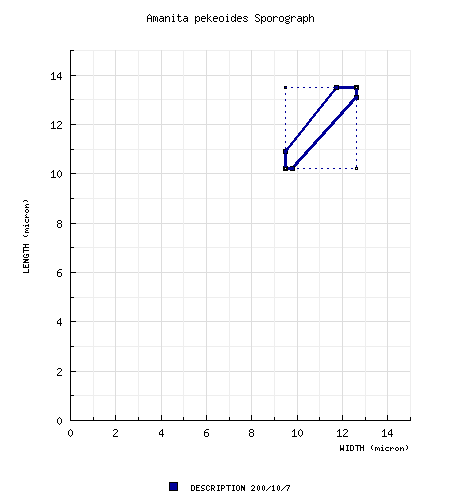
[200/10/7] (8.4-) 10.2 - 13.5 (-17.5) × (7.5-) 9.5 - 12.6 (-17.0) μm, (L = (10.9-) 11.5 - 12.8 μm; L’ = 12.0 μm; W = (10.0-) 10.2 - 11.8 μm; W’ = 11.1 μm; Q = (1.03-) 1.04 - 1.15 (-1.58); Q = 1.06 - 1.10 (-1.13); Q’ = 1.09), hyaline, colorless, thin-walled, smooth, inamyloid, globose to subglobose to broadly ellipsoid, rarely ellipsoid or broadly langeniform, at least somewhat adaxially flattened, sometimes expanded at one end; apiculus sublateral, cylindric, prominent; contents dominantly monoguttulate, occasionally multiguttulate or granular; white in deposit. |
| ecology |
type study of RET: Solitary to subgregarious to gregarious. Under Nothofagus menziesii (Hook. f.) Oerst. and N. fusca (Hook. f.) Oerst. (PDD 56143) or under N. truncata (Col.) Ckn. (PDD 56141, PDD 56142, PDD 56146) or under N. solandri (Hook. f.) Oerst. var. solandri or N. solandri var. clifortioides (Hook. f.) Poole. Paratypes not reviewed were collected under Leptospermum scoparium Forster & Forster f. [Segedin 206 (PDD)] and under Kunzea ericoides (A. Rich.) J. Thompson [Stevenson 83/153 (CHR)]. Information concerning the habitat of specific collections was provided to me by Dr. Ridley (pers. corresp.). |
| material examined |
type study of RET: NEW ZEALAND: NORTH ISLAND—Wellington Region - Eastbourne, Muritai Pk., 29.iii.1958 M. Bulmer s.n. [G. Stevenson 1271A] (paratype, K 36095); Lower Hutt, Taita, 18.iii.1958 G. Stevenson 1270 (paratype, K 36092); Rimutaka For. Pk., Orongorongo Track, 28.iii.1986 G. S. Ridley 18 (paratype, PDD 56142); Rimutaka For. Pk., Orongorongo Valley, Paua Ridge, 19.iii.1986, G. S. Ridley 13 (paratype, PDD 56141), 1.iv.1987 G. S. Ridley 374 (holotype, PDD 56146); S Wairarapa geographic region, Wairongomai Stn., 27.vii.1949 G. Stevenson 735 (paratype, K 36088).
SOUTH ISLAND—Canterbury Region - Ashley Gorge, 3.iii.1968 R. F. McNabb s.n. (paratype, PDD 31227). West Coast Region - Denniston, Denniston Walkway, 25.i.1987 L. D. Milicich s.n. [G. S. Ridley 284] (paratype, PDD 56143).
|
| citations |
Of the taxa studied to date, A. pekeoides has the greatest similarity to A. humboldtii Singer described from under Quercus humboldtii Bonpl. in Andean Colombia (Tulloss et al. 1992). The present taxon differs from A. humboldtii in having
- lamellae not marginate
- fewer cells in the subhymenium below the longest basidia/-oles
- vascular hyphae absent or certainly not common in pileipellis
- pileipellis twice as thick as in A. humboldtii
- interior of limb of universal veil having notably fewer inflated cells.
Amanita arctica differs from the present taxon by its
- white to pallid pileus
- presence of acrophysalides with walls up to 0.8 µm thick in contexts of both pileus and stipe
- notably greater number of inflated cells in the interior of the universal veil
- presence of inflated cells with walls up to 0.8 µm thick in the interior of the universal veil
- affinity to subarctic habitat.
Ridley 18 is immature and no spores were found on its lamellae; however, its macroscopic characters and anatomy clearly place it in A. pekeoides.
The McNabb collection has become rather damaged by mold; however, there are still sections of lamellae that are sufficiently well preserved so that the parameters of the mature subhymenial tree can be measured from them as well as they can be from any of the specimens examined. The spores of the collection are undamaged.
Paratype materials reportedly deposited in K could not be located; however, Dr. Ridley kindly sent me photocopies of his notes on those collections for my information.
In the protolog of the present species, Ridley distinguished two sets of “individuals” having what he considered to be minimal macroscopic differences from the set of specimens from which the above description was derived. He explicitly included these other specimens within the species although each of the two sets is described separately. One set is called “individuals with friable volva”; the other, “white individuals.” On the present site these are treated as two code-named, provisional taxa: A. sp-Ridley-pekeoides-friable-volva and A. sp-Ridley-pekeoides-white.—R. E. Tulloss |
| editors |
RET |
|


 Spore data sets and their composite