| name |
Amanita ovalispora |
| author |
Boedijn. 1951. Sydowia 5: 320, fig. 2(1). |
| name status |
nomen acceptum |
| english name |
"Boedijn's Oval-Spored Ringless Amanita" |
| MycoBank nos. |
292456 |
| GenBank nos. |
Due to delays in data processing at GenBank, some accession numbers may lead to unreleased (pending) pages.
These pages will eventually be made live, so try again later.
|
| holotypes |
BO (implicit, in liquid) |
| revisions |
Z. L. Yang. 1997. Biblioth. Mycol. 170: 92, figs. 72-76. |
| intro |
The following text may make multiple use of each data field.
The field may contain magenta text presenting data from a type study
and/or revision of other original material cited in the protolog of the present taxon.
Macroscopic descriptions in magenta are a combination of data from the protolog and
additional observations made on the exiccata during revision of the cited original
material.
The same field may also contain black text, which is data from a revision of the present
taxon (including non-type material and/or material not cited in the protolog).
Paragraphs of black text will be labeled if further subdivision of
this text is appropriate.
Olive text indicates a specimen that has not been
thoroughly examined (for example, for microscopic details) and marks other places in the text
where data is missing or uncertain.
The following material not derived from the protolog of the present taxon is based upon
cited research by ZLY and colleagues.
NOTE: Spore measurements from papers by Z. L. Yang use his "Times New Roman" face for "Q" and "Q'"—respectively, "Q" and "Q." |
| lamella edge tissue |
from protolog: inflated cells 15 - 30 μm long, globose to subglobose. |
| basidiospores |
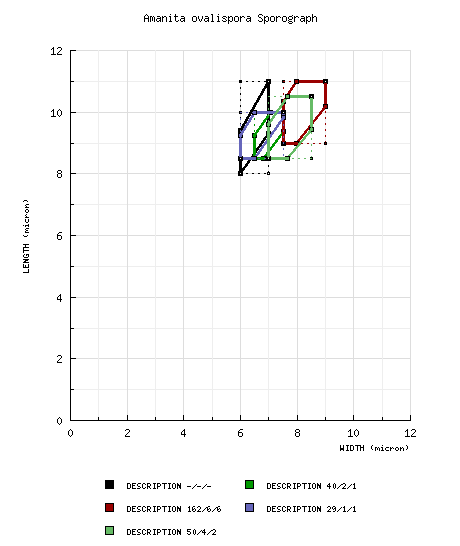
from protolog: [-/-/-] 8 - 11 × 6 - 7 μm, (est. Q = 1.33 - 1.57; est. Q = 1.46), ellipsoid; apiculus sublateral (per figure); contents not described; color in deposit not recorded. "Most common dimensions 9 - 10 × 6 - 6.5 μm." [Note: Range of Q conservatively estimated in order to permit sporograph generation.—ed.]
from study of type, Yang (1997): [40/2/1] (8.0-) 8.5 - 10.0 (-10.5) × (6.0-) 6.5 - 7.5 (-8.0) μm, (Q = (1.19-) 1.25 - 1.42 (-1.47); Q = 1.32 ± 0.06).
Yang (1997): [162/6/6] (8.5-) 9.0 - 11.0 (-12.0) × (7.0-) 7.5 - 9.0 (-9.5) μm, (Q = (1.05-) 1.13 - 1.38 (-1.51); Q = 1.25 ± 0.08), broadly ellipsoid to ellipsoid, occasionally subglobose, inamyloid, colorless, hyaline, smooth, thin-walled; apiculus ca. 1.0 μm long.
Yang (2000): [29/1/1] (8.0-) 8.5 - 10.0 (-13.0) × (5.5-) 6.0 - 7.5 μm,
(Q = (1.27-) 1.31 - 1.54 (-1.78); Q = 1.43 ± 0.11), hyaline, colorless, smooth, thin-walled, inamyloid, ellipsoid, infrequently broadly ellipsoid or elongate;.
Yang et al. (2001): [50/4/2] (8.0-) 8.5 - 10.5 (-11.0) × (6.5-) 7.0 - 8.5 (-9.0) μm, (Q = (1.08-) 1.11 - 1.37 (-1.46); Q = 1.24 ± 0.09), subglobose to broadly ellipsoid, occasionally ellipsoid, thin-walled, colorless, hyaline, inamyloid. |
| ecology |
Solitary or in small groups. China: At 600 - 1750 m elev. In conifer and broadleaf forests with Pinus kesiya var. langbianensis. |
| material examined |
from protolog: INDONESIA: JAVA—Bogor, Botanical Garden, iii.1925 van Overeem s.n. (holotype, BO, implicit, in liquid).
from study of type, Yang (1997): INDONESIA: JAVA—Bogor, Botanical Garden, iii.1925 van Overeem s.n. (holotype, BO, implicit, in liquid).
Yang (1997):
CHINA:
YUNNAN—Pu'er Prefecture - Jingdong Yi Autonomous County, Bian, 21.viii.1991 Z. L. Yang 1601 (HKAS 24161); Jinggu Dai and Yi Autonomous Co., Mengban, 21.viii.1991 G. Song 256 (HKAS 24152); Simao District, unkn. loc., 1.viii.1991 P. G. Liu 791 (HKAS 24159).
Xishuangbanna Dai Autonomous Prefecture - Menghai Co., Mangao, 16.viii.1991 Z. L. Yang 1585 (HKAS 24160); Mengla Co., Menglun, 11.ix.1974 S. Y. Zeng s.n. (HKAS 1441), s.n. (HKAS 1458).
Yang (2000): CHINA:
JIANGSU—Nanjing (sub-provincial) city - former city of Nanjing, Dr. Sun Yat-sen Mausoleum Nat. Pk., 14.vii.1936 S. C. Li (formerly "IBN 5808"; BPI 751435, as "Amanita vaginata").
Yang et al. (2001):
CHINA:
HAINAN—Ledong Li Autonomous Co. - Jianfengling, 2.ix.1999 X. L. Wu 20 (HKAS 34110), 3.ix.1999 X. L. Wu 19 (HKAS 34109). |
| citations |
—R. E. Tulloss |
| editors |
RET |
|


 Spore data sets and their composite