
| name | Amanita olivacea |
| name status | nomen acceptum |
| author | Beeli |
| english name | "Olivaceous Amidella" |
| intro |
The following description is based on Beeli (1935) and Gilbert (1941). |
| cap |
The cap is 120 - 180 mm
wide, brown-olive to sordid olive, at first convex, later concave, with
center sometimes appearing frosted-whitish, with a nonappendiculate
margin, nonstriate at first, more or less distinctly crenate-striate with
age. The flesh is whitish. The volva is present as several rather large
patches, and is rather thick, cream colored, and appearing felted (use
10x lens). The cap of Amanita olivacea is 40 - 50 mm wide, pale, convex, with a barely striate margin. The cap is covered with small, olivaceous, powdery, squamules that are easily removed. The flesh is firm. |
| gills | The gills are free to nearly free to narrowly adnate with a decurrent tooth, moderately distant to nearly distant in age, white, entire, with flocculose edges. The short gills are not described. |
| stem |
The stem is 150 - 200 × 20 - 25 mm, cream, somewhat brownish in older specimens, somewhat slippery, and nearly cylindric. The bulb is subglobose and up to 45 mm wide. The flesh is rather firm. The ring is superior to submedian, membranous, skirt-like, and persistent. The limbate volva is thick, robust, white on both surfaces, with surface layers relatively easily separated mechanically in dried material. The gills are free, somewhat rounded near the stem, 6 mm broad, and slightly yellow (distinctly pinkish in Madame Goossens' watercolors). Its stem is 90 - 100 × 6 - 8 mm, cylindrical, stuffed, pale, with slight squamules similar to those on the cap. The flesh is white. The ring is brownish and ephemeral. The volva is membranous and very thick . The volval sac is somewhat pointed below, as shown in Madame Goossens watercolors. |
| odor/taste | The odor is lacking in fresh material but like honey in dried material. The taste is sweet. |
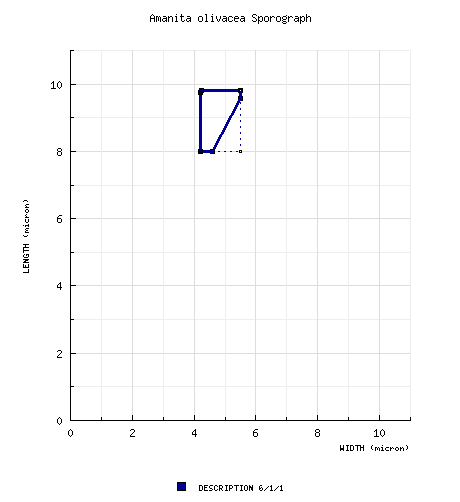
| spores | According to the spore drawings of Gilbert (1940 & 1941), spores of the present species measure 8.0 - 9.8 × 4.2 - 5.5 μm and are elongate to cylindric and amyloid. If the species is correctly placed in sect. Amidella, basidia probably lack clamps at their bases. |
| discussion |
The present species was originally described from the Republic of Congo where it occurred in dry forests. The powdery inner layer of the otherwise robust volval sac, the easily disintegrating ring, the striate margin of the cap, and the elongate spores are all consistent with placement of the present species in section Amidella. The colored lamellae are unusual in this section. The absence of a color change of the flesh when the stem is cut should be checked on fresh material especially on material in which the stipe is still expanding.—R. E. Tulloss |
| brief editors | RET |
| name | Amanita olivacea | ||||||||||||||||||||
| author | Beeli. 1931. Bull. Soc. Roy. Bot. Belgique 63: 106, pl. 9 (fig. 10). | ||||||||||||||||||||
| name status | nomen acceptum | ||||||||||||||||||||
| english name | "Olivaceous Amidella" | ||||||||||||||||||||
| synonyms |
≡Amidella olivacea (Beeli) E.-J. Gilbert. 1940. Iconogr. Mycol. (Milan) 27, suppl. (1): 77, tab. 29 (fig. 1). The editors of this site owe a great debt to Dr. Cornelis Bas whose famous cigar box files of Amanita nomenclatural information gathered over three or more decades were made available to RET for computerization and make up the lion's share of the nomenclatural information presented on this site. | ||||||||||||||||||||
| MycoBank nos. | 152708, 284136 | ||||||||||||||||||||
| GenBank nos. |
Due to delays in data processing at GenBank, some accession numbers may lead to unreleased (pending) pages.
These pages will eventually be made live, so try again later. Search:
Showing 0 to 0 of 0 entries | ||||||||||||||||||||
| holotypes | BR (implicit) | ||||||||||||||||||||
| selected illustrations |
Beeli. 1935. Fl. Champ. Congo 1: pl. 1 (fig. 10). E.-J. Gilbert. 1941. Iconogr. Mycol. (Milan) 27, suppl.: 312, tab. 39. | ||||||||||||||||||||
| intro |
The following text may make multiple use of each data field. The field may contain magenta text presenting data from a type study and/or revision of other original material cited in the protolog of the present taxon. Macroscopic descriptions in magenta are a combination of data from the protolog and additional observations made on the exiccata during revision of the cited original material. The same field may also contain black text, which is data from a revision of the present taxon (including non-type material and/or material not cited in the protolog). Paragraphs of black text will be labeled if further subdivision of this text is appropriate. Olive text indicates a specimen that has not been thoroughly examined (for example, for microscopic details) and marks other places in the text where data is missing or uncertain. The following material is derived from the protolog of the present taxon, (Beeli 1935), and (Gilbert 1940 & 1941). | ||||||||||||||||||||
| pileus | from protolog: 40 - 50 mm wide, with ground color (context?) whitish, convex; context white, fleshy, firm; margin not described; universal veil as weakly attached powdery squamules, olivaceous. | ||||||||||||||||||||
| lamellae | from protolog: free, density not described, slightly yellowish, 6 mm broad; lamellulae not described. | ||||||||||||||||||||
| stipe | from protolog: 90 - 100 × 6 - 8 mm, cylindric, decorated with light squamules similar to those on pileus; bulb lacking (per figure); context solid, firm; partial veil brownish, ephemeral; universal veil membranous, thick, fleshy (per figure). | ||||||||||||||||||||
| odor/taste | from protolog: Odor not described. Taste sweet. | ||||||||||||||||||||
| macrochemical tests |
none recorded. | ||||||||||||||||||||
| pileus context | not described. | ||||||||||||||||||||
| lamella trama | not described. | ||||||||||||||||||||
| subhymenium | not described. | ||||||||||||||||||||
| basidia | not described. | ||||||||||||||||||||
| universal veil | Beeli (1935): On pileus: filamentous hyphae branching, interconnectin with pileipellis; inflated cells generally globose, 20 - 40 μm in diameter, terminal. On stipe: not described. | ||||||||||||||||||||
| stipe context | not described. | ||||||||||||||||||||
| partial veil | not described. | ||||||||||||||||||||
| lamella edge tissue | not described. | ||||||||||||||||||||
| basidiospores |
from protolog: 7 - 9 × 4 - 5 μm, hyaline, smooth, "ellipsoid" (sic). [Note: From the dimensions, the spores are elongate. Sporograph not generated.—ed.] Beeli (1935): amyloid; white in deposit. Gilbert (1940 & 1941): [6/1/1] 8.0 - 9.8 × 4.2 - 5.5 μm, (L = 8.9 μm; W = 4.6 μm; Q = 1.74 - 2.32; Q = 1.94), hyaline, smooth, amyloid, elongate to cylindric; apiculus sublateral and cylindric (per figure); contents not described; white in deposit. [Note: Spore measurements are taken from the six drawings of (Gilbert 1940: tab. XXIX (fig. 1)) that are in apparent lateral view.—ed.] | ||||||||||||||||||||
| ecology | from protolog: Scattered. On soil in dry forest. | ||||||||||||||||||||
| material examined |
from protolog: CONGO, DEMOCRATIC REPUBLIC OF: PROV. EQUATEUR—Territoire Lisala - Binga [2°23'41" N/ 20°25'25" E, 361 m], Beeli (1935): CONGO, DEMOCRATIC REPUBLIC OF: PROV. EQUATEUR—Territoire Lisala - Binga [2°23'41" N/ 20°25'25" E, 361 m], Gilbert (1940 & 1941): CONGO, DEMOCRATIC REPUBLIC OF: PROV. EQUATEUR—Territoire Lisala - Binga [2°23'41" N/ 20°25'25" E, 361 m], | ||||||||||||||||||||
| discussion | The amyloid spores; the layered universal veil leaving a thin squamulose layer on the pileus and a fleshy, saccate volva at the stipe base; and the apparently totally elongating stipe suggest placement of the present species in Amanita sect. Amidella. | ||||||||||||||||||||
| citations | —R. E. Tulloss | ||||||||||||||||||||
| editors | RET | ||||||||||||||||||||
Information to support the viewer in reading the content of "technical" tabs can be found here.
| name | Amanita olivacea |
| bottom links |
[ Section Phalloideae page. ] [ Amanita Studies home. ] [ Keys & Checklists ]
[ Section Amidella page. ]
[ Amanita Studies home. ]
[ Keys & Checklists ] |
| name | Amanita olivacea |
| bottom links |
[ Section Phalloideae page. ] [ Amanita Studies home. ] [ Keys & Checklists ]
[ Section Amidella page. ]
[ Amanita Studies home. ]
[ Keys & Checklists ] |
 Spore data sets and their composite
Each spore data set is intended to comprise a set of measurements from a single specimen made by a single observer; and explanations prepared for this site talk about specimen-observer pairs associated with each data set. Combining more data into a single data set is non-optimal because it obscures observer differences (which may be valuable for instructional purposes, for example) and may obscure instances in which a single collection inadvertently contains a mixture of taxa.

Text and User-Generated Sporographs are published under the Creative Commons License.

In the case of a taxon page, image credits are on the 'image' tab.