| name |
Amanita nishidae |
| author |
Tulloss nom. prov. |
| name status |
nomen provisorum |
| english name |
"Nishida's Ringless Amanita" |
| etymology |
genitive of Latinized name, "Nishida's" or "of Nishida"
Named in honor of Dr. Florence H. Nishida, a driving force behind the Chiricahua Mycoflora Project. |
| GenBank nos. |
Due to delays in data processing at GenBank, some accession numbers may lead to unreleased (pending) pages.
These pages will eventually be made live, so try again later.
|
| intro |
Olive text indicates a specimen that has not been
thoroughly examined (for example, for microscopic details) and marks other places in the text
where data is missing or uncertain.
The following is based entirely on original research of R. E. Tulloss. |
| pileus |
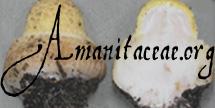
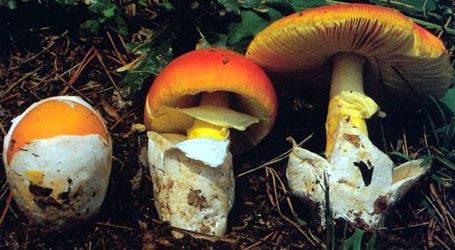
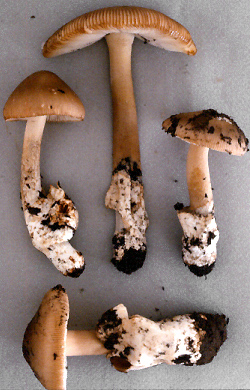
41 - 90 mm wide, young specimens fulvous or browner with olivaceous tint, soon fading to dull somewhat orangish brown (still with trace of olivaceous tint) and then palest at margin, finally orange-tan in age, broadly campanulate to convex to plano convex to nearly planar, umbonate, with decurved margin, tacky, matt to subshiny; context white to off-white, often faintly brownish or grayish in disc under pileipellis, unchanging when cut or bruised, 5 - 11 mm thick at stipe, thinning evenly for about eight ninths of radius or to within 2 mm of margin, then membranous to margin; margin striate (very slightly at first) (0.15 - 0.35R), nonappendiculate; universal veil commonly absent, occasionally as small white patch over disc and then developing orange-brown stains, soft, detersile, membranous. |
| lamellae |
free to narrowly adnate, with rather long decurrent line on stipe (lens), sometimes with decurrent tooth, crowded, off-white to cream and sometimes concolorous with pileus margin within 10 mm of same in mass, white to off-white or somewhat watersoaked in side view, 4.5 - 10 mm broad, sometimes marginate (brownish orange) in the last few mm near pileus margin; lamellulae truncate, of varying length, unevenly distributed, infrequent. |
| stipe |
91 - 132 × 8 - 15 mm, with pallid ground, browning or darkening on raised fibrils from handling and from drying in situ, narrowing upward, flaring (sometimes only very slightly) at apex in older specimens, otherwise not, with longitudinally oriented fibrils concolorous with (or slightly paler than) pileus, longitudinally striatulate to longitudinally striate, with surface sometimes cracking into recurved scales; context white or sometimes grayish to very pale grayish in lower half, becoming somewhat sordid in stipe base and in crushed material from central cylinder, infrequently with brick red spot(s) in base, concolorous in larva tunnels, stuffed with white cottony material (becoming sordid tan when curshed or pale ochraceous when damaged by larvae), becoming hollow with age, with central cylinder 4 - 7.5 mm wide; exannulate; universal veil as a saccate volva, membranous, with exterior soft and cottony to leathery, off-white on exterior surface with orange-brown to orangish to ochraceous stains (especially in upper portion), interior surface pale orange or color of pileus margin or slightly paler than pileus margin, up to 1.5 mm thick at midpoint between highest point of limb and point of attachment to stipe, 34 - 74 × 18 - 19 mm, appressed to stipe only at very base of stipe, limbus internus small, but distinct at first, located about one third of distance from point of attachment to highest point of limb. |
| odor/taste |
Odor indistinct. Taste bland at first, with faintly bitter, faintly metallic aftertaste. |
macrochemical
tests |
t.b.d. |
| lamella trama |
somewhat obscurely bilateral; wcs = 60 - 95 µm; with angle of divergence shallow, with subhymenial base containing plentiful inflated intercalary cells (often clavate, up to 50 × 21 µm); filamentous, undifferentiated hyphae 3.0 - 9.0 µm wide, branching, densely packed, with intercalary partially inflated segments up to 13.8 µm wide; divergent, terminal inflated cells not observed; vascular hyphae 10.5 - 14.0 µm wide, infrequent. |
| subhymenium |
wst-near = 50 - 75 µm; wst-far = (70-) 80 - 105 µm; branching structure with inflated cells and partially inflated and uninflated hyphal segments and branched elements, with elements smaller than those of subhymenial base (but with occasional obpyriform to clavate cell up to 29 × 21 µm), with some regions having plentiful inflated cells (approaching pseudoparenchymatous, about two cells thick), with basidia arising from inflated cells or from uninflated or partially inflated hyphal segments aligned perpendicular to central stratum. |
| basidia |
51 - 80 × 14.7 - 20 µm, 4-sterigmate; clamps not observed. |
| partial veil |
absent. |
| lamella edge tissue |
sterile. |
| basidiospores |
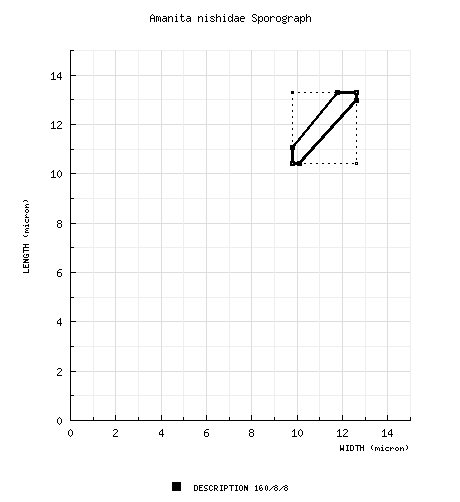
[160/8/8] (9.0-) 10.4 - 13.3 (-14.8) × (9.1-) 9.8 - 12.6 (-13.6) µm, (L = 11.1 - 12.6 (-12.8) µm; L’ = 11.9 µm; W = 10.4 - 11.7 (-12.0) µm; W’ = 11.1 µm; Q = (1.0-) 1.03 - 1.13 (-1.23); Q = (1.05-) 1.07 - 1.10; Q’ = 1.08), hyaline, colorless, thin-walled, smooth, inamyloid, globose to subglobose, rarely broadly ellipsoid, usually at least somewhat adaxially flattened, sometimes expanded at one end; apiculus sublateral, sometimes rather short, truncate-conic to narrowly truncate-conic to cylindric; contents monoguttulate, with or without additional small granules; white in deposit. |
| ecology |
Solitary to subgregarious to gregarious, from 1550 to 2600 m elev. With Quercus emoryi, Q. arizonica, Juniperus deppeana, Cupressus arizonica, Platanus wrightii, and Fraxinus velutina or in loam and litter with Abies concolor and Pinus flexilis or with P. arizonica and Pseudotsuga menziesii or with Juniperus deppeana, P. menziesii, C. arizonica, Quercus hypoleucoides, Q. arizonica, and Platanus wrightii or with Abies concolor, P. menziesii, P. arizonica, J. deppeana, P. chihuahuana. |
| material examined |
U.S.A.: ARIZONA—Cochise
Co. - CMP site #4, 16.viii.1989 R. Harvey s.n.
[CMP0120] (per collector "A. fulva", RET); CMP
site #5, 14.viii.1990 J. S. States AEF632 [CMP0393]
(MICH as "A. fulva"),
12.viii.1991 F. H. Nishida 4479 [CMP0954]
(RET); CMP site #6, 21.viii.1989 R. M. Chapman
s.n. [CMP0273] (per collector "A. fulva", RET);
CMP site #24, 11.viii.1991 R. M
Chapman s.n. [CMP1638] (RET); CMP site #30,
18.viii.1991 R. E. Tulloss 8-18-91-J [CMP0644]
(RET 701-2);
CMP site #40, 19.viii.1992 F. H. Nishida s.n.
[CMP1334 ; Tulloss 8-19-92-AE] (RET); CMP site #46,
21.viii.1989 R. M. Chapman s.n. [CMP0271] (per
collector "A. fulva", RET), F. H. Nishida
& R. E. Tulloss 8-18-91-K [CMP0649] (RET 701-7),
3.ix.1991 L. Ortiz s.n. [CMP1483] (RET); CMP site
#49, 28.viii.1991 J. Turney s.n. [CMP1672] (per
collector "A. pachycolea", RET). |
| discussion |
Many southwestern U.S. collectors call this entity A. fulva (Schaeff.) Fr.; but it is much more robust than usually seen in the European species, contains olivaceous tones in the pileipellis, has much shorter striae relative to the pileus radius, [anatomy]....
There were no field notes with CMP1672, but the form of the exsiccatum, the spore size and shape and the subhymenium and lamella trama are consistent with a determination as A. nishidae.
The present species has been referred to by me as "Amanita sp. AZ8" in correspondence, keys, and draft articles. |
| citations |
—R. E. Tulloss |
| editors |
RET |
|



 Spore data sets and their composite