

| name | Amanita neglecta |
| name status | nomen acceptum |
| author | Boedijn |
| english name | "Shadowy Amanita" |
| images | |
| intro | The following description is based on the original description by Boedijn (1951). |
| cap | The cap of Amanita neglecta is 40 - 110 mm wide, dirty brown, close to buffy brown, paler near the margin, at first hemispherical, later convex, then planar, with a smooth or weakly short-striate margin. The volva is present as more or less angular warts, 0.5 - 3 mm wide, very crowded in the center, darker than the cap; the warts can be easily lost as the mushroom ages. The flesh is thin, white, 2.5 - 5 mm thick over the stem, rapidly thinning towards the margin. |
| gills | The gills are free, dirty white to cream color, and 5 - 9 mm broad at the midpoint. |
| stem | The stem is 50 - 110 × 6 - 10 mm, narrowing upward, solid, becoming hollow in age, pallid, close to pinkish buff or somewhat darker, covered with dark scales below the ring. The basal bulb is 10 - 20 mm wide. The ring is pale yellow to about colonial buff, skirt-like, and membranous. The volva is present as dark scales arranged concentrically at the top of the bulb and often disappears. |
| spores | The spores measure 6 - 8.5 µm long and are subglobose to broadly ellipsoid. Our description of the spore shape is dependent on the illustration, not the text. |
| discussion |
Amanita neglecta was originally described from Java. In the original description, the author considered the possibility that this species was identical to Amanita fritillaria (Berk.) Sacc. The examination of the type of A. fritillaria by Corner & Bas (1962) demonstrated that the spores of that species are proportionately narrower than in A. neglecta and subsequent study reported on this site supports that observation. In selecting species for comparison with A. neglecta we looked for taxa with a dark colored cap, warts darker than the cap color, and spores dominantly broadly ellipsoid or a little broader. In this category, we find A. fritillara f. malayensis Corner & Bas, A. pilosella Corner & Bas, and A. pilosella f. atroconica Corner & Bas. None of these taxa have the pinkish buff stem and pale yellow ring described for A. neglecta. In the forms of A. pilosella, the spores are larger. Therefore the taxa seem to be distinct from A. neglecta; but, to say more about the morphological relationship, requires a modern reexamination of Boedijn'''s type.—R. E. Tulloss and L. Possiel |
| brief editors | RET |
| name | Amanita neglecta | ||||||||||||||||||||
| author | Boedijn. 1951. Sydowia 5: 324, fig. 4(2). | ||||||||||||||||||||
| name status | nomen acceptum | ||||||||||||||||||||
| english name | "Shadowy Amanita" | ||||||||||||||||||||
| synonyms |
double click in markup mode to edit. The editors of this site owe a great debt to Dr. Cornelis Bas whose famous cigar box files of Amanita nomenclatural information gathered over three or more decades were made available to RET for computerization and make up the lion's share of the nomenclatural information presented on this site. | ||||||||||||||||||||
| MycoBank nos. | 457565 | ||||||||||||||||||||
| GenBank nos. |
Due to delays in data processing at GenBank, some accession numbers may lead to unreleased (pending) pages.
These pages will eventually be made live, so try again later. Search:
Showing 0 to 0 of 0 entries | ||||||||||||||||||||
| holotypes | no holotype designated; 3 collections cited in protolog | ||||||||||||||||||||
| lectotypes | There are three syntypes (see "material examined" data field, below). | ||||||||||||||||||||
| intro |
The following text may make multiple use of each data field. The field may contain magenta text presenting data from a type study and/or revision of other original material cited in the protolog of the present taxon. Macroscopic descriptions in magenta are a combination of data from the protolog and additional observations made on the exiccata during revision of the cited original material. The same field may also contain black text, which is data from a revision of the present taxon (including non-type material and/or material not cited in the protolog). Paragraphs of black text will be labeled if further subdivision of this text is appropriate. Olive text indicates a specimen that has not been thoroughly examined (for example, for microscopic details) and marks other places in the text where data is missing or uncertain. The following material not directly from the protolog of the present taxon unless otherwise noted. | ||||||||||||||||||||
| pileus | from protolog: 40 - 110 mm wide, sordid brown (ca. Buffy Brown), paler toward margin, at first hemispheric, then convex to planar, more or less glabrous in age; context white, 2.5 - 5 mm thick above stipe, rapidly thinning near margin; margin smooth or weakly short-striate; universal veil as warts, darker than pileipellis, more or less angular, 0.5 - 3 mm wide, detersile. | ||||||||||||||||||||
| lamellae | from protolog: free. density not reported, sordid white to cream, 5 - 9 mm broad; lamellulae not described. | ||||||||||||||||||||
| stipe | from protolog: 50 - 110 × 6 - 10 mm, pallid, ca. Pinkish Buff or somewhat darker, narrowing upward; context solid at first, becoming hollow with age; bulb 10 - 20 mm wide; partial veil pale yellow, ca. Colonial Buff, pendent, lax; universal veil as adpressed scales, darker than stipe color, covering much of stipe below partial veil, in imperfect rings near base, at least sometimes detersile. | ||||||||||||||||||||
| odor/taste | not recorded. | ||||||||||||||||||||
| macrochemical tests |
none reported. | ||||||||||||||||||||
| pileipellis | not described. | ||||||||||||||||||||
| pileus context | not described. | ||||||||||||||||||||
| lamella trama | not described. | ||||||||||||||||||||
| subhymenium | not described. | ||||||||||||||||||||
| basidia | from protolog: 30 - 36 × 8 - 9.5 μm, 4-sterigmate. | ||||||||||||||||||||
| universal veil | not described. | ||||||||||||||||||||
| stipe context | not described. | ||||||||||||||||||||
| partial veil | not described. | ||||||||||||||||||||
| lamella edge tissue | from protolog: inflated cells globose, 12 - 30 μm wide. | ||||||||||||||||||||
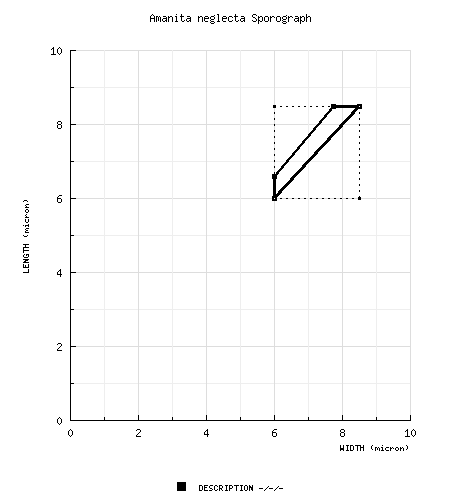
| basidiospores | from protolog: [-/-/-] 6 - 8.5 × 6 - 8.5 μm, (est. Q = 1.0 - 1.10), most commonly 5.6 - 7 μm wide, globose to subglobose, globose to subglobose. [Note: Reaction to Melzer's Reagent not reported. With only one dimension, a sporograph cannot be generated. Hence, we made a conservative approximation of the range of Q and assumed identical ranges for width and length in order to generate an approximation of a sporograph.—ed.] | ||||||||||||||||||||
| ecology | not recorded. | ||||||||||||||||||||
| material examined |
from protolog: INDONESIA: JAVA—Bogor, | ||||||||||||||||||||
| discussion |
Boedijn did not know A. fritillaria. Working only from its protolog, he was uncertain about the similarity between that species and the present one; however, he thought they were similar and might even prove to be the same entity. The following diagram provides a sporograph comparison (of course a rough approximation, see above) of A. fritillaria and the present species: We are not aware of anyone having proposed a lectotype for this species. In order to do so, the material will have to be revised to assess the relative value of the collections. | ||||||||||||||||||||
| citations | —R. E. Tulloss | ||||||||||||||||||||
| editors | RET | ||||||||||||||||||||
Information to support the viewer in reading the content of "technical" tabs can be found here.
 Spore data sets and their composite
Each spore data set is intended to comprise a set of measurements from a single specimen made by a single observer; and explanations prepared for this site talk about specimen-observer pairs associated with each data set. Combining more data into a single data set is non-optimal because it obscures observer differences (which may be valuable for instructional purposes, for example) and may obscure instances in which a single collection inadvertently contains a mixture of taxa.

Text and User-Generated Sporographs are published under the Creative Commons License.

In the case of a taxon page, image credits are on the 'image' tab.