
| name | Amanita nana |
| name status | nomen acceptum |
| author | Singer |
| english name | "Little Steppe Lepidella" |
| intro |
The following is largely based on the description of Bas (1969). |
| cap |
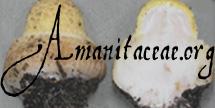
The cap of Amanita nana is about 20 - 50 mm wide, convex to flat, probably white, dry, flocculose-felted, appendiculate, with a nonsulcate margin. The cap is covered with badly delimited, floccose-felted, probably white, adnate patches to scales at the center, sometimes with subpyramidal, felted warts. |
| gills |
The gills are crowded, just free, proportionately rather broad, and ventricose. The short gills are rounded to attenuate. |
| stem |
The stem is about 40 - 70 × 4 - 8 mm, solid, probably white, equal, with subfusiform or subclavate base. The stem bears a submedian to superior, smooth annulus with a thickened, warty edge. A floccose-felted to floccose-squamulose sheath of volval tissue is present, ending just above the expanded basal part; the upper edge of the sheath is sometimes free. |
| spores |
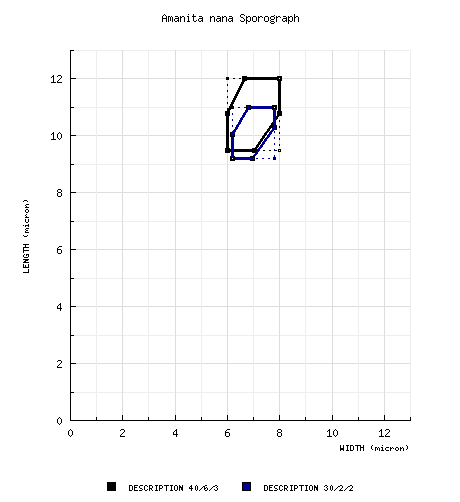
The spores measure (9.0-) 9.2 - 11.0 (-12.0) × 6.2 - 7.8 (-8.2) µm and are amyloid and ellipsoid to elongate. Clamps are present at bases of basidia. |
| discussion |
The original description was based on material from the steppes or semi-desert of
Kazakhstan. The species is also known from several sites within Pakistan. In the 1950's, Dr Sultan Ahmad reported
that it was common in certain parts of eastern Pakistan. Kreisel and Al-Fatimi (2008) reported this species from Yemen. It is not a well-known species, but appears not to
require a woody ectomycorrhizal symbiont. Bas' stirps Nana contains only the present species.—R. E. Tulloss |
| brief editors | RET |
| name | Amanita nana | ||||||||||||||||||||
| author | Singer. 1941. Bot. Mater. Otd. Sporov. Rast. Bot. Inst. Komarova Akad. Nauk S.S.S.R. 5: 85. | ||||||||||||||||||||
| name status | nomen acceptum | ||||||||||||||||||||
| english name | "Little Steppe Lepidella" | ||||||||||||||||||||
| synonyms |
≡Armillaria nana (Singer) Locq. 1952. Bull. Trimestriel Soc. Mycol. France 68: 167. The editors of this site owe a great debt to Dr. Cornelis Bas whose famous cigar box files of Amanita nomenclatural information gathered over three or more decades were made available to RET for computerization and make up the lion's share of the nomenclatural information presented on this site. | ||||||||||||||||||||
| MycoBank nos. | 282557, 282566 | ||||||||||||||||||||
| GenBank nos. |
Due to delays in data processing at GenBank, some accession numbers may lead to unreleased (pending) pages.
These pages will eventually be made live, so try again later. Search:
Showing 0 to 0 of 0 entries | ||||||||||||||||||||
| holotypes | LE | ||||||||||||||||||||
| revisions | Bas. 1969. Persoonia 5: 368, figs. 62-65. | ||||||||||||||||||||
| intro |
The following text may make multiple use of each data field. The field may contain magenta text presenting data from a type study and/or revision of other original material cited in the protolog of the present taxon. Macroscopic descriptions in magenta are a combination of data from the protolog and additional observations made on the exiccata during revision of the cited original material. The same field may also contain black text, which is data from a revision of the present taxon (including non-type material and/or material not cited in the protolog). Paragraphs of black text will be labeled if further subdivision of this text is appropriate. Olive text indicates a specimen that has not been thoroughly examined (for example, for microscopic details) and marks other places in the text where data is missing or uncertain. The following material is derived from (Bas 1969) and some original research of R. E. Tulloss. | ||||||||||||||||||||
| basidiospores |
Bas (1969): [40/6/3] (9.0-) 9.5 - 12.0 (-13.0) × 6.0 - 8.0 (-10.0) μm, (Q = 1.35 - 1.80; Q = 1.45 - 1.55), colorless, hyaline, thin-walled, amyloid, ellipsoid to elongate; apiculus abrupt, moderately large; contents guttulate to translucent; color in deposit not recorded. RET: [30/2/2] (9.0-) 9.2 - 11.0 (-12.0) × 6.2 - 7.8 (-8.2) μm, (L = 10.0 - 10.3 μm; L' = 10.2 μm; W = 6.6 - 7.2 μm; W' = 7.0 μm; Q = (1.28-) 1.32 - 1.62 (-1.74); Q = 1.45 - 1.50; Q' = 1.47), hyaline, colorless, smooth, thin-walled, amyloid, broadly ellipsoid to ellipsoid, often adaxially flattened; apiculus sublateral, rounded conic, proportionately rather broad; contents not described; color in deposit not recorded. | ||||||||||||||||||||
| ecology | RET: Pakistan: In sandy soil. | ||||||||||||||||||||
| material examined |
Bas (1969): KAZAKHSTAN: Golodnaya Step', 5.iv.1915 O. A. Fedtsechenko s.n. (holotype, LE).
PAKISTAN: PUNJAB—Sheikhupura Distr. - Lhadhar, 12.x.1952 S. Ahmad 4973 (L). Bahawalpur Distr. - Bahawalpur, 18.viii.1966 S. Ahamd 19367b (L). RET: PAKISTAN: PUNJAB—Lahore, | ||||||||||||||||||||
| citations | —R. E. Tulloss | ||||||||||||||||||||
| editors | RET | ||||||||||||||||||||
Information to support the viewer in reading the content of "technical" tabs can be found here.
 Spore data sets and their composite
Each spore data set is intended to comprise a set of measurements from a single specimen made by a single observer; and explanations prepared for this site talk about specimen-observer pairs associated with each data set. Combining more data into a single data set is non-optimal because it obscures observer differences (which may be valuable for instructional purposes, for example) and may obscure instances in which a single collection inadvertently contains a mixture of taxa.

Text and User-Generated Sporographs are published under the Creative Commons License.

In the case of a taxon page, image credits are on the 'image' tab.