| name |
Amanita mobilimanica |
| author |
Tulloss nom. prov. |
| name status |
nomen provisorum |
| english name |
"Loose Sleeve Ringless Amanita" |
| etymology |
mobilis "loose or easily moved" + manica
"sleeve"; hence, "loose sleeve," because of the manner
in which most or all of the volval sac slides up the
stipe during expansion of the basidiome. |
| GenBank nos. |
Due to delays in data processing at GenBank, some accession numbers may lead to unreleased (pending) pages.
These pages will eventually be made live, so try again later.
|
| intro |
Olive text indicates a specimen that has not been
thoroughly examined (for example, for microscopic details) and marks other places in the text
where data is missing or uncertain.
The following is based upon original research by R. E. Tulloss. |
| pileus |
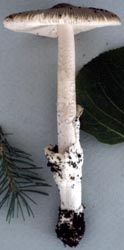
37 - 86 mm wide, pale sepia to sepia-brown to dark brown (browner than 2.5Y 5/2 or grayer and more olivaceous than 10YR 5/2) with darker disc or sepia-gray with sepia disc or lead gray (5E4) or pale gray to gray (with or without a darker disc), sometimes very pallid at first but becoming more distinctly pigmented with age, sometimes faintly virgate, hemispheric to convex to planoconvex, usually with distinct umbo in larger specimens, tacky or dry, matt to subshiny to waxy; context gray or brownish gray under pileipellis in band up to 1 mm thick across entire pileus or only in umbo, otherwise white, watery sordid white when crushed, occasionally ochraceous around edges of old wounds, 4.5 - 9 mm thick at stipe, usually thinning evenly for two-thirds or more of radius (even until last few mm of radius) and then membranous to margin, sometimes thinning more rapidly in first third or half of radius and then thinning evenly to margin; margin striate (0.2 - 0.5R), nonappendiculate; universal veil absent or, occasionally, as small or large patch or patches, membranous, originally white, eventually pale gray, sometimes wrinkled, usually smooth, sometimes minutely verruculose (lens), detersile. |
| lamellae |
free to receding to (occasionally) narrowly adnate with decurrent tooth, with occasionally quite long (although faint) decurrent line on stipe (lens) or very small decurrent tooth, close to subcrowded to crowded, off-white to sordid cream to cream to pale yellowish cream in mass, sordid cream to pale sordid cream to pale cream to very pale off-white to very pale grayish white to white in side view, unchanging when cut or bruised, sometimes becoming more sordid with age, 2.5 - 8.5 mm broad, infrequently anastomosing in one collection (CMP1837), rarely with reverse forking (CMP1837), with concolorous margin minutely flocculose at first (lens); lamellulae truncate to subtruncate to excavate-truncate, common to plentiful, of diverse lengths, unevenly distributed, sometimes infrequent in some sectors, occasionally attached to stipe rather than pileus margin. |
| stipe |
59 - 133 × 5.5 - 15 (-38) mm, white to very pale off-white, becoming pale gray to gray to brownish gray from handling, narrowing upward or cylindric, only flaring very close to apex (if at all), occasionally somewhat flattened, finely striatulate, faintly punctate (lens) or faintly pruinose or chalky near apex, minutely fibrillose (lens) and finely longitudinally striatulate below, with fibrils white to gray to dark gray, occasionally exhibiting bands of cracking in stipipellis, rather brittle in smallest specimens; context very pale grayish white or off-white to white with pale watery lines to white, unchanging when cut or bruised, concolorous to pale gray to sordid pale tan in larva tunnels, hollow or (occasionally) partially stuffed to stuffed, lined with cottony white fibrils or partially filled with such fibrils loosely packed, with central cylinder 1.5 - 8.5 mm wide; exannulate; universal veil as saccate volva, 25 - 80 × 7± - 24 mm, membranous, soft, somewhat easily torn, white to pale off-white, becoming very pale gray to pale brownish gray to gray in uppermost part of limb, at first flaring in upper portion, then collapsing on stipe, often constricted or broken below and raised along stipe like loose sleeve (strangulate or exposed-stipe region 0 - 24 mm long), up to 1 mm thick at midpoint between base (or upper end of constricted region if such is present) and topmost point of limb, with small limbus internus about one-third of distance from base of stipe to topmost point of limb (but often carried up above strangulate region and then may be three-quarters of distance from base of stipe to highest point of limb). |
| odor/taste |
Odor indistinct or faintly earthy. Taste not recorded. |
macrochemical
tests |
Paracresol spot test for tyrosinase - positive throughout basidiome except for some spots on faces of lamellae and, sometimes, external surface of universal veil. Syringaldazine spot test for laccase - positive in lower part of universal veil and very base of stipe and in some fragments of universal veil on stipe above volval limb. Test vouchers: CMP1337, CMP4712, Tulloss 8-14-97-A, 8-15-97-B. |
| pileipellis |
ungelatinized or partially gelatinized, ?layering? ? µm thick; filamentous, undifferentiated hyphae ? µm wide, ?, densely packed, subradially arranged; vascular hyphae 2.1 - 10.5 µm wide, extensively branching, common although unevenly distributed, locally plentiful, occasionally in knots. |
| basidia |
31 - 62 × 11.5 - 16.0 µm, 4-sterigmate; clamps not observed. |
| partial veil |
absent. |
| lamella edge tissue |
sterile. |
| basidiospores |
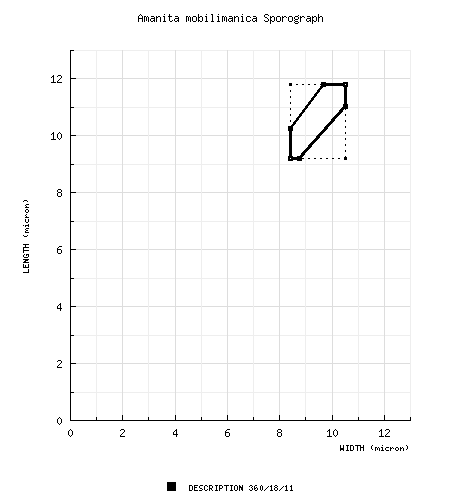
[360/18/11] (7.7-) 9.2 - 11.8 (-15.0) × (6.1-) 8.4 - 10.5 (-14.0) µm, (L = (9.4-) 9.7 - 11.2 (-11.3) µm; L’ = 10.5 µm; W = (8.5-) 8.9 - 9.9 (-10.0) µm; W’ = 9.4 µm; Q = (1.0-) 1.05 - 1.22 (-1.32); Q = (1.08-) 1.09 - 1.15 (-1.18); Q’ = 1.12), hyaline, colorless, thin-walled, smooth, inamyoid, globose to subglobose, infrequently broad ellipsoid, adaxially flattened; apiculus sublateral, cylindric; contents monoguttulate (with or without additional small particles) or multiguttulate; white in deposit. |
| ecology |
Arizona: Solitary to subgregarious from 1790 to 2790 m elev. Under Pseudotsuga menziesii in stone and clay at edge of road or in dark loam with Pinus arizonica or in forests of that tree mixed with Pseudotsuga menziesii or in forest with Quercus arizonica, Q. emoryi, Q. hypoleucoides, Juniperus deppeana, Cupressus arizonica, Pinus chihuahuana, P. discolor, Prunus serotina, and Platanus wrightii or with Pseudotsuga menziesii, Q. arizonica, and Q. hypoleucoides or in loam and litter in forest including Populus tremuloides, Pseudotsuga menziesii, and Pinus arizonica or with Populus tremuloides, Pseudotsuga menziesii, Acer glabrum, and Abies concolor or under Pinus engelmannii. |
| material examined |
U.S.A.: ARIZONA—Cochise Co. - CMP site #12, 23.viii.1991 R. M. Chapman s.n. [CMP1074] (LAM, as "A. velosa"); CMP site #25, 13.viii.1990 J. S. States s.n. [CMP0382] (RET); CMP site #28, 16.viii.1990 F. H. Nishida 4144 [CMP0486] (RET); CMP site #40, 19.viii.1992 R. E. Tulloss 8-19-92-S [CMP1336] (LAM; RET); CMP site #41, 19.viii.1992 collector unknown s.n. [CMP1337; Tulloss 8-19-92-Q] (LAM; RET); CMP site #46, 16.viii.1991 R. M. Chapman s.n. [CMP1137; Tulloss 8-16-91-A] (LAM; RET), 18.viii.1991 R. E. Tulloss 8-18-91-F [CMP0646] (LAM; RET), 21.viii.1992 R. L. Homola s.n. [CMP1350; Tulloss 8-21-92-R] (LAM; RET), W. J. Sundberg s.n. [CMP1837; Tulloss 8-21-92-ADb] (LAM; RET); CMP site #47, 18.viii.1991 R. E. Tulloss 8-18-91-B [CMP0640] (LAM; RET).
COLORADO—Summit Co. - 3.2 km S of Shrine Pass, 14.viii.1997 Jack Murphy s.n. [Tulloss 8-14-92-A] (F; RET). |
| discussion |
t.b.d.
CMP1074 was not accompanied by collecting notes. It is included in this taxon on the basis of the size and shape of its spores and the structure of its lamella trama and subhymenium.
The present species has been called "Amanita sp. AZ2," "Amanita sp. AZ4," "Amanita sp. AZ17," and “Amanita sp. AZ22” in keys, correspondence, and printed drafts of this description. |
| citations |
—R. E. Tulloss |
| editors |
RET |
|



 Spore data sets and their composite