E. M. Davison & G. M. Gates in Davison et al.
2017.
Death cap
mushrooms from southern Australia: additions to
Amanita (Amanitaceae, Agaricales)
section
Phalloideae Clade IX. Austral. Syst. Bot.
30(4): 379.
name status
nomen acceptum
etymology
protolog: "Named after the late Alan
K. Mills, lecturer in mycology at the
University of Tasmania."
Due to delays in data processing at GenBank, some accession numbers may lead to unreleased (pending) pages.
These pages will eventually be made live, so try again later.
protolog: Gregarious.
In sand, in native vegetation with nearby plants
include Allocasuarina spp.
material examined
protolog:
AUSTRALIA:
TASMANIA—? - Freycinet Nat. Pk.
[40.17° S/ 148.27$deg; E], 1.xii.2001 G. M. Gates
& D. A. Ratkowsy [Gates A32] (holotype, HO 581533;
isotype, HKAS 77322 in KUN).
editors
RET
Information to support the viewer in reading the content of "technical" tabs
can be found here.
name
Amanita millsii
name status
nomen acceptum
author
E. M. Davison & G. M. Gates
name
Amanita millsii
name
Amanita millsii
Spore data for collections provisionally identified as: Amanita millsii E. M. Davison & G. M. Gates
Each spore data set is intended to comprise a set of measurements from a single specimen made by a single observer;
and explanations prepared for this site talk about specimen-observer pairs associated with each data set.
Combining more data into a single data set is non-optimal because it obscures observer differences
(which may be valuable for instructional purposes, for example) and may obscure instances in which
a single collection inadvertently contains a mixture of taxa.



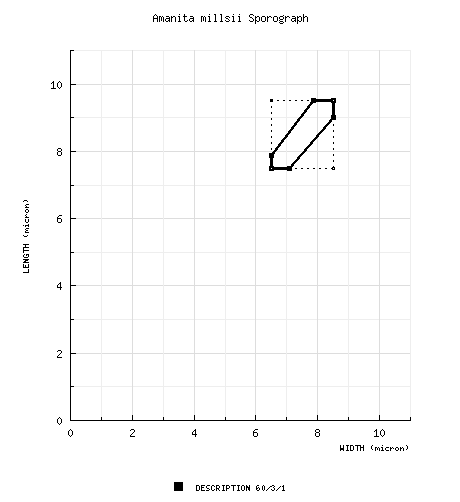
 Spore data sets and their composite